Decoding the 2025 Ford Explorer Drivetrain Architecture
When navigating the 2025 Ford Explorer official site drivetrain documentation, most consumers focus on the vehicle's horsepower ratings, towing capacities, and the standard rear-wheel-drive bias. However, as automotive technicians and drivetrain specialists operating in 2026, we must look deeper into the front-wheel drive (FWD) system operation. The Explorer's D6 platform utilizes a sophisticated longitudinal powertrain layout, but the front axle drive mechanism is a complex, always-ready mechanical network that requires precise diagnostic approaches when symptoms of failure arise.
Unlike traditional transverse FWD vehicles where the transmission and front differential are housed in a single transaxle casing, the Explorer routes front torque via a Power Transfer Unit (PTU) bolted to the rear of the 10-speed automatic transmission. Understanding this unique front-wheel drive system operation is the first step in accurately diagnosing clunks, whines, and shudders that frequently plague high-mileage or heavily taxed examples of this SUV.
The Mechanical Path of Front Torque Delivery
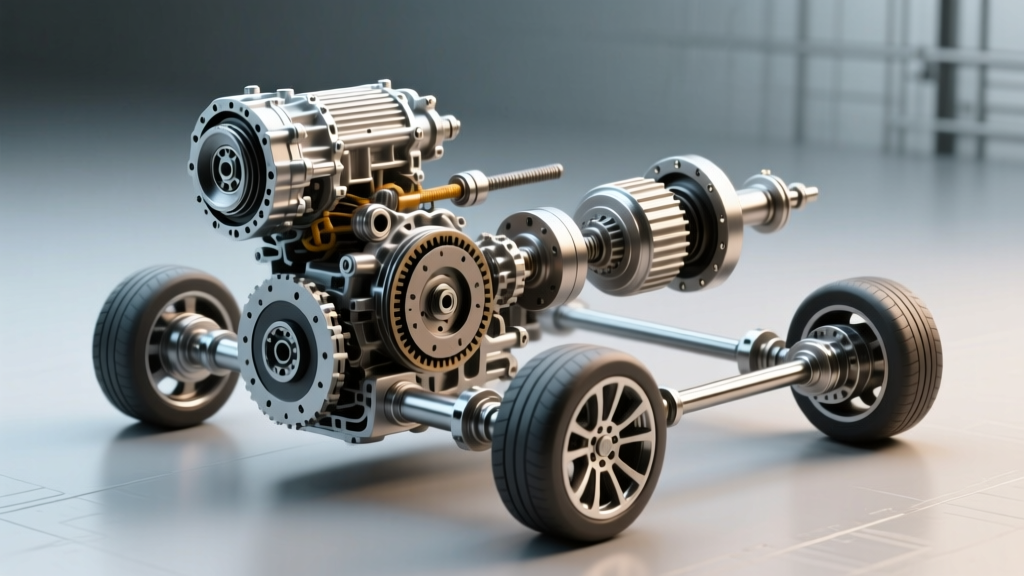
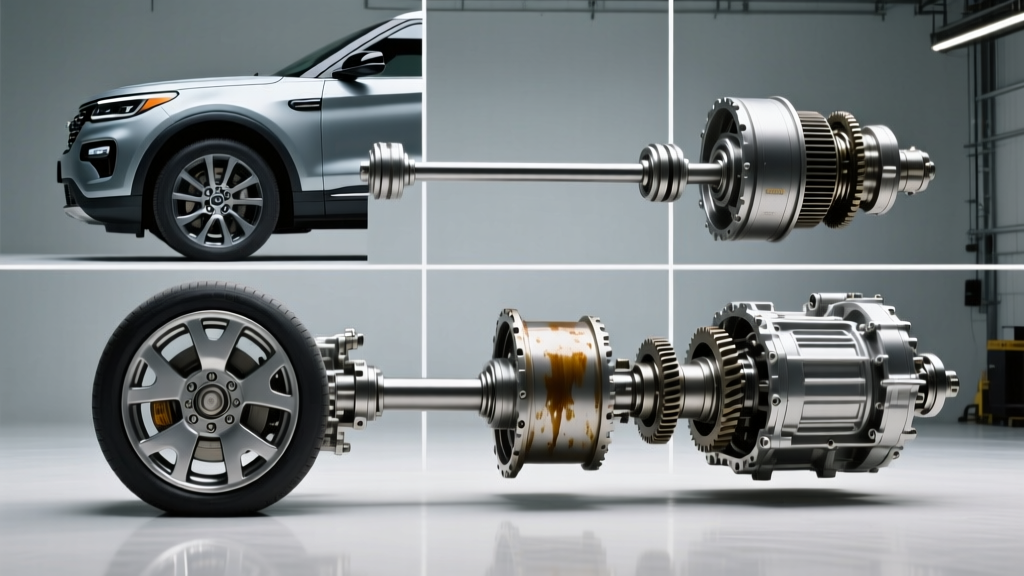
To troubleshoot effectively, you must trace the torque path. In the 2025 Explorer, whether equipped with the 2.3L EcoBoost (mated to the 10R60 transmission) or the 3.0L EcoBoost (mated to the 10R80), engine torque travels through the transmission output shaft. A helical gear set inside the PTU diverts a portion of this torque 90 degrees to the front driveshaft. From there, the torque crosses the front differential, which is integrated into the front subframe, and is ultimately delivered to the front wheels via half-shafts (CV axles). When the AWD system is inactive, the rear driveshaft may disconnect to save fuel, but the front PTU and front driveline components remain mechanically linked and spinning, making them susceptible to specific wear patterns.
Symptom Diagnosis: Front Drivetrain Malfunctions
Diagnosing front drivetrain issues requires isolating the noise or vibration based on vehicle speed, engine RPM, and steering angle. Below are the most common failure modes associated with the Explorer's front-wheel drive operation.
1. PTU Whine and Thermal Degradation
The Power Transfer Unit is notorious for running hot due to its proximity to the transmission and exhaust routing. The factory fill uses a specific 75W-85 synthetic gear oil (Motorcraft XT-140-85 or equivalent). When this fluid degrades, the helical gears and support bearings inside the PTU begin to whine, typically between 40 and 60 mph.
Diagnostic Tip: To differentiate PTU whine from transmission pump whine, use a wireless chassis ear. Place one microphone on the PTU casing and another on the transmission bell housing. If the frequency of the noise correlates strictly with vehicle speed rather than engine RPM, and peaks at the front differential, the PTU bearings or gear mesh are your primary suspects.
2. Front CV Axle and Hub Assembly Shudder
If a customer reports a shudder or binding sensation during tight, low-speed turns (such as parking), the issue often lies in the front-wheel drive system's outer Constant Velocity (CV) joints or the front hub assemblies. The Explorer's front axle uses a tripod-style inner joint and a Rzeppa-style outer joint. When the outer joint loses its molybdenum disulfide grease due to a torn boot, or when the internal cage wears, it causes a cyclical binding shudder.
Furthermore, the front wheel bearing and hub assembly (Motorcraft BR3Z-1104-C or equivalent D6 platform hub) can develop internal brinelling. This manifests as a growling noise that changes pitch when the vehicle's weight is transferred side-to-side during lane changes.
3. Electronic Torque Vectoring and Front Axle Bind
While the mechanical front differential is an open unit, the Explorer's overall AWD system relies on an electromechanical clutch pack in the rear, managed by the AWD module. In 2026, we are seeing an influx of software-related front drivetrain complaints. If the AWD module software is outdated, or if the tire circumference varies by more than 2% between the front and rear axles, the system may incorrectly command torque transfer, causing the front differential to experience unnatural torque loads, resulting in a low-speed clunk or shudder.
Troubleshooting Data Table: FWD Component Failure Modes
| Component | Primary Symptom | Root Cause | Diagnostic Verification | Est. Repair Cost (2026) |
|---|---|---|---|---|
| PTU Bearings | High-pitched whine at 45-65 mph | Fluid thermal breakdown, pitting | Chassis ear on PTU casing; fluid analysis | $1,200 - $1,800 |
| Front CV Axle (Outer) | Clicking/binding on tight turns | Boot tear, grease loss, cage wear | Visual inspection; road test in full lock | $350 - $600 per side |
| Front Hub Assembly | Growling noise, ABS fault codes | Bearing brinelling, tone ring damage | Stethoscope on steering knuckle; scan tool | $400 - $750 per side |
| PTU Splines | Clunk on acceleration/deceleration | Corrosion, lack of spline lubrication | Driveshaft removal; visual spline check | $800 - $1,400 |
Step-by-Step Front Axle Diagnostic Procedure
When a vehicle arrives with front drivetrain complaints, follow this systematic approach to avoid misdiagnosis and unnecessary parts replacement:
- Tire Circumference Verification: Measure the rolling circumference of all four tires. A variance greater than 5mm can cause the AWD system to bind the front drivetrain. Rotate or replace tires as necessary before condemning mechanical components.
- Software Calibration Check: Connect the Ford FDRS (Ford Diagnostic and Repair System) or a high-end aftermarket bidirectional scanner. Check for TSBs (Technical Service Bulletins) related to the AWD module and update the software to the latest 2026 calibration.
- Fluid Inspection: Extract a sample of the PTU fluid. If it contains metallic glitter or smells burnt, internal PTU damage has occurred. Note that the PTU does not have a traditional drain plug; fluid must be extracted via the fill plug using a vacuum pump.
- Driveshaft & Spline Check: If a clunk is present, drop the front driveshaft. Inspect the mating splines between the PTU output and the driveshaft yoke. Ford specifies a specific grease (Motorcraft XL-3) for these splines to prevent rust-jacking and backlash.
Critical Torque Specs and Fluid Capacities
Adhering to factory specifications is non-negotiable when reassembling the front-wheel drive components. Reference the Ford Workshop Manual Section 205-04 for the D6 platform:
- PTU Gear Oil Capacity: Approximately 0.85 Liters (0.9 Quarts) of 75W-85 Synthetic.
- Front Axle Hub Nut Torque: 350 Nm (258 lb-ft). Note: This is a torque-to-yield specification. The nut must be replaced every time it is removed.
- Front Driveshaft to PTU Flange Bolts: 80 Nm (59 lb-ft).
- Front Differential to Subframe Mounting Bolts: 150 Nm (111 lb-ft).
Sourcing Parts and Dealer vs. Independent Repair
When replacing front drivetrain components, the source of your parts dictates the longevity of the repair. For the PTU and front differential, OEM Motorcraft or genuine Ford parts are strongly recommended due to the precise gear tolerances required. For CV axles, while aftermarket options are cheaper, OEM Ford half-shafts utilize superior metallurgy in the tripod joints, which is critical for handling the 310 lb-ft of torque generated by the 2.3L EcoBoost engine.
For further reading on drivetrain architectures and official specifications, you can review the Ford Explorer Official Page. Additionally, tracking recurring drivetrain complaints and safety recalls is essential for any diagnostic technician; the NHTSA Database provides invaluable real-world failure data. Finally, for deep-dive engineering papers on AWD torque vectoring and PTU thermal dynamics, SAE International remains the gold standard for automotive research.
By understanding the intricate front-wheel drive system operation of the 2025 Explorer, technicians can move beyond guesswork, providing accurate diagnostics, preserving the vehicle's drivetrain warranty, and ensuring optimal performance for the long haul.