Platform Architecture: Clarifying the 2025 Ford Explorer Standard Drivetrain
When evaluating the 2025 Ford Explorer standard drivetrain, owners and technicians must first clarify a common architectural misconception. Built on Ford’s D6 (CD6) rear-wheel-drive-biased platform, the 'standard' drivetrain for base and XLT trims is actually Rear-Wheel Drive (RWD), not Front-Wheel Drive (FWD). Therefore, the vehicle does not use traditional front CV axles to drive the wheels. Instead, the rear independent suspension (IRS) utilizes rear half-shafts equipped with inner and outer Constant Velocity (CV) joints to manage suspension articulation and power delivery.
If your 2025 Explorer is equipped with the optional Intelligent All-Wheel Drive (AWD) system—standard on ST and Platinum trims—it adds a Power Transfer Unit (PTU) and front CV axles to the drivetrain equation. As we move through 2026, early-model 6th-generation Explorers are accumulating mileage, and drivetrain vibration complaints are rising. According to the National Highway Traffic Safety Administration (NHTSA), driveline clunk and vibration are among the most frequently logged powertrain complaints for the Explorer lineage. This guide provides a definitive cost analysis and technical breakdown for CV joint and axle service on the D6 platform.
Primary CV Joint Failure Modes on the D6 Platform
Whether you are dealing with the rear IRS half-shafts (RWD/AWD) or the front drive axles (AWD), CV joints operate under immense rotational stress and extreme angular deflection. Here are the specific failure modes we are seeing in shops in 2026:
- Outer Boot Degradation (Dry Rot): The thermoplastic elastomer (TPE) boots on the outer CV joints are exposed to road debris, ozone, and high brake temperatures. Micro-tears lead to grease centrifugation and water ingress, destroying the bearing cage within 3,000 to 5,000 miles.
- Inner Tripod Joint Wear (The 'Driveline Clunk'): The inner joints utilize a tripod (tulip) design to allow for plunging motion as the suspension cycles. On the heavy Explorer, aggressive acceleration from a stop can cause the tripod rollers to develop flat spots or wear the housing tracks, resulting in a distinct metallic 'clunk' when shifting from Reverse to Drive.
- PTU-Induced Thermal Damage (AWD Front Axles): The Explorer’s PTU is notorious for running hot. The proximity of the PTU to the catalytic converter and the engine block can bake the inner CV boot of the front passenger-side axle, causing premature grease breakdown and joint seizure.
2026 Cost Breakdown: OEM vs. Aftermarket Replacements
When a CV joint fails, the industry standard is to replace the entire half-shaft assembly rather than attempting a messy and unreliable boot-and-repack job. Below is a comprehensive cost matrix for 2025 Explorer CV axle replacements based on current 2026 market pricing from suppliers like RockAuto and OEM Ford Motorcraft channels.
| Component | OEM Motorcraft Cost | Premium Aftermarket (GSP/Dorman) | Standard Labor Time | Estimated Total Shop Cost |
|---|---|---|---|---|
| Rear Half-Shaft (Left or Right) | $480 - $620 | $130 - $190 | 1.2 Hours | $280 - $850 |
| Front CV Axle (AWD Models Only) | $390 - $510 | $110 - $160 | 1.5 Hours | $260 - $780 |
| CV Boot Kit (Joint Service) | $55 - $85 | $20 - $35 | 2.2 Hours | $250 - $420 |
| Hub Assembly (If splines damaged) | $280 - $350 | $90 - $140 | 0.5 Hours (Add-on) | $150 - $450 |
Note: Labor rates vary regionally. The estimates above assume an independent shop rate of $130-$160/hour. Dealership rates will push the upper limits of these estimates by 30-40%.
Hidden Labor Costs and Alignment Requirements
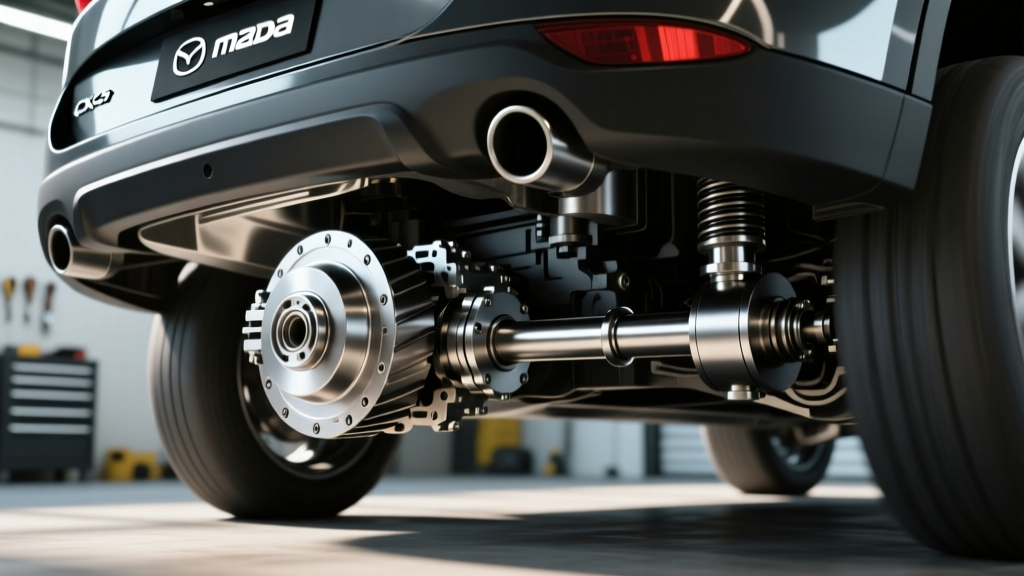
A critical aspect of drivetrain cost analysis is accounting for collateral labor. Replacing a rear half-shaft on the Explorer’s IRS requires unbolting the rear hub assembly and lowering the rear subframe slightly in some configurations to clear the exhaust routing. Furthermore, any time you disturb the rear suspension geometry or remove the rear hub, a rear toe and camber alignment is mandatory to prevent rapid inner-tire edge wear.
Alignment Add-on Cost: Expect to pay $120 to $180 for a four-wheel alignment post-repair. Skipping this step to save money will result in ruined tires within 5,000 miles, entirely negating any cost savings.
Critical Torque Specifications & TTY Fasteners
The D6 platform utilizes advanced metallurgy and specific fastener protocols. Reusing old axle nuts is a leading cause of post-repair wheel bearing failure and CV spline stripping. Below are the baseline torque specifications for the 2025 Explorer. Always verify with the specific vehicle’s Workshop Manual (WSM) via Ford's PTS system, as mid-year running changes occur.
- Rear Hub Axle Nut: 221 lb-ft (300 Nm). WARNING: This is typically a Torque-to-Yield (TTY) or staked fastener. It must be replaced with a new OEM Motorcraft nut every time the half-shaft is removed. Failure to do so will result in the nut backing off under load, destroying the wheel bearing and CV splines.
- Front Axle Nut (AWD): 184 lb-ft (250 Nm) + 90-degree turn. This is a strict TTY sequence. Use a calibrated torque wrench followed by an angle gauge.
- Inner Differential Flange Bolts (Rear): 85 lb-ft (115 Nm). Apply a medium-strength threadlocker (e.g., Loctite 243) if the factory patch is compromised.
- Wheel Lug Nuts: 150 lb-ft (204 Nm). Ford transitioned to higher torque specs on newer SUV platforms compared to the legacy 100 lb-ft standard.
Expert Troubleshooting: Diagnosing CV Clunk vs. Driveline Lash
Before authorizing a $600+ CV axle replacement, technicians must accurately isolate the noise. The 2025 Explorer’s 8-speed automatic transmission (10R60) and rear differential are known to exhibit minor driveline lash. Here is how to differentiate a failing CV joint from normal drivetrain characteristics:
- The 'Turn and Click' Test (Front AWD): Drive the vehicle in a tight circle at 5 mph with the windows down. A rhythmic 'click-click-click' that speeds up with vehicle speed is the hallmark of a worn outer front CV cage. If it clicks on a right turn, the left (loaded) axle is usually the culprit.
- The 'Load Reversal' Test (Rear IRS): If you hear a single, loud metallic 'clunk' when shifting from Park to Reverse, or when abruptly lifting off the throttle at 30 mph, this is often not the CV joint. This is typically caused by worn rear differential bushings, a failing PTU clutch pack (on AWD models), or normal 10R60 transmission accumulator lash. A worn inner CV tripod joint will cause a continuous shudder under acceleration, not a single clunk.
- Visual Boot Inspection: Use a borescope or inspection mirror to check the inner tripod boots near the differential. The heat shield above the exhaust crossover frequently melts the inner boot on the passenger side. If grease is slung in a 360-degree pattern around the differential housing, the boot has failed, and the joint is likely compromised by contamination.
Final Verdict: OEM vs. Aftermarket in 2026
For the 2025 Ford Explorer, the torque and load demands of the 2.3L EcoTech and 3.0L EcoBoost engines are substantial. While premium aftermarket brands like GSP or Dorman offer excellent value for high-mileage vehicles or trade-ins, we strongly recommend sticking to OEM Motorcraft half-shafts for vehicles you intend to keep past the 60,000-mile powertrain warranty mark. The metallurgical quality of the OEM tripod rollers and the exact grease formulation for the PTU-adjacent front axles provide a longevity that aftermarket equivalents struggle to match under the Explorer's heavy curb weight. Factor in the cost of a mandatory alignment, source new TTY axle nuts, and adhere strictly to the torque sequences to ensure a permanent repair.