The Dealership Confusion: Powertrain vs. Drivetrain
If you have ever sat in a dealership finance office or listened to a mechanic diagnose your SUV, you have likely heard the terms powertrain and drivetrain used interchangeably. For the everyday driver, they sound like the same thing. But when it comes to understanding your vehicle's anatomy, diagnosing a mechanical failure, or figuring out what your warranty actually covers, the distinction is critical.
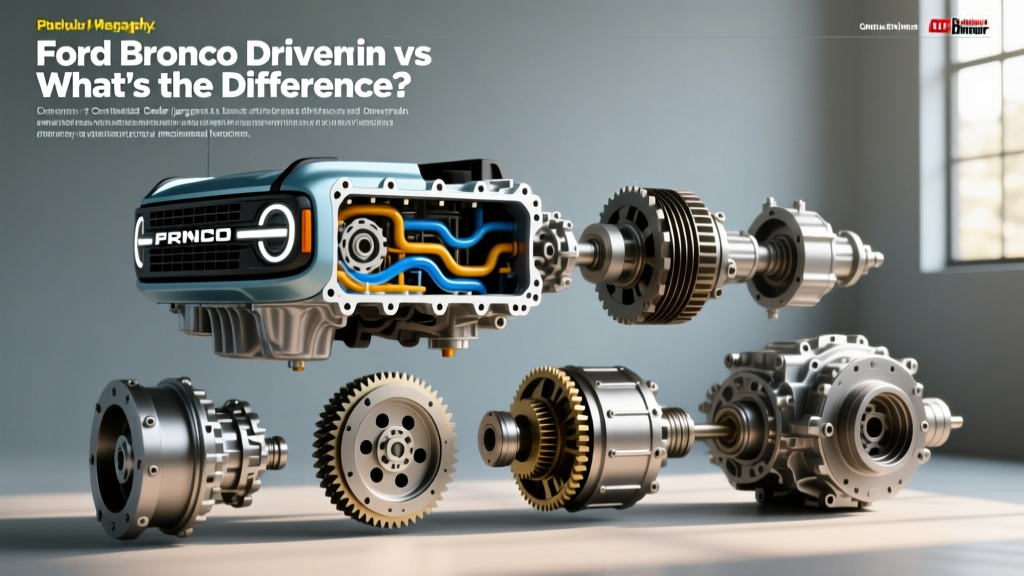
This is especially true for off-road enthusiasts. When you are researching the Ford Bronco drivetrain capabilities, you need to know exactly which components are pushing power to the dirt, and which components are generating that power in the first place. In this beginner-friendly explainer, we will break down the exact mechanical differences between the powertrain and the drivetrain, using the modern Ford Bronco as our masterclass example.
The Short Answer: An Anatomical Analogy
Before we dive into gear ratios and transfer cases, let us use a simple human anatomy analogy:
- The Powertrain is the Heart and Muscles: It includes every component that generates power and delivers it to the wheels. This includes the engine, the transmission, and the entire drivetrain system.
- The Drivetrain is the Skeletal System and Limbs: It includes only the components that take the power generated by the engine and physically transfer it to the wheels. The engine is entirely excluded from the drivetrain.
In short: All drivetrains are part of the powertrain, but not all powertrain components are part of the drivetrain.
Defining the Ford Bronco Powertrain (The Generator)
The powertrain is the complete package of propulsion. If a component is directly responsible for creating rotational force or managing that force before it hits the pavement, it is a powertrain component. For the modern Ford Bronco (2021 through the 2026 model years), the powertrain encompasses the following:
1. The Engine (Power Source)
The engine is the heart of the powertrain, but it is never considered part of the drivetrain. Depending on your Bronco trim, your powertrain starts with one of three main engines:
- 2.3L EcoBoost I-4: 300 horsepower and 325 lb-ft of torque.
- 2.7L EcoBoost V6: 330 horsepower and 415 lb-ft of torque (with the High-Performance package).
- 3.0L EcoBoost V6: 418 horsepower and 440 lb-ft of torque (exclusive to the Bronco Raptor).
2. The Entire Drivetrain Assembly
Everything bolted to the back of the engine that routes power to the tires completes the powertrain. This includes the transmission, driveshafts, transfer case, axles, and differentials. We will break these down in the next section.
Breaking Down the Ford Bronco Drivetrain (The Delivery System)
The drivetrain begins exactly where the engine's output shaft ends. Its sole job is to multiply torque, change rotational direction, and distribute power to the wheels. Here is a deep dive into the specific components that make up the Ford Bronco drivetrain.
The Transmissions
The transmission is the first stop in the drivetrain. It uses gear sets to multiply engine torque and provide a range of speeds. The Bronco utilizes two primary transmissions:
- 10R80 10-Speed Automatic: Co-developed by Ford and GM, this is the most common Bronco transmission. It features a deep 4.69:1 first gear for crawling and uses Mercon ULV fluid.
- Getrag MT88 7-Speed Manual: Available on select trims, this manual transmission features a dedicated 'C' (Crawler) gear with a massive 6.58:1 ratio, acting almost like a secondary transfer case reduction.
The Transfer Cases
Because the Bronco is a rear-wheel-drive-biased 4x4, the transfer case is a vital drivetrain component. It splits power between the front and rear axles. Ford uses BorgWarner units:
- BorgWarner 4421 (Part-Time): Found on Base and Big Bend trims. It is a traditional shift-on-the-fly system with 2H, 4H, and 4L modes.
- BorgWarner 4423 (Advanced 4x4): Found on Badlands and Wildtrak trims. It features an EMOD (Electro-Mechanical On-Demand) system that can automatically send up to 1,200 lb-ft of torque to the front axle when slip is detected.
Axles and Differentials
The axles house the differentials, which allow the left and right wheels to spin at different speeds while cornering. According to Dana Spicer's off-highway engineering data, the Bronco utilizes heavy-duty AdvanTEK axles:
- Dana 44 AdvanTEK: Standard on most trims, featuring an 8.25-inch ring gear for improved ground clearance and strength.
- Dana 50: Standard on the Sasquatch package and Bronco Raptor rear, featuring a massive 9.25-inch ring gear to handle 35-inch and 37-inch tires.
Driveshafts and Joints
These are the physical tubes connecting the transfer case to the axles. The Bronco uses a front Constant Velocity (CV) driveshaft to accommodate the extreme suspension articulation and steering angles required for off-roading, paired with a traditional U-joint rear driveshaft.
Comparison Chart: Bronco Powertrain vs. Drivetrain
To visualize how these systems overlap, review the component breakdown below:
| Component | Part of Powertrain? | Part of Drivetrain? | Ford Bronco Example |
|---|---|---|---|
| Engine Block & Internals | Yes | No | 2.7L EcoBoost V6 |
| Engine Accessories | Yes | No | Alternator, Water Pump |
| Transmission | Yes | Yes | 10R80 10-Speed Auto |
| Transfer Case | Yes | Yes | BorgWarner 4423 EMOD |
| Driveshafts | Yes | Yes | Front CV / Rear U-Joint |
| Axles & Differentials | Yes | Yes | Dana 44 AdvanTEK |
Why This Matters: Warranties and Repair Costs
Understanding the difference between the Ford Bronco drivetrain and the broader powertrain is crucial when reading your warranty paperwork or negotiating a repair bill.
Warranty Coverage Realities
Ford's standard factory warranty includes a 5-Year/60,000-Mile Powertrain Limited Warranty. Because the drivetrain is a subset of the powertrain, this warranty covers your engine, transmission, transfer case, and axles. However, if you purchase a third-party extended warranty labeled "Drivetrain Only," your engine block, cylinder heads, and internal engine components will be entirely excluded. Always read the fine print. You can review standard coverage terms on the official Ford Warranty portal.
Real-World Repair Costs (2026 Estimates)
Drivetrain components are incredibly expensive to replace because of their complexity and the labor required to drop them from the chassis. Here is what you can expect to pay out-of-warranty for major Bronco drivetrain repairs:
- 10R80 Transmission Replacement: $5,500 to $7,500 (includes core charge and programming).
- BorgWarner Transfer Case Actuator Motor: $450 to $650 (a common failure point when owners shift into 4L without coming to a complete stop).
- Dana 44 Regear (Front and Rear): $2,000 to $2,800. If you install 35-inch tires on a Bronco with a factory 4.27 gear ratio, your 10R80 transmission will hunt for gears and overheat. Regearing to 4.70 is a mandatory drivetrain modification.
- Front CV Driveshaft Replacement: $1,200 to $1,600 (often required if the factory rubber boot tears and dirt contaminates the CV joint).
Beginner Maintenance Guide: Keeping the Drivetrain Alive
The Ford Bronco is a highly capable machine, but its drivetrain requires strict adherence to fluid intervals, especially if you take it off-road. Water ingress and extreme heat degrade lubricants rapidly. Here are the exact specifications you need to know for your next garage weekend:
1. 10R80 Transmission Maintenance
The 10R80 does not have a traditional dipstick. It requires a lift and a temperature-check procedure via the OBD2 port. Fluid: Mercon ULV (Ultra Low Viscosity). Capacity: 13.1 quarts (dry fill). Never use standard Mercon V in this transmission, or you will destroy the clutch packs.
2. Dana 44 Differential Service
You should change your differential fluid every 30,000 miles, or immediately if you submerge the axles in water. Fluid: 75W-85 Synthetic Gear Oil (Motorcraft or Amsoil). Capacity: Approx. 2.1 pints per axle. Torque Spec: When reinstalling the differential cover, tighten the M10 bolts to exactly 25 lb-ft in a star pattern to prevent warping the stamped steel cover.
3. BorgWarner Transfer Case
The transfer case is often forgotten until it whines or fails to engage. Fluid: Mercon V (for most BW 4421/4423 applications, but always verify your specific build tag). Capacity: 1.5 quarts. Torque Spec: Fill and drain plugs should be torqued to 22 lb-ft.
Summary
When you strip away the dealership jargon, the difference is simple. The powertrain is the entire propulsion system, starting with the combustion in your EcoBoost engine and ending at the contact patch of your tires. The Ford Bronco drivetrain is the heavy-duty mechanical skeleton—comprising the 10R80 transmission, BorgWarner transfer cases, and Dana axles—that physically routes that power to the ground. By understanding exactly which components make up your drivetrain, you can better maintain your rig, understand your warranty coverage, and confidently tackle any off-road trail.