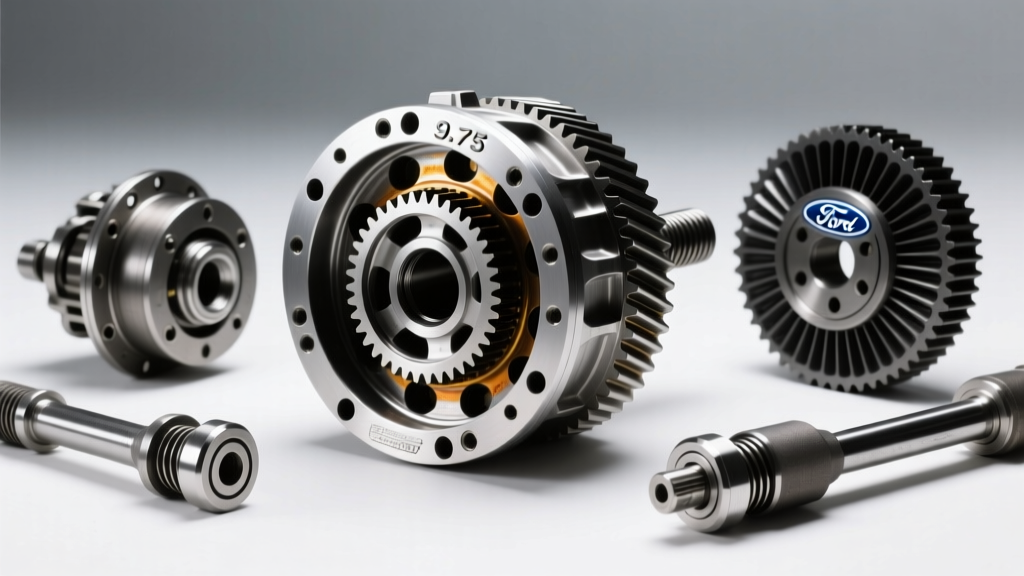
When Ford transitioned the F-150 to aluminum bodies and EcoBoost engines, they heavily utilized the 9.75-inch semi-floating rear axle. To meet stringent EPA fuel economy targets, factory gear ratios were often set to 3.31 or 3.55. While adequate for empty highway cruising, these ratios severely bottleneck performance when towing trailers exceeding 6,000 pounds. As we move through 2026, the push for heavier towing capacities on half-ton trucks means the Ford 9.75-inch axle is seeing more extreme gear swaps than ever before. Upgrading to a 4.10 or 4.56 ratio restores low-end torque multiplication, but it introduces a secondary enemy: exponential heat generation. This model-specific repair guide details the precise teardown, setup, and thermal management protocols required when swapping gears and installing high-capacity Yukon differential covers on the Ford 9.75 platform.
The Physics of Gear Ratios and Thermal Load
Changing your differential gear ratio alters the mechanical advantage between the driveshaft and the axle shafts. Moving from a 3.55 to a 4.56 ratio means the pinion gear must rotate 4.56 times for every single revolution of the ring gear. This 28% increase in pinion revolutions per mile directly correlates to increased friction, gear mesh cycling, and bearing drag.
In heavy towing scenarios, the stock stamped-steel differential cover acts as an insulator rather than a heat sink. Fluid temperatures can easily exceed 230°F, causing standard 75W-90 gear oils to shear and lose film strength. This leads to accelerated wear on the ring and pinion teeth. To combat this, integrating finned aluminum Yukon differential covers is not merely an aesthetic upgrade; it is a mandatory thermal intervention. These covers increase fluid capacity by up to 1.5 quarts and utilize external cooling fins to drop operating temperatures by 30°F to 50°F under load.
Parts Selection and Performance Metrics
For a Ford 9.75-inch axle, precision is paramount. Below is the recommended parts list for a heavy-duty towing setup, followed by a performance delta chart.
- Ring and Pinion: Yukon 4.56 Ratio (Part # YG F9.75-456) - Nitro-carburized for extreme durability.
- Master Install Kit: Yukon YK F9.75 (Includes Timken bearings, crush sleeve, pinion seal, ring gear bolts).
- Cover: Yukon Hardcore Aluminum Cover with Magnetic Drain Plug (Fits Ford 9.75).
- Sealant: Permatex Ultra Black RTV (Part # 85084) for the cover and axle seals.
- Gear Oil: 75W-140 Full Synthetic (Amsoil Severe Gear or Mobil 1).
Performance Delta: 33-Inch Tires at 70 MPH
| Gear Ratio | Engine RPM | Pinion Revs/Mile | Est. Fluid Temp Delta |
|---|---|---|---|
| 3.55 (Stock) | 1,950 | 2,410 | Baseline (180°F) |
| 4.10 | 2,250 | 2,784 | +25°F |
| 4.56 | 2,500 | 3,096 | +45°F (Requires Finned Cover) |
Data sourced from Yukon Gear & Axle technical bulletins and real-world F-150 towing telemetry.
Step-by-Step Setup: Achieving the Perfect Pattern
Regearing a 9.75 axle requires meticulous measurement. The Ford 9.75 uses a semi-floating design with a specific carrier shim setup that demands attention to detail.
Pinion Depth and Bearing Preload
The pinion gear's depth relative to the ring gear centerline is dictated by a shim located between the pinion head and the inner bearing. The factory pinion gear head is marked with a variance number (e.g., +2 or -1). If your old pinion was marked "0" and the new Yukon pinion is marked "+2", you must add 0.002 inches to your baseline shim thickness.
Install the pinion using a setup bearing (a bearing with the ID honed out slightly for easy sliding). Torque the pinion nut to achieve the correct bearing preload. For new Timken bearings on a 9.75 axle, the target rotating torque is 15 to 25 in-lbs. Use a beam-style inch-pound torque wrench to verify this. If preload is too low, the pinion will chatter under load; too high, and the bearings will overheat and fail prematurely.
Backlash and Carrier Shims
Once the pinion depth is set, mount the ring gear to the differential carrier. Apply red Loctite to the ring gear bolts and torque them to 75 lb-ft in a star pattern. The Ford 9.75 uses side shims (located behind the carrier bearings) to adjust backlash and gear pattern. The target backlash specification is 0.006 to 0.010 inches, with 0.008 inches being the sweet spot for heavy towing. Use a dial indicator mounted to the axle housing to measure backlash at three different points around the ring gear. If variance exceeds 0.002 inches between points, the ring gear is improperly seated or the carrier is warped.
Reading the Marking Compound
Apply yellow gear marking compound to the ring gear teeth. Rotate the gear under moderate resistance (use a rag wrapped around the ring gear to create drag).
- Drive Side Pattern: Should be centered from top to bottom, slightly biased toward the heel (inner edge).
- Coast Side Pattern: Should mirror the drive side but shift slightly toward the toe (outer edge).
If the pattern is high on the tooth, increase pinion depth (add shims). If low, decrease depth. For a deeper dive into pattern diagnosis, consult the F-150 Online technical archives.
Installing Finned Yukon Differential Covers
With the gear setup verified and the axle shafts reinstalled, it is time to address thermal management. The stock Ford 9.75 cover holds roughly 2.5 quarts of fluid and offers zero external surface area for convective cooling. Yukon differential covers for the 9.75 application are cast from A380 aluminum and feature deep external fins aligned with the lateral airflow under the truck. Furthermore, they include a magnetic drain plug—a critical feature for the break-in period to capture metallic particulate.
Sealing and Torque Specifications
Do not use cheap paper gaskets. Clean the axle housing mating surface with brake cleaner and a brass wire brush. Apply a continuous, 1/4-inch bead of Permatex Ultra Black RTV to the cover. Ensure the bead encircles all bolt holes on the inside to prevent oil starvation. Thread the 12 cover bolts by hand to prevent cross-threading the aluminum housing. Tighten in a crisscross pattern to a final torque of 25 lb-ft. Allow the RTV to cure for a minimum of 12 hours before filling with fluid.
Fluid Selection and the 500-Mile Break-In Protocol
Because the 4.56 ratio and the deeper Yukon cover alter the system's volume and thermal profile, fluid choice is critical. Standard 75W-90 is insufficient for towing with lower numerical gears. Fill the axle with 75W-140 Full Synthetic Gear Oil. The larger cover will increase capacity to approximately 3.5 to 4.0 quarts. Fill until the fluid level is exactly at the bottom of the fill hole threads. If your truck is lifted, ensure the fluid level reaches the factory fill plug, or install a relocated fill tube to prevent axle bearing starvation on steep inclines.
The Break-In Procedure
The first 500 miles dictate the lifespan of your new ring and pinion.
- Miles 0-50: Drive under 45 MPH. No towing. The gears are mating, and friction is at its highest.
- Miles 50-100: Allow the differential to cool completely. It is normal for the new Yukon aluminum cover to be too hot to touch during this phase.
- Miles 100-500: Vary your speed between 45 and 65 MPH. Avoid wide-open throttle and do not exceed 4,000 lbs of towing weight.
- At 500 Miles: Drain the fluid. Inspect the magnetic drain plug on the Yukon cover. A fine, paste-like metallic sludge is normal. Shiny metal flakes or chunks indicate improper pinion depth or bearing failure. Refill with fresh 75W-140 synthetic, and the axle is cleared for maximum towing duty.
By pairing a precise 4.56 gear setup with the superior thermal dissipation of Yukon differential covers, your Ford 9.75 axle will reliably handle extreme towing loads without succumbing to heat-induced fluid failure.