The Engineering Legacy of the Ford 8.8 Axle
Since its introduction in the early 1980s, the Ford 8.8-inch rear axle has remained one of the most versatile and robust drivetrain components in the American automotive landscape. Found in everything from the Fox Body Mustang and early F-150s to the Explorer and Ranger, the 8.8 differential bridges the gap between the lighter 7.5-inch units and the heavy-duty, but significantly heavier, Sterling 10.5-inch axles. In 2011, Ford introduced the 'Super 8.8' for the Mustang, and later adapted it for the aluminum-bodied F-150s, featuring a larger pinion shaft, upgraded 34-spline axle shafts, and enhanced bearing capacities to handle modern high-torque EcoBoost and Coyote V8 engines.
Whether you are rebuilding a classic Ranger for off-road crawling, optimizing an F-150 for heavy towing, or dialing in a Mustang for the drag strip, understanding the intricate relationship between your Ford 8.8 differential gear ratio, drivetrain physics, and differential fluid dynamics is critical. This model-specific repair guide delves into the exact specifications, setup procedures, and fluid requirements necessary for a bulletproof 8.8 regear.
Decoding Ford 8.8 Axle Identification Tags
Before ordering a ring and pinion set or purchasing gear oil, you must verify your current gear ratio and differential type. Ford utilizes a two-character axle code located on the Safety Compliance Certification Label (door jamb sticker).
- Code 19: 3.55 Ratio (Open)
- Code D4: 3.73 Ratio (Open)
- Code 41: 3.31 Ratio (Traction-Lok / Limited Slip)
- Code Z5: 3.31 Ratio (Open)
- Code H9: 3.55 Ratio (Traction-Lok)
Additionally, the physical axle tag bolted to the rear differential cover provides the exact build date, gear ratio, and ring gear diameter. If the tag is missing, you can manually count the driveshaft rotations relative to the rear wheel rotations with the vehicle safely elevated on jack stands and the transmission in neutral.
How Gear Ratios Alter Drivetrain Performance
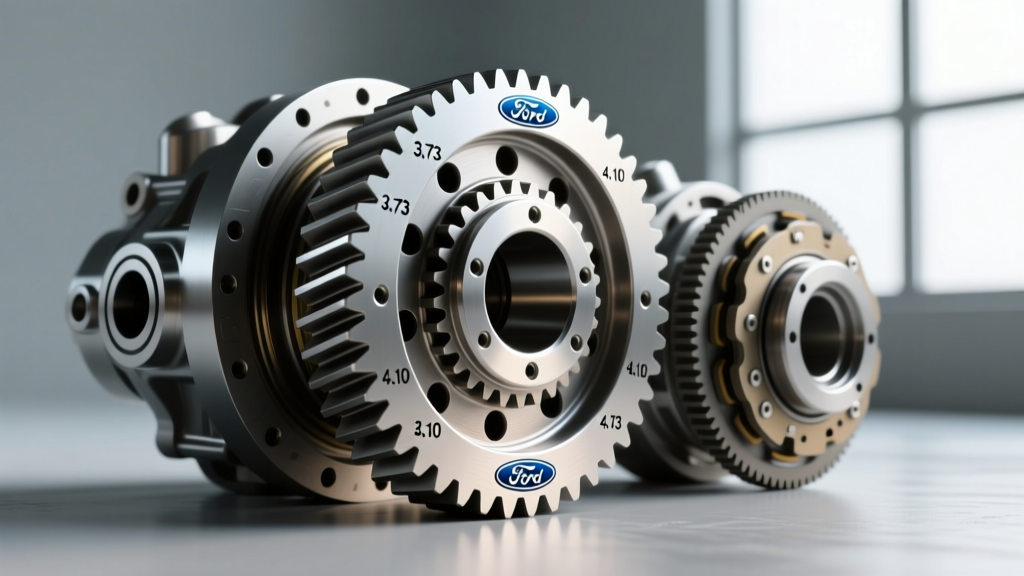
The numerical gear ratio dictates the mechanical advantage between the engine and the wheels. A higher numerical ratio (e.g., 4.10:1) multiplies torque more aggressively, improving off-the-line acceleration and low-speed towing grunt, but at the cost of increased highway RPMs and reduced fuel economy. Conversely, a lower numerical ratio (e.g., 3.15:1) reduces engine RPM at cruising speeds, optimizing highway efficiency but sacrificing towing capability and track performance.
Mustang Track vs. Street Setups
For S197 and S550 Mustang owners utilizing the Super 8.8, the factory 3.15 or 3.31 ratios are heavily biased toward EPA fuel economy mandates. Upgrading to a 3.73 or 4.10 ratio dramatically transforms the vehicle's character. A 4.10 gear set paired with a manual transmission allows the Coyote 5.0L V8 to stay squarely in its peak torque band (4,000–5,500 RPM) during track sessions. However, for daily driven street cars with an automatic 10R80 transmission, a 3.73 ratio is generally the sweet spot, preventing excessive drone on the interstate while still providing aggressive 60-foot times.
F-150 and Ranger Towing Configurations
Truck owners must balance payload capacity with drivability. When towing a 7,000 lb trailer, an F-150 equipped with 3.31 gears will constantly hunt for lower gears on inclines, generating excessive transmission heat. Swapping to a 3.73 or 4.10 ratio in the Ford 8.8 differential lowers the mechanical strain on the 10-speed automatic and keeps the engine in its optimal boost threshold.
| Gear Ratio | Primary Application | 70 MPH RPM (28" Tire) | Towing & Track Impact |
|---|---|---|---|
| 3.15:1 | Highway Cruising / Fuel Economy | ~1,750 RPM | Poor towing; sluggish track times |
| 3.31:1 | OEM Balanced / Light Towing | ~1,850 RPM | Adequate for light utility trailers |
| 3.73:1 | Street Performance / Medium Towing | ~2,100 RPM | Excellent daily driver and towing compromise |
| 4.10:1 | Heavy Towing / Drag Racing / Off-Road | ~2,300 RPM | Maximum torque multiplication; high highway RPM |
| 4.56:1 | Dedicated Crawl / Drag / Large Tires | ~2,550 RPM | Requires aftermarket tuning; not for highway use |
Precision Setup: Ring, Pinion, and Bearing Specs
Setting up a Ford 8.8 differential is not a task for the faint of heart. It requires precision measuring tools, including a dial indicator with a magnetic base, a pinion depth setting tool, and an inch-pound torque wrench. The longevity of your ring and pinion gears relies entirely on achieving the correct pinion depth, bearing preload, and backlash.
Critical Torque Specifications
When assembling the 8.8 center section, adhering to factory torque specifications is non-negotiable. Always use a high-strength threadlocker on the ring gear bolts to prevent catastrophic failure under high-torque loads.
- Ring Gear Bolts (Standard 8.8): 85–95 lb-ft (Apply red Loctite 271 to threads)
- Ring Gear Bolts (Super 8.8): 110–125 lb-ft
- Bearing Cap Bolts: 70–85 lb-ft
- Pinion Nut (Crush Sleeve): Tighten incrementally until rotational torque reaches 8–14 in-lbs (for new bearings) or 4–6 in-lbs (for reused bearings). Note: Many modern builders prefer installing a solid pinion spacer kit to eliminate the crush sleeve entirely, requiring a specific torque value usually around 160-200 lb-ft paired with shimming.
Backlash and Gear Pattern Reading
The Ford 8.8 differential requires a backlash specification of 0.008 to 0.012 inches. Backlash is adjusted by moving the side bearing adjuster nuts (or shims, depending on the specific 8.8 variant) equally to maintain bearing preload while shifting the ring gear closer to or further from the pinion.
Once backlash and preload are set, apply yellow gear marking compound to the ring gear teeth. Rotate the assembly under load and inspect the pattern. A perfect pattern will be centered on the tooth face, slightly biased toward the toe and the heel. If the pattern is high on the flank, increase pinion depth (move pinion closer to ring gear). If the pattern is low on the face, decrease pinion depth. For detailed visual guides on pattern reading, drivetrain specialists like Motive Gear offer extensive technical documentation on achieving the optimal contact patch.
Break-In Procedures and Differential Fluid Selection
As a core component of differential maintenance, the gear oil you select immediately after a regear dictates the lifespan of the metallurgy. The mating surfaces of a new ring and pinion gear are not perfectly smooth at a microscopic level. During the first 500 miles, these gears undergo a controlled wear process known as 'break-in' or 'lapping.'
The Danger of Early Synthetic Fluids
A common and costly mistake is filling a freshly built Ford 8.8 differential with full synthetic gear oil immediately. Synthetic oils possess superior lubricity and extreme pressure (EP) additives that prevent wear. However, during break-in, you need controlled wear to lap the gears together. Using synthetic oil too early can cause the gears to glaze, resulting in a permanent, high-pitched whine that no amount of fluid swapping will fix.
The Break-In Protocol:
- Fill the differential with a high-quality Conventional 80W-90 GL-5 gear oil (e.g., Motorcraft SAE 80W-90 Premium Rear Axle Lubricant).
- Drive the vehicle for 15-20 minutes under light load to bring the fluid up to operating temperature.
- Allow the axle to cool completely (this prevents heat warping).
- Repeat the heat cycle process over the first 500 miles, avoiding sustained highway speeds over 65 MPH and avoiding heavy towing or drag launches.
- At 500 miles, drain the conventional fluid, flush out any metallic glitter (which is normal during break-in), and refill with your long-term synthetic fluid.
Long-Term Fluid and Trac-Lok Additives
For long-term use, especially in Super 8.8 axles or vehicles used for towing and track duty, a full synthetic 75W-140 GL-5 is highly recommended. Brands like AMSOIL or Motorcraft Synthetic provide superior thermal stability, resisting the extreme shear forces generated by the hypoid gear cut of the 8.8.
If your Ford 8.8 is equipped with a Trac-Lok (clutch-type limited-slip differential), you must add a friction modifier. Without it, the clutch packs will bind and chatter violently during low-speed cornering. Ford specifies the Motorcraft XL-3 Friction Modifier (typically 4 oz per axle). Add the modifier before filling the axle with gear oil to ensure proper mixing.
2026 Pricing: What Does an 8.8 Regear Cost?
Understanding the financial commitment of a differential rebuild helps in budgeting for performance upgrades. Prices have stabilized in 2026, though premium metallurgy and master rebuild kits remain an investment.
- Ring and Pinion Gear Set (Motive Gear, Yukon, or OEM): $250 – $450
- Master Rebuild Kit (Timken bearings, seals, shims, crush sleeve): $120 – $180
- Solid Pinion Spacer Kit (Highly Recommended): $45 – $65
- Break-In Conventional Fluid + Long-Term Synthetic + XL-3 Additive: $80 – $120
- Professional Labor (if not performing DIY): $600 – $950
Total DIY Cost: $495 – $815
Total Shop Cost: $1,095 – $1,765
Final Thoughts on the 8.8 Platform
The Ford 8.8 differential remains a masterpiece of automotive engineering, capable of handling well over 600 horsepower at the wheels when properly built with 31-spline or 34-spline axle shafts and an aftermarket girdle or aftermarket housing. By respecting the precise setup tolerances, understanding the physics of your chosen gear ratio, and strictly adhering to the conventional-to-synthetic fluid break-in protocol, your 8.8 axle will deliver years of whine-free, high-performance service whether you are launching at the strip or towing through the mountains.