The Anatomy of DPS6 Low-Speed Shudder
If you own or wrench on a 2014 Ford Focus equipped with the 2.0L Duratec or 1.0L EcoBoost engine, you are likely intimately familiar with the Getrag DPS6 (6DCT250) PowerShift transmission. By 2026, these vehicles have aged well past their original powertrain warranties, and the notorious low-speed shudder, hesitation, and harsh 1-2 shifts have forced thousands of owners to seek out a replacement 2014 Ford Focus dual clutch kit. However, simply throwing parts at the DPS6 rarely solves the underlying issue. True symptom diagnosis requires a deep understanding of clutch friction materials, Transmission Control Module (TCM) adaptation logic, and precise mechanical tolerances.
The DPS6 utilizes two dry clutches: Clutch A (odd gears 1, 3, 5) and Clutch B (even gears 2, 4, 6, R). Unlike wet dual-clutch systems found in high-performance applications, the dry DPS6 relies entirely on the friction material's coefficient of friction (CoF) curve to modulate torque transfer during low-speed creep and gear overlaps. When diagnosing shudder, the first question a transmission specialist must ask is: What friction material is currently mating with the flywheel, and is it compatible with Ford's TCM algorithms?
Scan Tool Diagnostics: Beyond the Code Reader
Before tearing into the bellhousing, you must interrogate the TCM using a bi-directional scan tool like FORScan or the OEM Ford IDS. Generic OBD2 scanners will only tell you if a solenoid is dead; they cannot diagnose friction material degradation. You need to monitor specific Parameter IDs (PIDs) during a road test:
- TQ_CLTCH_A / TQ_CLTCH_B (Clutch Torque Command): Monitors the torque the TCM is requesting.
- RPM vs. VSS (Vehicle Speed Sensor): Look for RPM flares that do not correlate with vehicle acceleration.
- CLTCH_SLIP_A / CLTCH_SLIP_B: Calculated slip RPMs. During a 1-2 shift, slip should smoothly transition from Clutch A to Clutch B. If you see erratic slip spikes exceeding 150 RPM while the clutch command is above 80%, the friction material is likely glazed, contaminated, or mechanically failing.
If the TCM detects excessive slip, it will eventually abort the adaptive learning process and throw codes such as P287A (Clutch 'A' Torque Capacity) or P073E (Gear 1 Incorrect Ratio). This is your primary indicator that the 2014 Ford Focus dual clutch kit has reached the end of its service life.
Friction Material Showdown: Organic vs. Ceramic vs. Sintered
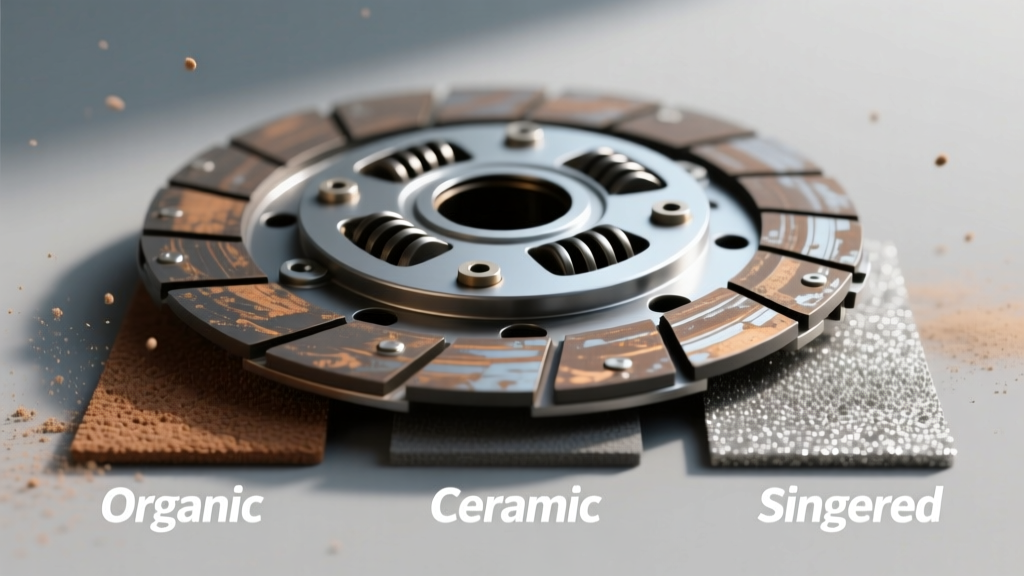
When sourcing a replacement kit, the aftermarket is flooded with options. Understanding the metallurgy and composite science of clutch discs is critical for dry DCT applications. Below is a comparative breakdown of the three primary friction materials and how they interact with the DPS6 transmission.
| Material Type | Friction Curve Profile | Heat Tolerance | DCT Compatibility | Common Application |
|---|---|---|---|---|
| Organic (Aramid/Cellulose) | Progressive, highly linear | Low-Medium (250°C max) | Excellent (OEM Spec) | Daily driving, dry DCTs |
| Ceramic (Cerometallic) | Aggressive, sudden bite | High (450°C+) | Poor (Causes TCM faults) | Dedicated track/race manuals |
| Sintered (Bronze/Iron) | Flat, high static CoF | Very High (500°C+) | Terrible (Destroys NVH) | Heavy-duty towing, rally |
Why Organic is the Only DPS6 Solution
The OEM 2014 Ford Focus dual clutch kit (typically manufactured by LuK, part number 602 0005 00 or Motorcraft 7M5Z-7540-B) utilizes a specialized organic friction material. Organic discs possess a progressive friction curve, meaning the CoF increases smoothly as slip speed decreases. This physical characteristic is what allows the DPS6's electric clutch actuator motors to smoothly 'feather' the clutch during low-speed parking maneuvers and 1-2 upshifts. According to Schaeffler REPXPERT documentation, the dampening springs integrated into the organic disc hub are specifically tuned to absorb the torsional vibrations of the 2.0L engine at idle. Without this organic dampening, the transmission casing and differential gears will rattle violently.
The Sintered and Ceramic 'Upgrade' Trap
A common troubleshooting scenario in 2026 involves a Focus owner complaining of violent bucking and TCM adaptation failures immediately after an independent shop installed an 'upgraded' clutch kit. Often, well-meaning but misinformed technicians will install a ceramic or sintered clutch disc—sometimes adapted from a Focus ST manual application or a third-party 'performance' kit.
Ceramic and sintered materials have an aggressive, almost binary friction curve. They do not slip gracefully; they grab instantly. When the DPS6 TCM attempts to execute a micro-slip maneuver to crawl forward in traffic, the sintered disc snaps shut. The TCM registers a massive, sudden torque spike, interprets this as a mechanical binding fault, and immediately commands the clutch open to protect the driveline. This results in a P073E code, severe NVH (Noise, Vibration, and Harshness), and an undrivable vehicle. Never install ceramic or sintered discs in a dry DPS6 dual-clutch system.
Mechanical Troubleshooting & Measurement Specs
Even with the correct organic 2014 Ford Focus dual clutch kit, shudder will persist if the mechanical mating surfaces and actuator alignments are out of specification. The DPS6 is incredibly sensitive to runout and axial misalignment. Follow these strict measurement protocols during installation:
- Flywheel Runout: Mount a dial indicator on the engine block and measure the dual-mass flywheel (DMF) mating surface. Maximum allowable runout is 0.05 mm (0.002 in). If the DMF exceeds this, it must be replaced. Do not attempt to resurface a DMF; the internal grease and spring tensions will be ruined by the heat of machining.
- Input Shaft Seal Inspection: A primary cause of organic clutch failure is contamination. The DPS6 input shaft seals are prone to weeping gear oil (Motorcraft Dual Clutch Transmission Fluid, typically 1.9L capacity) onto the dry clutch discs. If you find black, oily residue on the old organic friction material, you must replace the input shaft O-rings and seals before installing the new kit, or the new clutch will glaze within 5,000 miles.
- Clutch Actuator Motor Torque: The DPS6 uses two electric motors to actuate the clutch levers. When reinstalling the actuators, the mounting bolts must be torqued to exactly 10 Nm (89 lb-in). Over-torquing can warp the actuator housing, causing the internal potentiometer to misread the clutch touch-point.
- Bellhousing Alignment: The bellhousing to engine block M10 bolts must be torqued in a star pattern to 47 Nm (35 lb-ft). Any misalignment here will cause the transmission input shafts to bind, mimicking the symptoms of a warped clutch disc.
The TCM Touch-Point Adaptation Procedure
Diagnosing a shudder is incomplete without addressing the software side of the hardware. Once the correct organic 2014 Ford Focus dual clutch kit is installed and torqued to spec, the physical 'touch point' (the exact millimeter where the clutch disc kisses the flywheel) has changed. The TCM must relearn this baseline.
Using Ford IDS or FORScan, navigate to the Transmission module and initiate the Clutch Touch Point Learning routine. This requires the vehicle to be on a lift (or a very long, empty road), the transmission fluid temperature to be between 60°C and 80°C, and the steering wheel perfectly centered. The TCM will slowly engage Clutch A and Clutch B against the engine's idle torque to map the new friction curve. If this step is skipped, the TCM will rely on the worn-out baseline data from the previous clutch, resulting in immediate slip and a return of the dreaded low-speed shudder.
Expert Insight: As of 2026, the aftermarket has largely corrected the early 2010s issues of counterfeit friction materials. However, always verify that your replacement kit includes the specific LuK or OEM Ford aramid-cellulose organic compound. Sourcing a genuine SAE-compliant dry DCT friction interface is the only way to ensure long-term TCM harmony.
2026 Sourcing & Cost Breakdown
When budgeting for a 2014 Ford Focus dual clutch kit replacement, expect the following real-world pricing tiers (parts only, excluding labor and TCM programming):
- OEM Motorcraft / Genuine Ford (7M5Z-7540-B): $550 - $700. Includes the dual clutch assembly, release bearings, and alignment tool. Best for guaranteed TCM compatibility.
- OEM Equivalent (LuK RepSet 602 0005 00): $350 - $450. LuK is the original manufacturer for Ford's DPS6. This is the smartest choice for independent shops and DIYers, offering identical organic friction materials at a lower markup.
- Aftermarket 'Performance' Kits (Sintered/Ceramic): $250 - $400. Avoid entirely for street-driven DPS6 applications.
By combining precise scan-tool diagnostics, strict adherence to organic friction material requirements, and meticulous mechanical measurements, you can permanently eliminate DPS6 shudder and restore the 2014 Ford Focus to its intended, seamless shifting glory.