When a transmission cooler leak occurs inside the radiator tank, the result is often catastrophic. Coolant breaches the internal barrier, mixing with automatic transmission fluid (ATF) to create a milky, pink emulsion affectionately known by technicians as the 'strawberry milkshake of death.' This fluid contamination destroys the friction material on clutch packs and degrades the paper and cork seals inside the valve body, often requiring a complete transmission rebuild.
As of 2026, modern 8-speed and 10-speed transmissions operate under immense thermal loads, making the debate between an OEM radiator-integrated cooler and an external auxiliary cooler more relevant than ever. This model-specific repair guide breaks down the mechanical realities of a transmission cooler vs radiator cooler setup, providing exact repair procedures, torque specifications, and part numbers for popular platforms like the GM 6L80/8L90 and Ford 10R80.
The Anatomy of a Transmission Cooler Leak
To understand the repair path, we must first examine how the two primary cooling architectures function and fail.
OEM Radiator-Integrated Coolers (The Failure Point)
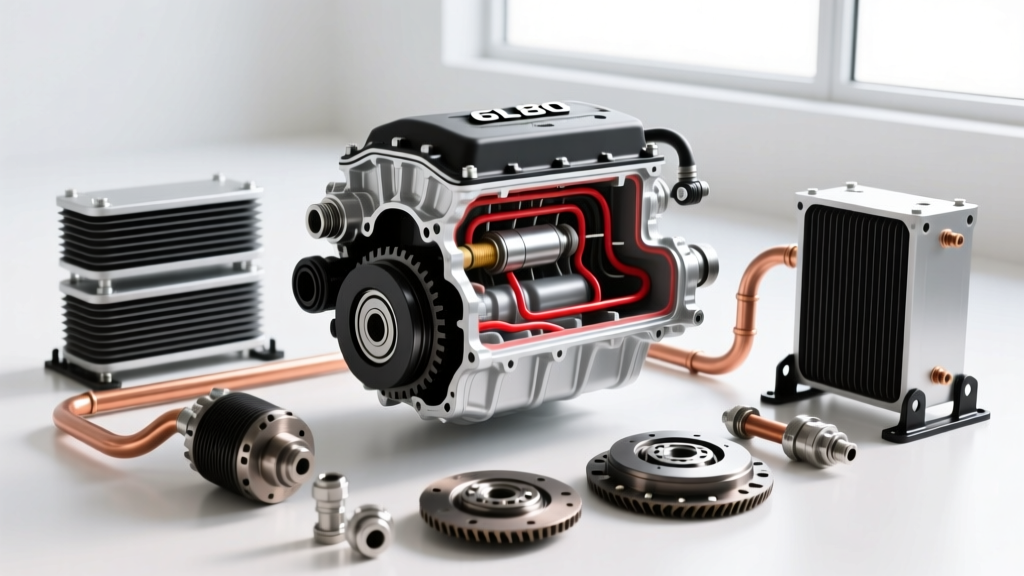
Most factory setups utilize a 'tank-in-tank' heat exchanger located in the lower coolant tank of the engine radiator. Transmission fluid routes through a bundle of copper or aluminum tubes submerged in engine coolant. While this design helps the transmission reach operating temperature quickly in cold climates, it presents a massive vulnerability. Galvanic corrosion, vibration fatigue at the crimped end-caps, and thermal cycling eventually compromise the seals. When the internal barrier fails, coolant (pressurized at roughly 15-18 PSI) forces its way into the ATF return line, pushing coolant directly into the transmission pan.
External Auxiliary Coolers (The Reliable Alternative)
An external cooler mounts independently in front of the A/C condenser and radiator. By entirely separating the ATF and engine coolant circuits, the risk of cross-contamination drops to absolute zero. Modern stacked-plate external coolers offer superior thermal dissipation without the restrictive pressure drops associated with older tube-and-fin designs.
Radiator vs. External Cooler: Technical Comparison
When deciding whether to replace a failing OEM radiator or bypass it entirely in favor of an external unit, consider the following engineering metrics.
| Feature | OEM Radiator-Integrated Cooler | External Stacked-Plate Cooler |
|---|---|---|
| Cooling Capacity | 12,000 - 15,000 BTU/hr | 20,000 - 30,000+ BTU/hr |
| Pressure Drop | 3 - 5 PSI | 1 - 2 PSI (High-flow turbulator plates) |
| Cross-Contamination Risk | High (Catastrophic failure mode) | Zero (Circuits are physically isolated) |
| Cold-Weather Warmup | Fast (Heated by engine coolant) | Slower (Requires inline thermostat bypass) |
| Replacement Cost | $300 - $800 (Full radiator swap) | $80 - $180 (Cooler + lines + fittings) |
Model-Specific Repair Guide: GM 6L80 / 8L90 Radiator Bypass
The GM 6L80 and 8L90 transmissions (found in Silverados, Tahoes, and Camaros) are notorious for radiator-induced failures. If you have identified a transmission cooler leak at the radiator, the most cost-effective and reliable repair is bypassing the radiator entirely and installing a heavy-duty stacked-plate cooler.
Required Parts and Materials
- Cooler: Hayden 678 Rapid-Cool Stacked-Plate (Rated for 30,000 GVWR)
- Hose: 5/8" I.D. Gates 3325 Transmission Cooler Hose (Must withstand 250+ PSI burst pressure)
- Fittings: 5/8"-18 UNF O-ring boss to 5/8" hose barb adapters
- Fluid: ACDelco Dexron VI (11.2 Quart total dry capacity; expect to use 7-8 quarts for this service)
Step-by-Step Bypass Procedure
- Drain and Isolate: Remove the transmission pan drain plug. Once drained, remove the pan (Torque spec for pan bolts upon reassembly: 10 Nm / 89 lb-in). Disconnect the battery to prevent accidental starter engagement.
- Cap the Radiator: Disconnect the OEM steel cooler lines from the lower radiator tank. Install 5/8"-18 UNF solid brass block-off plugs with new Viton O-rings into the radiator ports to prevent engine coolant loss. Do not attempt to reuse the leaking internal cooler.
- Mount the External Cooler: Mount the Hayden 678 directly in front of the A/C condenser using the included zip-ties and rubber isolation pads to prevent chassis vibration transfer.
- Route New Lines: Connect the transmission 'OUT' port (pressure line) to the bottom inlet of the external cooler, and the cooler 'OUT' (top) to the transmission 'IN' (return) port. Secure hose clamps to 35 lb-in.
- Refill and Verify: Fill the pan with Dexron VI. Start the engine, cycle the gear shifter through all positions, and check the fluid level via the side check-plug with the fluid temperature between 86°F and 122°F (verified via OBD2 scanner).
For authoritative guidance on GM transmission cooling specifications and line pressure dynamics, consult the engineering resources available at Sonnax Industries.
Model-Specific Repair Guide: Ford 10R80 Thermal Bypass Delete
The Ford 10R80 (used in the F-150 and Mustang) utilizes a highly complex thermal management system. Owners frequently misdiagnose a restricted thermal bypass valve as a transmission cooler leak or external blockage due to sudden temperature spikes and erratic line pressures.
The 10R80 Thermal Bypass Valve Issue
Ford installed a thermal bypass valve in the cooler lines to restrict ATF flow to the cooler until the fluid reaches a specific temperature. Unfortunately, this valve frequently sticks in the closed position, causing transmission temperatures to exceed 230°F under load, degrading the Mercon ULV fluid and burning out the C-clutch.
The Repair: Bypass Valve Delete
Instead of replacing the OEM lines with another faulty factory unit, install the Sonnax 10R80-TBVD Thermal Bypass Valve Delete Kit. This kit replaces the restrictive valve with a high-flow, CNC-machined aluminum bypass block.
- Line Disconnect: Use a 5/8" fuel line disconnect tool to separate the OEM quick-connect fittings.
- Installation: Install the Sonnax delete block inline. Ensure the flow direction arrow on the block points toward the transmission return port.
- Torque Spec: Secure the block mounting bracket to the chassis crossmember using M6 bolts torqued to 10 Nm (89 lb-in).
By eliminating this restriction, the 10R80 maintains consistent cooler flow, dropping operating temperatures by an average of 30°F to 45°F during heavy towing. For detailed fluid routing diagrams and Mercon ULV specifications, refer to Hayden Automotive's technical bulletins.
Sizing Your External Cooler: The BTU Formula
If you are upgrading from a radiator cooler to an external unit to prevent future leaks and overheating, proper sizing is non-negotiable. An undersized cooler will result in fluid degradation, while a massively oversized cooler without a thermostat bypass can prevent the fluid from reaching optimal operating temperature (180°F - 200°F), leading to sluggish valve body shifts and torque converter shudder.
- Light Duty (Commuting, Empty Bed): 15,000 - 18,000 BTU/hr (e.g., Derale Series 8000 Plate-and-Fin)
- Medium Duty (Light Towing, 5,000 lbs): 20,000 - 24,000 BTU/hr (e.g., Hayden 678 Stacked-Plate)
- Heavy Duty (Max Towing, 10,000+ lbs): 28,000 - 40,000 BTU/hr (e.g., Derale Hyper-Cool with inline thermostat)
For high-performance applications and severe-duty towing, exploring advanced stacked-plate configurations from Derale Performance ensures maximum heat rejection with minimal parasitic drag on the transmission oil pump.
Conclusion
A transmission cooler leak at the radiator is a critical failure that demands immediate intervention. While replacing the OEM radiator restores the vehicle to factory specifications, it leaves the transmission vulnerable to the exact same tank-in-tank failure mechanism down the road. By executing a radiator bypass and installing a correctly sized external stacked-plate cooler, or by deleting restrictive thermal valves on modern 10-speed units, you permanently isolate the ATF from engine coolant and drastically improve the thermal longevity of the drivetrain. Always adhere to manufacturer torque specifications and utilize high-burst-pressure hoses to ensure a leak-free, reliable repair.