Understanding Automatic Clutch Drag and Release Failures
When drivers and technicians search for automatic clutch problems, the immediate assumption is often clutch slip or shudder. However, clutch drag and failure to release are equally destructive, frequently leading to harsh shifts, engine stalling, transmission overheating, and catastrophic planetary gearset failure. Unlike manual transmissions where a faulty master cylinder or warped pressure plate causes drag, automatic transmissions rely on complex hydraulic circuits, pulse-width modulation (PWM) solenoids, and precise mechatronic adaptations to apply and release internal friction packs and torque converter clutches (TCC).
In modern vehicles, including traditional torque-converter automatics like the GM 6L80 and ZF 8HP, as well as Dual-Clutch Transmissions (DCTs) like the VW DQ250, a failure in the release circuit means hydraulic pressure remains trapped. This keeps the friction material partially engaged against the steel separator plates, generating immense heat and contaminating the fluid with Kevlar or carbon debris. This guide provides a step-by-step diagnostic framework to isolate and repair automatic clutch drag and release problems.
The Mechanics of Clutch Drag in Modern Transmissions
Torque Converter Clutch (TCC) Release Circuit Failure
The TCC is essentially a large internal clutch that locks the engine to the transmission input shaft for 1:1 efficiency. When the vehicle stops, the Transmission Control Module (TCM) must exhaust the apply fluid and route release pressure to push the TCC piston away from the converter cover. If the TCC regulator valve in the valve body is worn, or if the PWM solenoid sticks in the 'apply' position, the TCC drags. This manifests as a severe engine shudder at idle, harsh engagements into Reverse or Drive, or the engine stalling completely when coming to a stop.
Planetary Gearset Friction Pack Drag
Inside the transmission case, multiple clutch packs (e.g., the Overrun clutch, 3-5-Reverse clutch) are applied via hydraulic pistons sealed with O-rings and lip seals. If the exhaust orifice in the drum is restricted by debris, or if the return springs are fatigued, the piston fails to retract. The resulting drag causes 'shift tie-up'—a condition where two opposing gear ratios are applied simultaneously, creating massive internal binding and rapid fluid temperature spikes.
Dual-Clutch Transmission (DCT) Release Bearing Wear
In dry and wet DCTs, clutch release is managed by electromechanical actuators pushing on release bearings. If the release bearing cage fractures or the mechatronic adaptation data drifts, the clutch may not fully disengage. This causes gear whine, difficulty shifting into neutral, and premature wear of the dual-mass flywheel (DMF).
Step-by-Step Diagnostic Guide
Follow this systematic approach to pinpoint the root cause of the drag before tearing down the transmission.
Step 1: Bi-Directional OBD-II Scanning and Data Logging
Modern 2026 OBD-II mandates require advanced bi-directional scan tools to view real-time clutch pressure commands versus actual feedback.
- Scan for Codes: Look for P0741 (TCC System Stuck Off/Performance), P0742 (TCC System Stuck On), or P2786 (Gear Shift Module Actuator Circuit). P0742 is a primary indicator of TCC drag.
- Monitor TCC Slip Speed: With the vehicle in Drive at a stop (foot firmly on the brake), the TCC slip speed should match engine RPM (meaning the clutch is fully released). If slip speed reads near 0 RPM while the brake is applied and the engine is lugging, the TCC is dragging.
- Command Solenoid Release: Use the scan tool to manually command the TCC solenoid to 0% duty cycle or 0 mA. If the engine still stalls, you have a mechanical or hydraulic valve body issue, not an electrical one.
Step 2: Hydraulic Line and TCC Pressure Testing
Connect a 500 PSI transmission pressure gauge to the TCC apply port on the transmission case.
- Idle in Park/Neutral: TCC apply pressure should read 0-5 PSI. Any reading above 15 PSI indicates a cross-leak in the valve body or a stuck TCC regulator valve.
- Stall Test (Apply): When commanded ON, pressure should rapidly rise to 90-110 PSI (specs vary by model, e.g., GM 6L80).
- Release Exhaust Check: When commanded OFF, the gauge must drop to 0 PSI instantly. A slow bleed-down confirms a restricted exhaust circuit or binding spool valve.
Step 3: Fluid Contamination Analysis
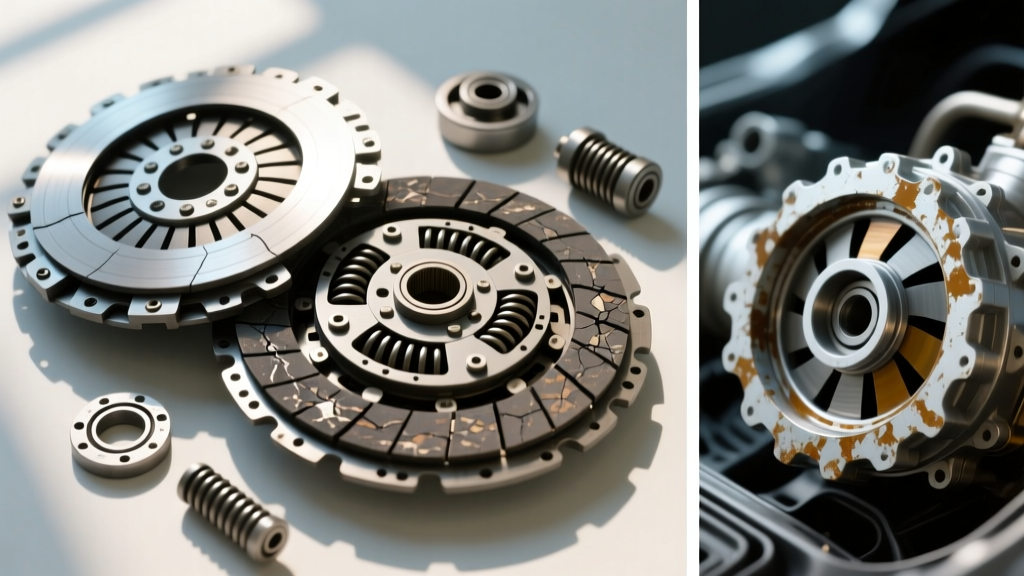
Drop the transmission pan and inspect the fluid. Friction material suspended in the fluid looks like glitter or dark silt. According to the Automatic Transmission Service Group (ATSG), heavy carbon or Kevlar debris in the pan often originates from a dragging clutch pack that has been riding the steels for thousands of miles. If the fluid smells burnt and contains metallic flakes, the release failure has likely destroyed the clutch hub or planetary gears.
Common Drag Symptoms by Transmission Model
| Transmission Model | Clutch Component | Drag Symptom | Common Culprit | Repair / Part Solution |
|---|---|---|---|---|
| GM 6L80 / 6L90 | Torque Converter Clutch | Engine stall at stop, harsh reverse engagement | Worn TCC Regulator Valve bore in pump | Install Sonnax 15741-09K TCC Regulator Valve Kit |
| ZF 8HP45 / 8HP70 | Overrun / A-Clutch Pack | 1-2 Shift bind, overheating, limp mode | Swollen piston seals, mechatronic adapter leak | Replace ZF mechatronic sleeve seals, verify 0.040'-0.060' pack clearance |
| VW DQ250 (DSG) | K1/K2 Release Bearing | Gear whine in Neutral, incomplete disengagement | Bearing cage fracture, dry mechatronic fluid | Replace DMF and concentric release bearing, perform basic settings |
| Ford DPS6 (PowerShift) | Dry Clutch Actuators | Shudder from stop, failure to shift to 2nd gear | Actuator motor failure, clutch gap out of spec | Measure clutch gap (0.5mm-1.0mm), replace actuator motors |
Step-by-Step Repair and Calibration Procedures
Fixing GM 6L80 TCC Drag (Valve Body Service)
If hydraulic testing confirms TCC pressure at idle, the pump cover must be removed to service the TCC regulator valve.
- Remove the transmission pan and filter. Drain the Dexron ULV fluid.
- Remove the valve body mounting bolts. Torque Spec Note: When reinstalling the valve body, tighten the M6 bolts to exactly 8 Nm (71 lb-in) in the factory spiral sequence to prevent casing distortion.
- Extract the TCC regulator valve from the pump cover. You will likely find severe scoring on the aluminum bore.
- Use a Sonnax reaming tool to bore out the housing and install the hardened steel sleeve and anodized valve (Part #15741-09K). This permanently resolves the cross-leak causing the drag.
- Refill with 6.0 - 6.5 quarts of OEM Dexron ULV and perform a TCC adapt reset via the scan tool.
DCT Clutch Bite Point Adaptation (VW/Audi DSG)
If a DCT exhibits drag after a mechatronic unit replacement or fluid service, the clutch bite points must be recalibrated. According to ZF Aftermarket and OEM guidelines, failing to adapt the clutches will result in immediate drag and overheating.
- Connect an OEM-level bi-directional scanner (e.g., VCDS or ODIS).
- Navigate to Transmission Control Module (Address 02) -> Basic Settings.
- Select 'Clutch Adaptation' or 'Basic Setting of Clutch 1 and 2'.
- The vehicle must be on a lift with wheels free to spin. The TCM will slowly engage the clutches to measure the exact millimeter point where friction material contacts the flywheel.
- Once the adaptation reaches a 'Finished' or 'Correct' status, clear all codes and perform a 10-mile road test to allow the micro-adaptations to finalize.
Cost Breakdown for Drag and Release Repairs
Addressing automatic clutch problems early prevents collateral damage to the planetary gearsets and torque converter. Below is an estimated cost breakdown for common release-circuit repairs in 2026:
- TCC Solenoid / PWM Valve Replacement: $80 - $180 (Parts) + $300 (Labor for pan drop and fluid).
- Valve Body Bore Reaming & Sleeve Kit: $50 - $120 (Parts) + $450 (Labor).
- Mechatronic Unit / TEHCM Replacement: $900 - $1,800 (Part) + $400 (Labor & Programming).
- DCT Release Bearing & DMF Service: $400 - $700 (Parts) + $800 - $1,200 (Labor for transmission removal).
- Full Friction Pack Rebuild (Due to Drag Burnout): $1,800 - $3,500 depending on vehicle class and hard-part damage.
Expert Diagnostic Tip: Never ignore a slight engine RPM drop or a subtle 'thud' when shifting from Park to Reverse. In 8-speed and 10-speed automatics, this is often the first symptom of a dragging overrun clutch or a failing TCC release circuit. Catching a $60 valve body wear issue early prevents a $3,500 complete transmission rebuild.
Summary
Diagnosing automatic clutch problems related to drag and release requires moving beyond simple code reading. By utilizing hydraulic pressure testing, analyzing fluid contamination, and understanding the specific mechanical vulnerabilities of units like the GM 6L80, ZF 8HP, and modern DCTs, technicians can accurately pinpoint the failure. Whether the issue stems from a worn TCC regulator valve, a fractured DCT release bearing, or a blocked exhaust orifice, following a strict diagnostic sequence ensures a lasting repair and restores seamless transmission operation.