Truck owners and off-road enthusiasts often share a passion for the water. Whether you are hauling a bass boat to the local reservoir or towing a heavy cabin cruiser up a mountain grade, understanding mechanical leverage is critical. This dual lifestyle often prompts a fascinating crossover question among gearheads: what is gear ratio on fishing reels, and how does that exact same physics concept map directly to automotive axle ratio identification and differential upgrades?
As we navigate the 2026 landscape of half-ton and heavy-duty towing, factory axle ratios are often optimized for EPA fuel economy tests rather than real-world pulling power. Upgrading your ring and pinion is one of the most transformative drivetrain modifications you can make. To understand why, we first look to the tackle box.
The Angler’s Analogy: Fishing Reel Gear Ratios Explained
In the fishing world, a baitcasting reel's gear ratio dictates how many times the spool rotates for every single 360-degree turn of the handle. A 5.1:1 ratio is considered a "winch"—it provides massive cranking power to pull heavy jigs out of deep weeds, but retrieves line slowly. Conversely, an 8.3:1 ratio is a "burner"—it sacrifices torque to retrieve line rapidly for burning crankbaits across the surface.
The mechanical architecture of a high-end Shimano or Lew's baitcaster is virtually identical to an automotive differential. The handle shaft acts as the input (driveshaft), the main drive gear acts as the ring gear, and the spool shaft acts as the pinion. The physics of rotational leverage do not change whether you are fighting a 10-pound largemouth or towing a 7,500-pound trailer up a 6% grade.
Translating Reel Mechanics to Automotive Differentials
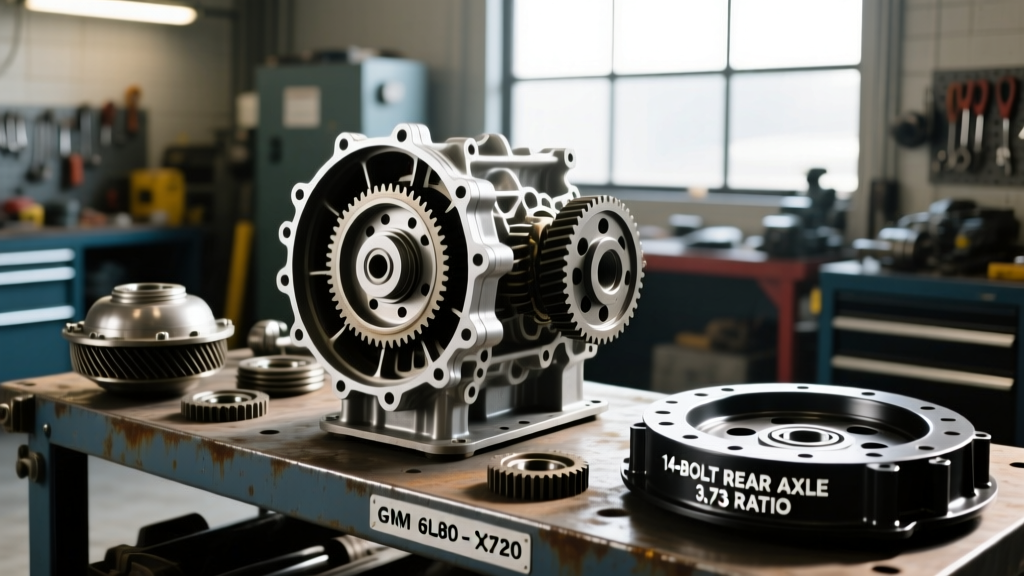
In a Ford 8.8-inch or GM 8.5-inch 10-bolt differential, the driveshaft acts as your reel handle. The pinion gear is the input shaft, and the ring gear is bolted to the differential case (the spool). If your truck has a 3.73 axle ratio, the driveshaft must rotate 3.73 times to turn the axle shafts and wheels one full revolution.
- Low Numerical Ratios (e.g., 3.08 or 3.23): Act like high-speed 8.1:1 fishing reels. Excellent for highway fuel economy and light loads, but they struggle to get heavy trailers moving from a dead stop, causing excessive transmission hunting and heat.
- High Numerical Ratios (e.g., 4.10 or 4.56): Act like 5.1:1 winching reels. They multiply engine torque aggressively at the wheels, drastically improving low-end pulling power, reducing transmission shift cycling, and lowering engine strain during heavy towing.
Step-by-Step Axle Ratio Identification
Before ordering a set of 4.10 gears from Yukon Gear & Axle, you must definitively identify your current ratio. Guessing based on badging or previous owner claims is a recipe for wasted labor. Use these three methods to verify your starting point.
Method 1: Decoding RPO Codes and Door Jam Tags
For GM trucks (Silverado/Sierra), check the glovebox for the Service Parts Identification sticker. Look for three-character RPO codes: GU6 (3.42), GT4 (3.73), or GT5 (4.10). For Ford F-150s and Super Duties, check the driver’s door jamb certification label. Locate the "AXLE" code; for example, a code of 19 indicates a 3.55 limited-slip, while 27 indicates a 3.73 electronic locker.
Method 2: The Driveshaft Spin Test
If the tags are missing, use physics. Jack up the rear of the vehicle so both rear tires are off the ground (if equipped with an open differential) or just one tire (if equipped with a locking differential). Place a piece of masking tape on the driveshaft and another at the 12 o'clock position on the tire. Rotate the tire exactly one full 360-degree revolution while a helper counts the driveshaft rotations. If the driveshaft turns roughly 3.75 times, you have a 3.73 ratio. If it turns just over 4 times, you have a 4.10.
Method 3: Counting Ring and Pinion Teeth
The only 100% foolproof method requires removing the differential cover. Drain the fluid, rotate the carrier, and count the teeth on the large ring gear and the small pinion gear. Divide the ring gear teeth by the pinion teeth. For example, 41 ring gear teeth divided by 11 pinion teeth equals 3.727 (marketed as 3.73). Most OEM ring gears also have the ratio stamped directly on the outer edge (e.g., "41-11").
Performance Upgrade Matrix: Selecting Your Next Ratio
Choosing the right ratio requires balancing your tire size, engine torque curve, and primary use case. Oversized tires effectively "taller" your gearing, necessitating a numerical increase to restore factory performance.
| Axle Ratio | Reel Equivalent | Best Application | Towing Impact (vs 3.23) | Highway RPM Impact |
|---|---|---|---|---|
| 3.23 | 8.1:1 (Burner) | Empty highway cruising, light cargo | Baseline (High Trans Heat) | Baseline (Lowest) |
| 3.55 | 7.1:1 (All-Around) | Daily driving, 5,000 lb boat towing | +10% Low-End Torque | +150 RPM @ 70 MPH |
| 3.73 | 6.3:1 (Versatile) | 6,500 lb trailers, 33-inch tires | +18% Low-End Torque | +250 RPM @ 70 MPH |
| 4.10 | 5.4:1 (Puller) | Heavy towing, 35-inch tires, hills | +28% Low-End Torque | +400 RPM @ 70 MPH |
| 4.56 | 5.1:1 (Winch) | Max payload, 37"+ tires, off-road | +41% Low-End Torque | +550 RPM @ 70 MPH |
The Upgrade Blueprint: Torque Specs and Real Costs
Setting up a ring and pinion is not a beginner DIY job; it requires precision measuring tools and strict adherence to torque specifications. Let us break down the real-world costs and specs for upgrading a common GM 8.5-inch 10-bolt differential from a 3.08 to a 3.73 ratio.
Parts and Pricing (2026 Estimates)
- Ring & Pinion Set: Yukon Gear 3.73 (Part# YG GM8.5-373) — $230 to $260.
- Master Bearing Install Kit: Includes Timken bearings, crush sleeve, pinion seal, and shims (Part# YK GM8.5) — $175 to $195.
- Consumables: Red Loctite 272, yellow gear marking compound, 3 quarts of 75W-90 synthetic gear oil, and RTV silicone — $60.
- Professional Labor: Driveline specialty shops typically charge 4 to 6 hours of labor at $130-$160 per hour, totaling $520 to $960.
Critical Torque Specifications (GM 8.5" 10-Bolt)
When assembling the differential, fastener stretch and rotational preload are paramount. Reference technical guides from Ring & Pinion for platform-specific nuances, but standard GM 8.5-inch specs include:
- Ring Gear to Case Bolts: 70 lb-ft. (Must be cleaned with brake cleaner and secured with Red Loctite 272. Torque in a star pattern).
- Differential Bearing Cap Bolts: 60 lb-ft.
- Pinion Nut Torque: 160 to 250 lb-ft. (This is a yield-based spec; you tighten the nut until the new crush sleeve collapses enough to achieve the correct pinion bearing rotational preload).
- Pinion Bearing Preload: 14 to 19 inch-pounds of rotational torque (measured with a dial inch-pound torque wrench on the pinion yoke, with the carrier removed).
- Target Backlash: 0.006" to 0.010" (measured via dial indicator on the ring gear face).
Verifying the Gear Tooth Contact Pattern
Torque specs alone will not save your differential from catastrophic failure. The gear tooth contact pattern must be verified using yellow marking compound painted on three consecutive ring gear teeth. Under load (using a brake drum or rag to apply resistance to the carrier), rotate the gears in both the drive and coast directions.
Ideally, the pattern should sit dead-center on the tooth face, slightly favoring the heel. If the pattern is high on the tooth (toward the top land), the pinion is too deep, and you must reduce the pinion depth shim by 0.002" to 0.004" increments. If the pattern is low (toward the root), increase the pinion depth shim. A flawed contact pattern will result in gear whine under deceleration and premature tooth shearing under heavy towing loads.
Drivetrain Calibration: The Final Step
Once the mechanical upgrade is complete and the differential cover is sealed, the digital side of the truck must be addressed. Changing your axle ratio alters the final drive multiplier. If you skip this step, your speedometer will read incorrectly, your cruise control will hunt, and your Transmission Control Module (TCM) will command shifts at the wrong vehicle speeds, potentially inducing limp mode.
Using a tuning interface like HP Tuners MPVI3 or FORScan (for Ford applications), you must update the "Axle Ratio" parameter in the PCM/TCM. Additionally, recalculate your "Tire Revolutions Per Mile" based on the actual measured height of your loaded tires, not the manufacturer's sidewall claim. Proper calibration ensures your 2026 truck's 8-speed or 10-speed transmission utilizes its gear spread exactly as the engineers intended, maximizing both the new pulling power and your fuel efficiency.
For those sourcing specialized setup tools like dial indicators and yoke holders, retailers like Summit Racing offer comprehensive drivetrain toolkits that bridge the gap between professional driveline shops and advanced home mechanics. Whether you are fine-tuning a high-speed baitcaster for the weekend tournament or setting up a 4.10 ring and pinion for the mountain pass, precision and leverage are the ultimate keys to performance.