The Physics of Hauling: Why Stock Gearing Fails Under Load
When you attach a 300-pound cargo trailer to a motorcycle, UTV (quad bike), or heavy-duty e-bike, you completely alter the drivetrain's mechanical advantage. Factory gearing on most modern bikes prioritizes top speed, emissions compliance, and fuel economy—not low-end towing torque. If you have been searching for how to calculate gear ratio bike configurations for towing and hauling, you must first understand that hauling requires a massive multiplication of torque at the rear wheel. Failing to adjust your final drive ratio or internal gear hub setup when towing leads to catastrophic drivetrain failures, ranging from snapped chains to melted stators and glazed CVT belts.
In this 2026 troubleshooting guide, we approach gear ratio calculations from a Symptom Diagnosis perspective. We will identify the exact mechanical failure modes caused by improper towing ratios and provide the mathematical fixes, specific part numbers, and torque specifications required to build a bulletproof hauling drivetrain.
Step-by-Step: How to Calculate Gear Ratio Bike Setups for Towing
Before diagnosing failures, you must establish your baseline mechanical advantage. The fundamental formula for your final drive ratio (FDR) is:
Final Drive Ratio = Rear Sprocket Teeth / Front Countershaft Sprocket Teeth
For example, a stock dual-sport motorcycle might have a 14-tooth front and a 42-tooth rear, yielding an FDR of 3.00:1. This means the transmission output shaft turns three times for every one revolution of the rear wheel. When towing, you need a higher numerical ratio (e.g., 3.50:1) to multiply torque. You achieve this by dropping front teeth or adding rear teeth.
For e-bikes and cargo bicycles, we use Gear Inches to calculate the effective hauling leverage:
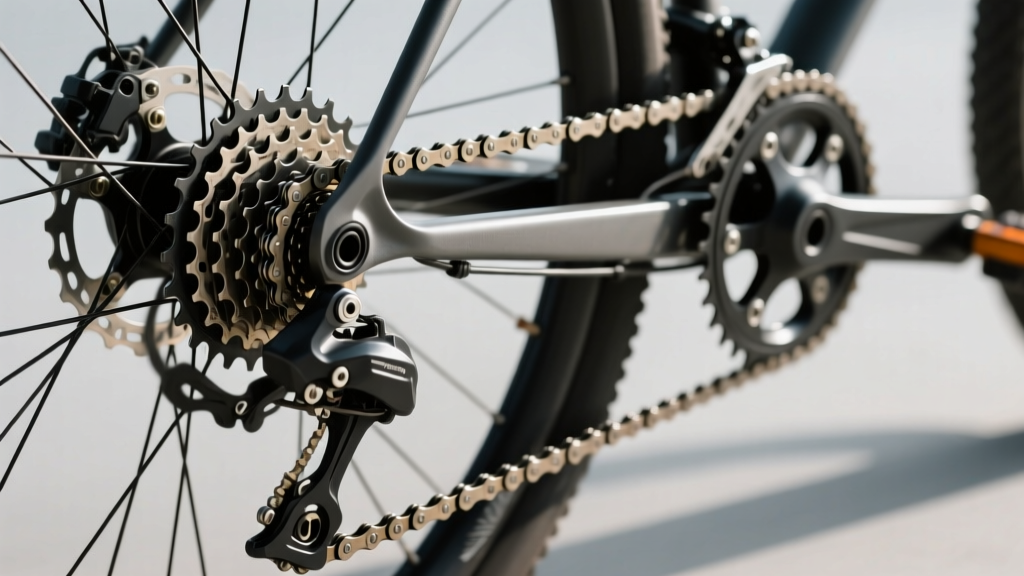
Gear Inches = (Chainring Teeth / Cog Teeth) x Wheel Diameter (in inches)
For heavy hauling, you want your lowest gear to be under 20 gear inches. Anything above 35 gear inches will cause severe drivetrain strain when starting from a dead stop with a loaded trailer. For a deeper mathematical breakdown of bicycle and light-motorcycle gearing, Sheldon Brown's Gear Calculator remains the industry-standard reference tool.
Symptom Diagnosis: Troubleshooting Hauling Drivetrain Failures
When your gear ratio is mismatched for your towing payload, the drivetrain will communicate the failure through distinct mechanical symptoms. Here is how to diagnose and fix the three most common hauling-related drivetrain issues.
Symptom 1: Chain Skip, Stretch, and 'Shark Fin' Sprocket Wear
The Diagnosis: You accelerate from a stop light with a loaded trailer and hear a loud metallic crack or feel the drivetrain jump. Inspecting the rear sprocket reveals asymmetric, hooked teeth (often called 'shark finning'). This occurs when a tall stock gear ratio forces the chain to endure tensile loads exceeding its yield strength during low-RPM towing.
The Fix: You must lower the gearing to reduce peak chain tension. Drop one tooth on the front countershaft sprocket (e.g., from 15T to 14T) and add two to three teeth on the rear. Furthermore, upgrade to an X-Ring chain designed for high-tensile shock loads. The DID 520 VX3 X-Ring Chain (approx. $125-$145) offers a tensile strength of 8,200 lbs, which is critical for towing. Always replace the front and rear sprockets simultaneously; pairing a new chain with a worn towing sprocket will destroy the new chain in under 500 miles.
Symptom 2: Motor Overheating and Thermal Derating (E-Bikes & UTVs)
The Diagnosis: Your mid-drive e-bike (such as a Bafang BBSHD) or small-displacement quad bike begins to lose power halfway up a graded incline while pulling a trailer. The motor casing is hot to the touch. This is thermal derating. Because the gear ratio is too 'tall' (numerically low), the motor is lugging below its optimal RPM efficiency band, converting electrical/fuel energy into waste heat rather than rotational force.
The Fix: Recalculate your gear ratio to keep the motor in its peak torque band (typically 90-120 RPM for mid-drive e-bikes, or 4,500-6,000 RPM for gas UTVs). For e-bikes, swap the stock 44T or 46T chainring for a 36T Lekkie Bling Ring (approx. $85). This single modification drops your gear inches dramatically, allowing the motor to spin faster, engage its internal cooling fan more effectively, and eliminate thermal cut-offs during heavy hauling.
Symptom 3: CVT Belt Slip and Glazing on Quad Bikes
The Diagnosis: On CVT-equipped UTVs and ATVs (frequently referred to as quad bikes), towing heavy loads prevents the primary clutch from opening fully. The drive belt rides low in the sheaves, causing friction, extreme heat, and a burnt rubber smell. Over time, the belt develops a hard, glossy glaze that ruins its grip.
The Fix: You must alter the clutching profile to match your new, lower gear ratio. Install a smaller front countershaft sprocket (e.g., a JT Sprockets 13T, approx. $22) to artificially raise the RPM at cruising speeds. To complement this, increase the secondary clutch spring rate. Swapping to an EPI Heavy Duty Towing Spring (e.g., the EPI Spring #044, approx. $28) increases clamping force on the belt, preventing slip under the high-torque loads generated by the new gear ratio.
Hauling vs. Speed: Gear Ratio Comparison Chart
The table below illustrates how altering sprocket sizes impacts the final drive ratio, theoretical top speed, and low-end towing torque for a standard 250cc dual-sport motorcycle or equivalent gas-powered quad bike platform.
| Setup Configuration | Front / Rear Teeth | Final Drive Ratio | 1st Gear Torque Multiplier | Top Speed Impact | Best Use Case |
|---|---|---|---|---|---|
| Stock Commuter | 14T / 42T | 3.00:1 | Baseline (1x) | Baseline (75 mph) | Unloaded highway riding |
| Light Hauling | 13T / 44T | 3.38:1 | +12.6% | -8 mph | Small cargo trailers (150 lbs) |
| Heavy Towing | 12T / 48T | 4.00:1 | +33.3% | -18 mph | Heavy UTV/Moto towing (300+ lbs) |
| Extreme Crawling | 11T / 52T | 4.72:1 | +57.3% | -25 mph | Steep grade logging/hauling |
Note: Dropping front teeth increases chain articulation angle, which accelerates wear. For extreme towing setups (4.00:1 and higher), always use a high-quality O-ring or X-ring chain and adhere to strict maintenance intervals.
Precision Fixes: Torque Specs and Installation Protocols
Calculating the correct gear ratio is only half the battle; improper installation under towing loads will result in immediate mechanical failure. When re-gearing a bike for hauling, adhere strictly to these torque specifications and assembly protocols:
- Rear Axle Nut Torque: Most full-size motorcycles and UTVs require between 65 to 80 ft-lbs (88 to 108 Nm). E-bike cargo bikes typically require 35 to 45 Nm. Always use a calibrated torque wrench; an under-torqued axle will shift under towing loads, destroying the chain adjusters and snapping the chain.
- Countershaft Sprocket Nut: Apply Loctite 243 (Blue) to the threads and torque to factory specifications (usually 45-55 ft-lbs). Towing creates immense rotational shock that easily backs off dry threads.
- Chain Slack Adjustment: Hauling causes the rear suspension to squat, which pulls the swingarm pivot and rear axle further apart, tightening the chain. Set your chain slack slightly looser than the stock manual recommends—typically 1.4 to 1.8 inches of free play—measured while the bike is fully loaded with the trailer tongue weight applied.
- Alignment Verification: Use a laser chain alignment tool (e.g., Motion Pro Chain Alignment Tool, approx. $25). A misaligned chain under a 300-lb towing load will shred the side plates and destroy the transmission output shaft bearing in under 100 miles.
Final Thoughts on Drivetrain Tuning
Understanding how to calculate gear ratio bike setups for towing is an exercise in managing mechanical trade-offs. You are intentionally sacrificing top-end speed and highway RPMs to gain the low-end torque necessary to move heavy mass without destroying your engine, motor, or CVT. By diagnosing the specific symptoms of a poorly geared towing rig—whether it is chain stretch, thermal derating, or belt glaze—you can apply targeted mathematical fixes and precision hardware upgrades to turn your bike into a reliable, heavy-duty hauling machine. For further reading on motorcycle and powersports gearing dynamics, consult RevZilla's Sprocket Gearing Guide and eBikeSchool's BBSHD Tuning Guide.