The Anatomy of the F150 Torque Converter Shudder
If you drive a 2011-2014 F-150 equipped with the 6R80 transmission, or a 2018-and-newer model with the 10R80, you are likely familiar with the infamous F150 torque converter shudder. This symptom typically manifests as a rhythmic vibration—often described as feeling like driving over highway rumble strips—occurring between 30 and 55 mph under light throttle application.
From an engineering standpoint, this shudder is not a random mechanical defect; it is a byproduct of Ford's aggressive 'controlled slip' torque converter clutch (TCC) strategy. To meet stringent CAFE fuel economy standards, Ford programmed the transmission control module (TCM) to keep the TCC partially engaged (slipping) at very low RPMs in higher gears. While this reduces drivetrain parasitic loss and saves fuel, it generates immense localized heat inside the torque converter. Over time, this thermal abuse degrades the friction material on the TCC lining, leading to the severe shudder that plagues these trucks.
2026 Repair Cost Breakdown: Dealership vs. Independent vs. DIY
Addressing the F150 torque converter shudder requires dropping the transmission, removing the flexplate, and replacing the torque converter. Below is a realistic 2026 pricing matrix based on current national labor averages and OEM part pricing.
| Repair Route | Parts Cost | Labor Cost | Total Est. (2026) | Warranty Coverage |
|---|---|---|---|---|
| Dealership (OEM) | $850 - $1,200 | $1,100 - $1,450 | $1,950 - $2,650 | 2-Year / 24,000 Miles |
| Independent Shop (Reman) | $450 - $700 | $900 - $1,250 | $1,350 - $1,950 | 1-Year / 12,000 Miles |
| DIY (OEM Parts) | $850 - $1,000 | $0 | $850 - $1,000 | Parts-Only Limited |
The Dealership Premium
Dealerships will exclusively use new OEM Motorcraft torque converters. For the 10R80, the book time for a 4WD F-150 transmission R&R (Remove and Replace) is approximately 6.8 hours. At an average 2026 dealer labor rate of $165 per hour, labor alone will exceed $1,120. Furthermore, dealerships will mandate a complete machine flush of the transmission cooler lines, adding roughly $150 to the final invoice.
The Independent Shop Route
A reputable independent transmission shop will often source high-quality remanufactured torque converters from suppliers like Sonnax or Precision of New Hampton. These units frequently feature upgraded billet steel covers and reinforced friction linings designed specifically to resist the thermal degradation that causes the F150 torque converter shudder. While the parts cost is lower, the labor time remains identical to the dealership.
The Hidden Cost: Valve Body Contamination & Solenoid Wear
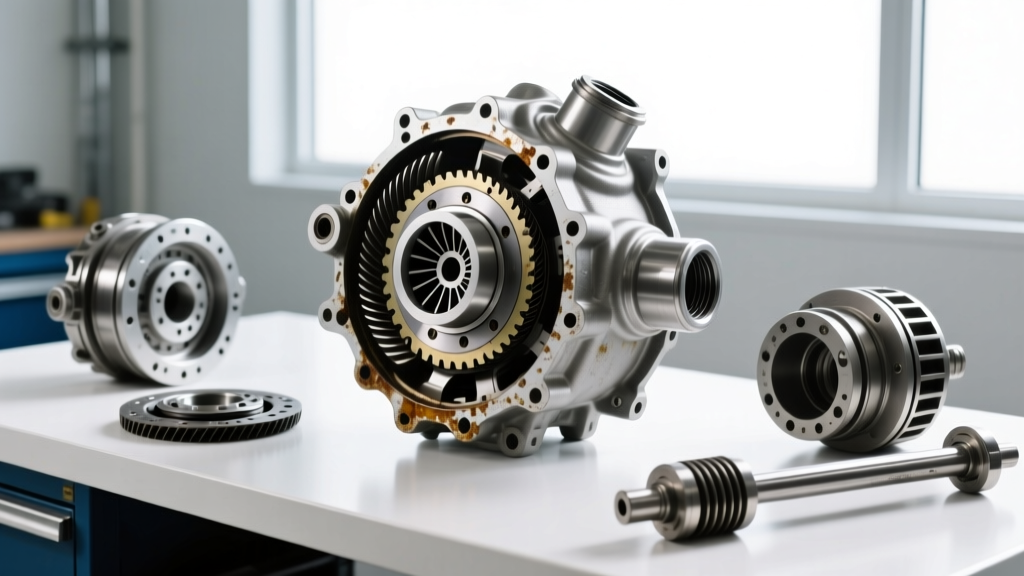
Many owners and budget-conscious mechanics make a fatal error when treating torque converter shudder: they replace the converter but ignore the contaminated fluid ecosystem. When the TCC friction material breaks down, it sheds microscopic clutch dust and metallic particulate directly into the transmission pan and valve body.
In the 10R80 and 6R80 transmissions, this debris inevitably migrates to the mechatronic valve body, clogging the intricate TCC apply solenoids and pressure control valves. If you install a $1,000 torque converter into a transmission with a compromised valve body, the new converter will begin shuddering within 10,000 miles due to improper hydraulic apply pressure.
- Mandatory Fluid Service: A simple drain and fill is insufficient. You must drop the transmission pan, replace the integrated filter screen, and clean the valve body magnets.
- Solenoid Block Replacement: If the shudder has persisted for more than a few thousand miles, expect to replace the solenoid body assembly (Motorcraft part number
JK1021for select 10R80 applications), adding $250-$400 to your parts budget. - Cooler Line Flush: The F-150's auxiliary transmission cooler holds nearly 2 quarts of contaminated fluid. Failing to back-flush these lines guarantees immediate contamination of the new converter.
OEM vs. Aftermarket Torque Converters & Fluid Specs
Selecting the correct replacement hardware and fluid is non-negotiable. Mixing fluids or using an incorrect stall-speed converter will trigger immediate TCM fault codes and harsh shifting.
6R80 Applications (2011-2014 F-150)
- OEM Part Number: Motorcraft
FK-1053(Verify against your specific VIN and axle ratio, as 3.31 and 3.73 ratios utilize different stall speeds). - Required Fluid: Motorcraft MERCON LV. Capacity: ~13.1 quarts (Dry), ~6.0 quarts (Service Fill).
10R80 Applications (2018+ F-150)
- OEM Part Number: Motorcraft
JK-1036or updated Ford engineering numberJL3Z-7902-C. - Required Fluid: Motorcraft MERCON ULV (Ultra Low Viscosity). Capacity: ~13.9 quarts (Dry), ~6.5 quarts (Service Fill).
Critical Warning: MERCON ULV and MERCON LV are not interchangeable. Using LV fluid in a 10R80 transmission will cause catastrophic TCC slip and immediate shudder due to the fluid's higher viscosity preventing proper solenoid operation.
Essential Torque Specifications for F-150 R&R
For the DIY mechanic tackling the F150 torque converter shudder in their home garage, adhering to factory torque specifications is vital to prevent flexplate cracking or bellhousing misalignment. Always use a calibrated torque wrench and new hardware where specified.
- Torque Converter to Flexplate Nuts (10R80/6R80): 35 lb-ft (47 Nm). Note: These must be replaced, not reused.
- Flexplate to Crankshaft Bolts: 66 lb-ft (90 Nm) + an additional 90-degree turn.
- Transmission Bellhousing to Engine Block: 60 lb-ft (81 Nm).
- Transmission Crossmember to Frame: 76 lb-ft (103 Nm).
- Driveshaft Flange Bolts: 76 lb-ft (103 Nm).
The 'Band-Aid' Protocol: TCM Reprogramming & TSBs
Before authorizing a $2,500 teardown, it is imperative to check for active Technical Service Bulletins (TSBs). Ford has released multiple software updates aimed at mitigating the F150 torque converter shudder. By altering the TCM's TCC apply strategy—specifically by locking the converter fully rather than allowing it to slip at low RPMs—the software update can eliminate the vibration.
According to data tracked by the National Highway Traffic Safety Administration (NHTSA), many owners report temporary relief following a PCM/TCM reflash. However, this is a software mask for a hardware failure. If the friction material is already physically degraded, no software update will restore the clutch lining. A reflash costs between $120 and $180 at a dealership and is worth performing as a diagnostic step, but it is not a permanent cure for high-mileage trucks.
For comprehensive diagnostic steps and factory-approved maintenance schedules, owners should regularly consult the official Ford Support portal to ensure their vehicle's calibration is up to date before attempting mechanical repairs.
Final Verdict: Is It Worth the Investment?
The F150 torque converter shudder is an expensive, engineered flaw born from the pursuit of fuel economy. If your truck is otherwise mechanically sound, investing $1,500 to $2,500 into a high-quality remanufactured torque converter, a rigorous valve-body flush, and a TCM reflash will easily extend the life of your 6R80 or 10R80 transmission by another 100,000 miles. Skimping on the cooler flush or reusing contaminated fluid, however, will turn a costly repair into a recurring financial nightmare.