Understanding 4x2 Drivetrain Architectures in Modern Light-Duty Trucks
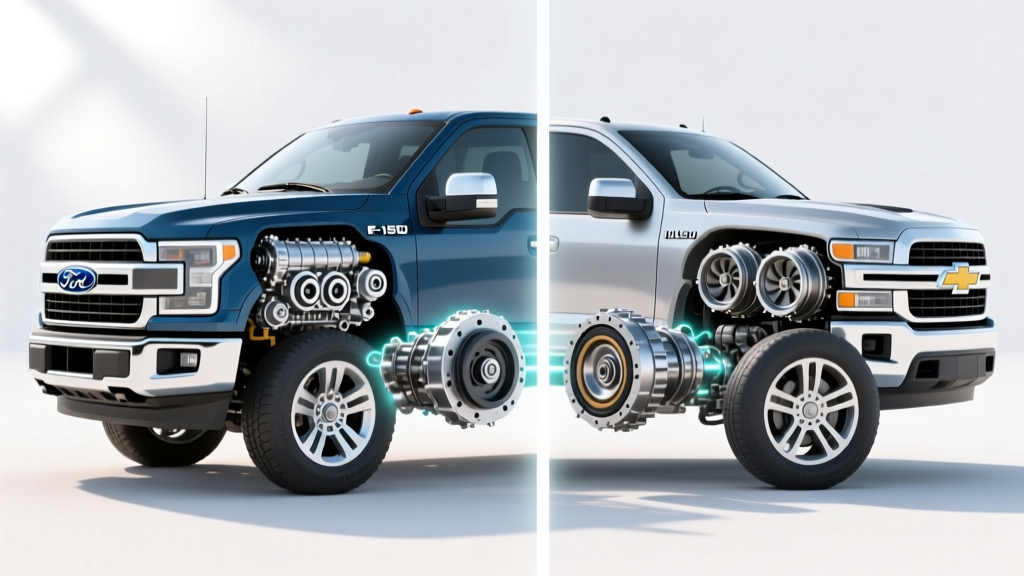
When evaluating drivetrain types for different vehicles, the distinction between four-wheel-drive and two-wheel-drive configurations goes far beyond the absence of a front differential. For modern light-duty trucks, the 4x2 drivetrain requires specialized engineering to handle torque delivery, NVH (Noise, Vibration, and Harshness) management, and driveshaft geometry. As of 2026, the Ford F-150 and Chevrolet Silverado 1500 remain the benchmark platforms for 2WD commercial and fleet applications.
Unlike their 4x4 counterparts, which utilize a transfer case to split torque and effectively shorten the rear driveshaft, 4x2 models rely on extended transmission output shafts, specific extension housings, and uniquely angled rear driveshafts. This model-specific repair guide breaks down the mechanical nuances, common failure points, and exact service specifications for the 4x2 drivetrain layouts found in the Ford F-150 (10R80) and Chevy Silverado 1500 (10L80).
Ford F-150 4x2 Drivetrain: 10R80 Transmission & Rear Axle Dynamics
The 13th and 14th generation Ford F-150 4x2 models are predominantly equipped with the 10R80 10-speed automatic transmission. Because there is no transfer case bolted to the rear of the transmission, Ford utilizes a dedicated 2WD extension housing and a longer output shaft to mate directly to the rear driveshaft.
2WD Output Shaft and Slip Yoke Configurations
Depending on the wheelbase, the F-150 4x2 drivetrain utilizes different rear driveshaft setups. The 122-inch wheelbase (Regular Cab/Short Bed) typically uses a one-piece aluminum driveshaft with a direct slip yoke. However, the 145-inch and 157-inch wheelbases (SuperCrew/Long Bed) require a two-piece steel or aluminum driveshaft featuring a center support bearing (CSB).
- Common Failure: The 10R80 2WD tail shaft bushing (located inside the extension housing) is prone to wear under heavy towing. When this bushing degrades, the slip yoke wobbles, destroying the rear output seal.
- OEM Part Reference: Motorcraft Rear Output Shaft Seal (BR3Z-7A103-A). If the bushing is scored, the entire extension housing or a specialized Sonnax bushing kit must be utilized.
- Repair Cost: A standard seal replacement runs $150–$250, but if the output shaft bushing requires transmission removal and teardown, labor costs easily exceed $1,200.
Center Support Bearing NVH Issues
On long-wheelbase 4x2 F-150s, the two-piece driveshaft relies on a center support bearing to manage harmonic vibrations. Because 2WD trucks sit lower in the front (lacking the front differential and associated suspension lift), the static driveline angle is flatter. If a technician replaces the CSB without properly indexing the driveshaft or adjusting the pinion angle shims, a severe 45-55 mph driveline vibration will occur. Always mark the driveshaft flanges before removal to maintain the original factory phase.
Chevy Silverado 1500 4x2 Drivetrain: 10L80 & 9.5-Inch Rear
General Motors equips the T1-platform Silverado 1500 4x2 models with the 10L80 transmission and, in most V8 and high-torque turbo configurations, the robust 9.5-inch semi-floating rear axle. The 4x2 drivetrain layout here presents its own unique diagnostic challenges.
10L80 2WD Extension Housing and OSS Placement
The 10L80 in a 2WD configuration features a specific Output Shaft Speed (OSS) sensor placement that differs from the 4WD transfer-case-mounted sensors. A frequent misdiagnosis in 4x2 Silverados involves confusing a failing OSS sensor with a torque converter shudder. Because the 2WD driveline has less parasitic drag (no front axle/transfer case), torque converter slip rings can wear differently, mimicking a driveline vibration.
For deep-dive component analysis and valve body upgrades, transmission specialists frequently reference Sonnax's 10L80/10L90 technical resources to address internal pressure losses that exacerbate 2WD output shaft wear.
9.5-Inch Axle Pinion Seal Leaks
Fleet 2WD Silverados are heavily biased toward payload and towing, placing immense stress on the 9.5-inch rear differential. The pinion seal (ACDelco 15816366) is a frequent failure point. Unlike 4x4 models where the front driveshaft angle changes dynamically with suspension articulation, the 4x2 pinion angle is relatively static but subjected to higher continuous torque loads during highway towing.
Technician Note: When replacing the 9.5-inch pinion seal on a 4x2 Silverado, never reuse the crush sleeve. The pinion nut must be torqued to achieve a specific rotating preload (typically 12-16 in-lbs for new bearings, or 8-10 in-lbs for used bearings). Overtorquing to a specific foot-pound value without measuring rotational drag will destroy the differential bearings within 5,000 miles.
Comparative Data: 4x2 Drivetrain Types and Specifications
Understanding the exact fluid capacities and structural differences is critical for accurate servicing. The table below outlines the primary 4x2 drivetrain specifications for both platforms.
| Specification | Ford F-150 4x2 (10R80) | Chevy Silverado 1500 4x2 (10L80) |
|---|---|---|
| Transmission Fluid Type | MERCON ULV | ACDelco Dexron ULV |
| Service Fill Capacity | ~10.5 Quarts (13.1 Qt Dry) | ~11.4 Quarts |
| 2WD Output Shaft Spline Count | 31-Spline (Typical Slip Yoke) | 32-Spline (Flange/Yoke dependent) |
| Standard Rear Axle (Towing) | 9.75-inch Semi-Floating | 9.5-inch Semi-Floating |
| Driveshaft Material (Crew Cab) | 2-Piece Steel w/ CSB | 1-Piece Aluminum or 2-Piece Steel |
Model-Specific Torque Specs & Fastener Data
Proper fastener torque is non-negotiable when reassembling 4x2 driveline components. Incorrect torque on extension housings can lead to case warping and internal fluid leaks. Always consult the latest OEM service manuals or parts catalogs like RockAuto for updated revision numbers.
- Ford 10R80 Extension Housing to Case Bolts: 33 lb-ft (45 Nm)
- Ford 9.75-inch Driveshaft to Pinion Flange Bolts: 76 lb-ft (103 Nm)
- Chevy 10L80 Extension Housing Bolts: 25 lb-ft (34 Nm)
- Chevy 9.5-inch Driveshaft to Pinion Flange Bolts: 85 lb-ft (115 Nm)
- Center Support Bearing to Crossmember (Both): 59 lb-ft (80 Nm)
Diagnostic Framework for 4x2 Drivetrain Vibrations
Diagnosing NVH in a 4x2 drivetrain requires isolating the vibration from engine and tire harmonics. Because 2WD trucks lack the dampening mass of a front differential and front driveshaft, cabin resonance can be more pronounced.
- Neutral Coast-Down Test: Drive the truck to 65 mph and shift into neutral. If the vibration persists, the issue is likely wheel/tire balance or a stuck brake caliper. If the vibration disappears, the issue is driveline or engine-load related.
- Engine RPM Sweep (Static): With the vehicle in park, raise the RPM to match the suspected vibration frequency (usually between 1800-2200 RPM). If the vibration returns, suspect a torque converter imbalance or engine misfire, not the rear driveline.
- Driveshaft Phase Check: If the vibration occurs strictly between 45-55 mph under light acceleration, inspect the 2WD slip yoke and u-joints. A worn slip yoke on the 10R80 or 10L80 will cause a 'clunk' on engagement and a high-frequency buzz at highway speeds due to improper u-joint working angles.
Conclusion
The 4x2 drivetrain in modern light-duty trucks is a highly optimized, purpose-built system. While it lacks the complexity of a transfer case and front axle, the extended output shafts, specific extension housings, and unique driveshaft geometries demand precise diagnostic and repair protocols. Whether you are addressing a 10R80 tail shaft seal leak on a Ford F-150 or replacing a 9.5-inch pinion seal on a Chevy Silverado, adhering to exact torque specifications and understanding the NVH characteristics of 2WD platforms will ensure a durable, vibration-free repair.
For further technical documentation on 10-speed transmission internals and driveline component upgrades, technicians should regularly consult Sonnax's Ford 10R80 technical bulletins and OEM service portals to stay ahead of mid-year manufacturing revisions.