The Thermal Challenge of Modern F-150 Transmissions
When evaluating the longevity of Ford’s half-ton truck lineup, transmission temperature management is the single most critical variable. Whether your truck is equipped with the legendary 6R80 six-speed or the advanced 10R80 ten-speed automatic, the factory-integrated radiator transmission fluid cooler (RTFC) is designed primarily for daily driving and light payloads. However, when you push the truck to its Gross Combined Weight Rating (GCWR) limits, the thermal dynamics shift dramatically. Installing an auxiliary Ford F150 transmission cooler is not just an aftermarket luxury; it is a vital preventive maintenance upgrade that fundamentally alters the degradation curve of your drivetrain.
Modern Ford transmissions rely heavily on torque converter clutch (TCC) slip strategies to smooth out shifts and improve fuel economy. While this yields excellent drivability, it generates immense localized friction heat. In heavy towing scenarios—such as pulling an 8,000-pound travel trailer through mountain grades—transmission fluid temperatures (TFT) can easily spike past 225°F. At this threshold, synthetic base stocks begin to oxidize, and the delicate clutch linings inside the 10R80 start to glaze. This guide explores the engineering benefits of adding an external cooler and outlines the precise maintenance protocols required to execute the upgrade correctly.
Top 5 Benefits of an Auxiliary Transmission Cooler
Upgrading your cooling system yields compounding benefits that extend far beyond the transmission pan. Here is why fleet managers and heavy-duty towers universally recommend this modification.
- Halts MERCON ULV and SP Oxidation: The 10R80 requires MERCON ULV fluid, while the 6R80 uses MERCON SP. Both are highly engineered synthetic fluids designed to operate optimally between 160°F and 180°F. Every 20°F increase above 180°F cuts the fluid's effective lifespan in half. An external stacked-plate cooler keeps fluids in the safe zone, preventing the formation of corrosive acids and varnish deposits.
- Prevents PCM Thermal Derating: Ford’s Powertrain Control Module (PCM) actively monitors the TFT sensor. If temperatures exceed 240°F, the PCM will initiate a fail-safe cooling strategy, locking the torque converter and restricting engine torque output to prevent catastrophic failure. An auxiliary cooler prevents this "limp mode" derating, ensuring consistent power delivery on steep grades.
- Preserves Clutch Pack Integrity: The 10R80 features six clutch packs. Excessive heat causes the friction material to delaminate and the steel separator plates to warp. By maintaining lower baseline temperatures, you preserve the microscopic surface textures required for firm, slip-free engagements.
- Reduces Engine Coolant Temperatures: The factory setup routes transmission fluid to a heat exchanger inside the truck's radiator. Under heavy towing loads, transmission heat transfers into the engine coolant, raising overall engine operating temperatures. By routing the transmission fluid to an external air-to-oil cooler, you remove this heat load from the radiator, resulting in lower engine coolant temperatures (ECT) and reduced stress on the water pump and radiator fans.
- Increases Safe Towing Margins: While an auxiliary cooler does not legally change your truck's factory GCWR, it provides the thermal headroom necessary to safely tow near your maximum rated capacity in high-ambient-temperature environments without accelerating drivetrain wear.
Thermal Dynamics: Factory vs. Auxiliary Cooling
Understanding the mathematical relationship between temperature and fluid life is crucial for preventive maintenance planning. The table below illustrates how an auxiliary cooler impacts long-term service intervals.
| Operating Scenario | Average TFT (°F) | Fluid Degradation Rate | Recommended Service Interval |
|---|---|---|---|
| Empty Highway Driving (Factory) | 165°F - 175°F | Minimal (Optimal) | 150,000 Miles |
| Towing 8,000 lbs (Factory Only) | 215°F - 235°F | Severe (Rapid Oxidation) | 30,000 Miles |
| Towing 8,000 lbs (With 24k GVWR Aux Cooler) | 180°F - 195°F | Moderate (Controlled) | 60,000 - 80,000 Miles |
Note: Service intervals assume the use of genuine Motorcraft MERCON ULV or SP fluid. Always consult your specific owner's manual for severe-duty schedules.
Sizing and Selecting the Right Cooler
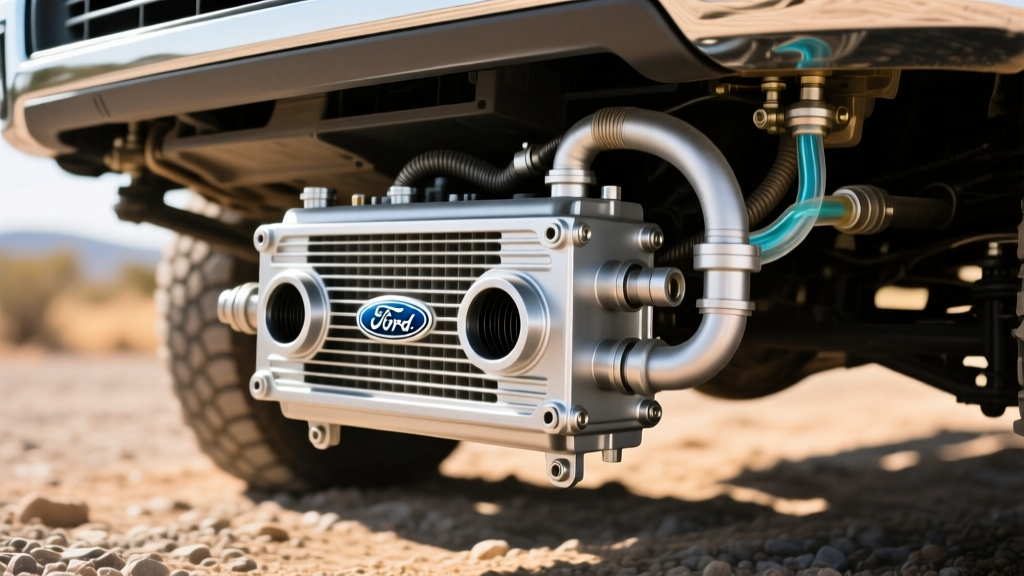
Not all coolers are created equal. For the F-150 platform, you must balance cooling efficiency with airflow restriction to the engine radiator. Tube-and-fin coolers are outdated and prone to internal turbulence. For modern trucks, you must select a stacked-plate or plate-and-fin design. According to Derale Performance, stacked-plate coolers offer the highest heat dissipation per square inch due to their turbulator technology, which forces fluid into a chaotic flow to maximize contact with the aluminum fins.
Recommended Specifications for F-150 Applications
- GVWR Rating: Select a cooler rated for 24,000 to 30,000 lbs GVWR. This provides adequate surface area without causing excessive fluid pressure drop.
- Dimensions: A core size of approximately 11" x 12" x 7/8" (e.g., Derale Series 9000 Plate-Fin, Part #13960 or Hayden Rapid-Cool Part #676) fits perfectly behind the F-150's front bumper beam or lower grille opening.
- Fittings: Ensure the kit includes 1/2" barb fittings or specific quick-disconnect adapters compatible with Ford's 1/2"-20 UNF or 5/8" push-lock cooler lines.
The Routing Debate: Pre-Radiator vs. Post-Radiator
The most common mistake DIYers make when installing an auxiliary Ford F150 transmission cooler is incorrect fluid routing. Ford utilizes a thermal bypass valve in the transmission cooling circuit. This valve remains closed when the fluid is cold, forcing fluid through a small bypass loop to allow the transmission to reach operating temperature quickly. Once the fluid reaches approximately 190°F, the valve opens, sending fluid to the cooler.
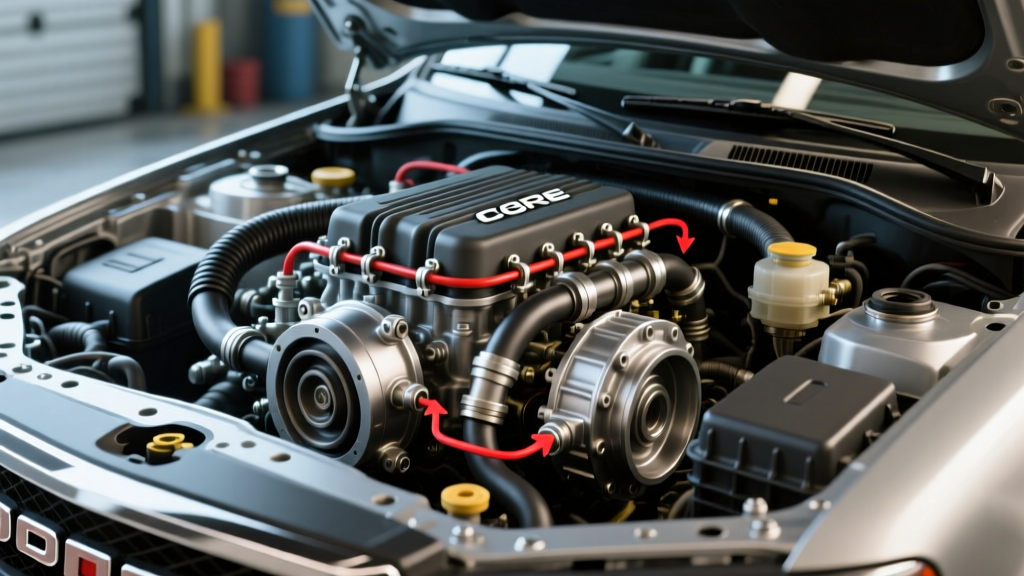
Expert Routing Tip: Always route the auxiliary cooler in series before the factory radiator cooler. The flow should be: Transmission Out -> Auxiliary Cooler -> Factory Radiator Cooler -> Transmission In.
Why? If you route the auxiliary cooler after the radiator, the radiator will heat the transmission fluid up to the engine's thermostat temperature (usually around 195°F-205°F) before it ever reaches the auxiliary cooler, severely limiting the auxiliary cooler's ability to drop temperatures below the engine's operating threshold. By routing it first, the auxiliary cooler does the heavy lifting of shedding tow-generated heat, and the factory radiator acts as a thermal stabilizer, ensuring the fluid returns to the transmission at a consistent, optimal temperature.
Installation and Preventive Maintenance Protocols
Executing the installation with precision ensures no leaks or pressure drops. The 10R80 and 6R80 are highly sensitive to fluid levels and line pressure.
Mounting and Hardware Specs
Mount the cooler using zip-ties and foam pads only as a temporary measure. For a permanent installation, fabricate or purchase an aluminum mounting bracket that bolts to the core support. Use M6x1.0 flange bolts, torqued to 89 lb-in (10 Nm). Ensure there is a minimum of 1/2" of clearance between the cooler fins and the A/C condenser to prevent chafing and allow airflow.
Line Connections and Pressure Testing
Ford uses quick-disconnect fittings on the transmission side of the cooler lines. When reconnecting these lines, you must hear a distinct, audible "click" indicating the internal retaining clips have engaged. After installation, use an OBD2 bi-directional scanner to monitor transmission line pressure at idle and under stall. Line pressure should remain stable between 45-65 PSI at idle. A significant drop indicates an undersized cooler or a crushed hose.
Fluid Top-Off Procedures (10R80 Specific)
The 10R80 does not feature a traditional dipstick; it utilizes a fluid level check plug on the transmission pan. Adding an external cooler requires approximately 1.5 to 2.0 additional quarts of MERCON ULV. To check the level accurately, the transmission must be running, the vehicle perfectly level, and the TFT sensor must read exactly 185°F to 195°F. Remove the check plug; if fluid trickles out in a steady stream, the level is correct. If it pours, it is overfilled. If it drips or stops, add fluid through the fill tube until a steady stream is achieved. Overfilling will cause fluid aeration, leading to erratic shifts and pump cavitation.
Final Thoughts on Drivetrain Preservation
An auxiliary cooler is the most cost-effective insurance policy you can buy for your F-150's transmission. With complete aftermarket kits ranging from $80 to $160, the return on investment is realized the moment you avoid a $4,500 transmission rebuild. By understanding the thermal limits of the 10R80, selecting a high-efficiency stacked-plate design, and adhering to strict routing and fluid-level protocols, you ensure your truck remains capable, reliable, and ready for the heaviest loads the highway can present.