Navigating the 2025 Ford Explorer Drivetrain Options by Trim
As we move through 2026, the used and Certified Pre-Owned market is seeing an influx of 2025 Ford Explorer models. For buyers and technicians alike, understanding the 2025 Ford Explorer drivetrain options by trim is critical, not just for performance expectations, but for long-term reliability and NVH (Noise, Vibration, and Harshness) management. The Explorer’s unibody architecture, paired with Ford’s 10R60 10-speed automatic transmission, creates a highly efficient but complex power delivery system. However, the specific driveshaft configurations vary significantly depending on whether you are looking at a base 2.3L EcoBoost model or a high-output 3.0L ST.
This buyer’s guide and technical manual bridges the gap between trim-level comparisons and deep-dive driveshaft vibration diagnosis. Whether you are evaluating a CPO purchase or diagnosing a customer's complaint of highway shudder, this guide provides the exact specifications, failure modes, and repair matrices you need.
Trim-by-Trim Driveshaft & Drivetrain Specifications
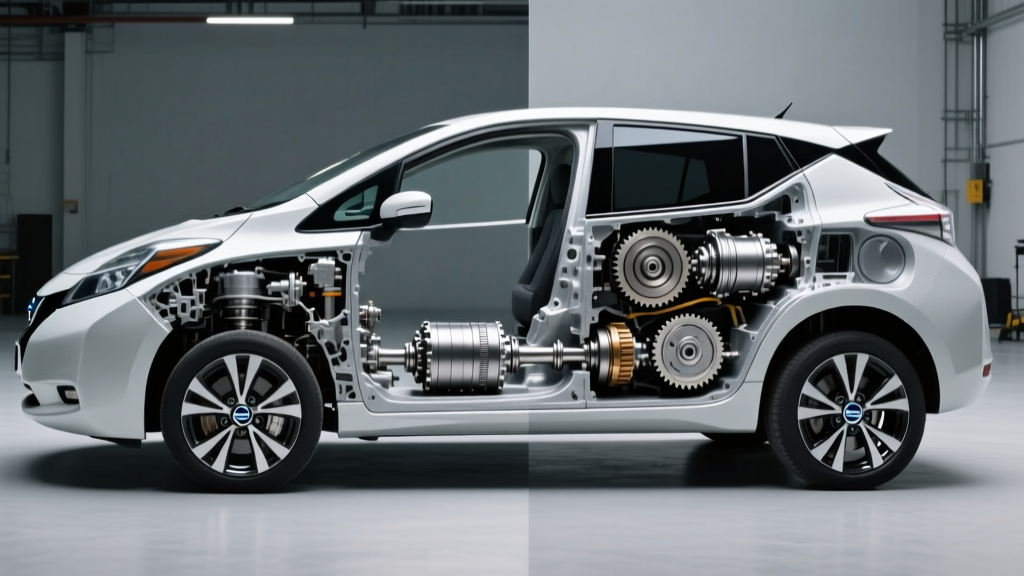
The 2025 Explorer utilizes a front-engine, longitudinal layout (despite being FWD-biased in its base architecture) to accommodate the 10R60 transmission. This necessitates specific driveshaft engineering to manage the distance between the transmission output shaft and the rear differential. Below is a comparison of the drivetrain layouts and driveshaft hardware across the primary trims.
| Trim Level | Engine & Output | Drivetrain Config | Driveshaft Type & Hardware | Common NVH Profile |
|---|---|---|---|---|
| Base / XLT | 2.3L EcoBoost I4 (300 hp) | RWD / Intelligent AWD | 2-Piece Aluminum with CSB; Standard U-Joints | Low-frequency hum at 65+ mph |
| Timberline | 2.3L EcoBoost I4 (300 hp) | Enhanced AWD w/ Rear Locker | 2-Piece Steel/Aluminum Hybrid; Heavy-Duty CV | Take-off clunk due to locker engagement |
| Limited / Platinum | 2.3L or 3.0L V6 (400 hp) | Intelligent AWD | 2-Piece Aluminum; High-Angle Rear CV Joint | Slip-yoke bind on cold take-off |
| ST | 3.0L EcoBoost V6 (400 hp) | Performance AWD | Upgraded 2-Piece; Spicer 1330-equivalent U-Joints | Driveline shudder under WOT (Wide Open Throttle) |
According to the official Ford Explorer lineup specifications, the Intelligent AWD system can route up to 100% of rear-biased torque to the wheels with traction. This aggressive torque vectoring places immense stress on the rear driveshaft CV joints and the center support bearing (CSB), particularly in the heavier Platinum and high-torque ST trims.
Driveshaft Vibration Diagnosis: The 2026 Service Reality
With 2025 models now hitting the 30,000 to 50,000-mile mark in 2026, driveline vibrations are becoming a primary complaint in service bays. Diagnosing these vibrations requires isolating the frequency and the load state. Here is the expert diagnostic framework for Explorer-specific driveline issues.
1. Cold Take-Off Shudder and Slip Yoke Bind
Symptom: A distinct 'clunk' or binding shudder felt in the floorpan when shifting from Reverse to Drive, or during initial acceleration from a stop, especially in cold weather.
Root Cause: The slip yoke, which allows the driveshaft to change length as the rear suspension articulates, suffers from inadequate lubrication or PTFE coating degradation. This is highly prevalent in the Limited and Platinum trims equipped with the high-angle rear CV joint.
Diagnostic & Repair Action:
- Remove the rear driveshaft assembly (Part Number reference: LB5Z-4R602-A for select AWD models).
- Inspect the slip yoke splines for galling or metallic debris.
- Do not use standard lithium grease. You must use Motorcraft PTFE Premium Driveshaft Lubricant (Part No. XL-3). This specific friction modifier is required to prevent the splines from binding under the 10R60's aggressive torque converter lockup.
- Torque Spec: When reinstalling the rear CV joint to the differential flange, torque the M10 stretch bolts to 35 lb-ft plus an additional 90-degree turn. Always use new OEM stretch bolts.
2. 60-75 MPH Resonance: Center Support Bearing (CSB) Failure
Symptom: A cyclic, low-frequency boom or vibration that peaks between 60 and 75 mph, often feeling like driving over rumble strips. It is load-independent (occurs whether accelerating or coasting).
Root Cause: The Explorer's 2-piece driveshaft relies on a rubber-isolated Center Support Bearing. The 10R60 transmission's tendency to keep RPMs low for fuel economy (lugging the engine) sends torsional vibrations through the aluminum shaft, prematurely degrading the CSB rubber isolator.
Diagnostic & Repair Action:
- Use an NVH (Noise, Vibration, and Harshness) accelerometer app or chassis ear. A 1st-order driveshaft vibration at 70 mph with the Explorer's 3.31 rear axle ratio and 255/55R20 tires will manifest at approximately 28-32 Hz.
- Visually inspect the CSB. If the rubber is cracked, separated from the metal sleeve, or if the bearing exhibits axial play greater than 0.010 inches, replacement is mandatory.
- Torque Spec: The CSB bracket-to-crossmember M10 bolts must be torqued to exactly 35 lb-ft (47 Nm). Over-torquing will distort the bearing race; under-torquing will cause the bracket to walk, destroying the U-joint angles.
3. High-Frequency Whine and U-Joint Cap Wear
Symptom: A metallic chirping or high-frequency whine that correlates directly with vehicle speed, often accompanied by a harsh vibration under heavy throttle (especially in the 400-hp ST trim).
Root Cause: The ST trim's launch control and aggressive sport-mode shift mapping subject the U-joints to shock loads that exceed the standard grease viscosity limits, leading to brinelling inside the needle bearings. For deep technical references on U-joint lifecycle under high-torque applications, Spicer Driveshafts engineering documentation highlights that shock-loading drastically reduces the fatigue life of non-greasable OEM joints.
Diagnostic & Repair Action:
- Perform a rotational runout test using a dial indicator mounted on the differential housing. Max allowable runout at the rear of the shaft is 0.030 inches. If runout exceeds this, the shaft is bent and must be replaced as an assembly.
- If the U-joints are failing but the shaft is straight, aftermarket builders like Denny's Driveshafts offer upgraded 1330-series solid-body U-joints that can be pressed into the OEM aluminum yokes, provided the yoke ears are not wallowed out.
Repair Matrix: OEM vs. Aftermarket Costs (2026 Pricing)
When faced with a failed driveshaft assembly or a vibrating CSB, buyers and shop owners must weigh OEM convenience against aftermarket durability. Below is the current market pricing and labor matrix for the 2025 Explorer AWD driveline.
| Component / Service | OEM Ford Parts Cost | Aftermarket / Upgraded Cost | Book Labor Time | Expert Recommendation |
|---|---|---|---|---|
| Complete 2-Piece Driveshaft Assy | $950 - $1,250 | $750 - $900 (Upgraded U-Joints) | 1.8 Hours | Aftermarket (Spicer/Denny's) for ST trims due to better U-joint metallurgy. |
| Center Support Bearing (CSB) | $180 - $220 | $120 - $150 | 2.2 Hours | OEM only. Aftermarket CSB rubber compounds often lack proper harmonic damping. |
| Slip Yoke Service & Lube | $45 (XL-3 Grease + Seals) | N/A | 1.5 Hours | Mandatory use of Motorcraft XL-3 PTFE. |
| Rear Pinion Flange Seal | $35 | $25 | 1.2 Hours | Requires pinion nut torque to 258 lb-ft with holding tool T74P-4851-A. |
Buyer's Verdict: Which Trim's Drivetrain Holds Up Best?
If your primary concern is drivetrain longevity and minimal NVH intervention, the XLT with the 2.3L EcoBoost remains the most robust configuration. The 300 lb-ft of torque is well within the safety margins of the standard U-joints and CSB, and the 10R60 transmission operates with less aggressive shock-loading compared to the ST.
However, if you are buying the Explorer ST or Platinum, budget for a slip-yoke service and CSB inspection at the 40,000-mile mark. The 400 hp and 415 lb-ft of torque generated by the 3.0L V6 will inevitably find the weakest harmonic link in the driveline. By understanding these specific 2025 Ford Explorer drivetrain options by trim, you can negotiate better CPO warranties, anticipate maintenance costs, and eliminate driveline vibrations with precision rather than guesswork.
Pro-Tip for 2026 Buyers: Always request a road test on a smooth, highway-grade surface at exactly 65 mph. If the steering wheel shakes, it is wheel balance or tire conicity. If the seat and floorpan vibrate but the steering wheel remains still, you are feeling a 1st-order rear driveshaft or rear axle resonance. Walk away or demand the CSB and slip yoke be serviced prior to purchase.