The Mechanical Divide: Navigating Modern Drivetrain Configurations
As we navigate the automotive landscape of 2026, the transition from internal combustion engine (ICE) platforms to battery electric vehicles (BEVs) has fundamentally altered how power reaches the pavement. Enthusiasts and daily drivers alike often conflate four-wheel drive (4WD), all-wheel drive (AWD), and front-wheel drive (FWD) EV layouts. Understanding the mechanical distinctions between a traditional mechanical 4WD transfer case, an active electro-hydraulic AWD coupling, and a single-motor EV setup—like the iconic Nissan Leaf drivetrain—is critical for effective preventive maintenance.
This guide dissects these layouts, providing exact fluid capacities, torque specifications, and failure edge cases to keep your vehicle out of the shop and operating at peak efficiency.
4WD vs AWD Differences Explained: The ICE Perspective
To master drivetrain maintenance, you must first understand the hardware. While marketing materials often use the terms interchangeably, the mechanical reality of 4WD versus AWD is vastly different.
Four-Wheel Drive (4WD): Mechanical Locking
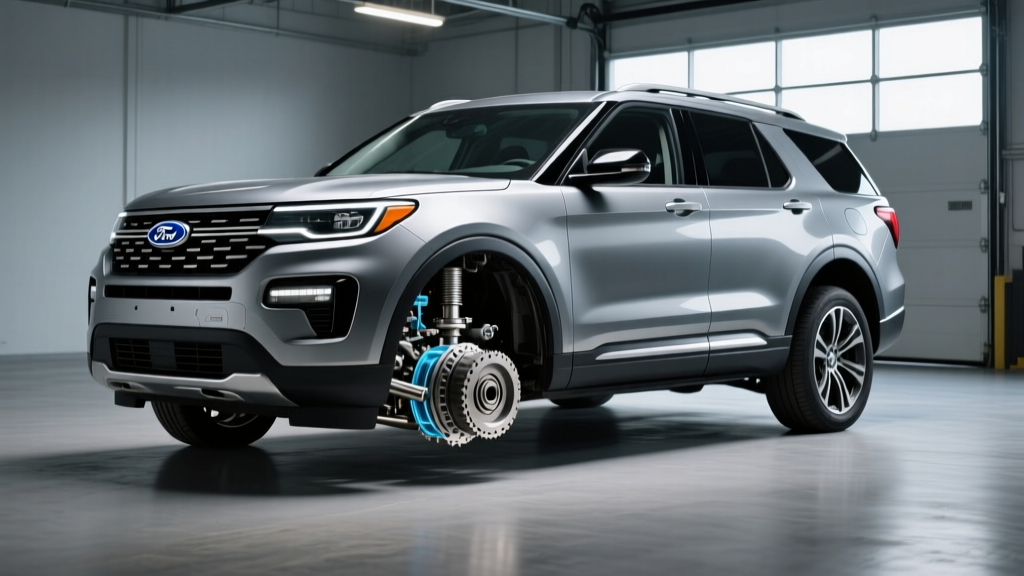
Traditional 4WD systems, found in trucks and off-road SUVs, utilize a transfer case (such as the New Venture NV241OR or BorgWarner BW4493) bolted directly to the transmission output shaft. These systems feature a heavy-duty Morse chain and a planetary gearset that allows the driver to mechanically lock the front and rear driveshafts together in a 50/50 torque split (4-High or 4-Low).
Maintenance Focus: 4WD preventive maintenance centers on the transfer case fluid, the front/rear differential gear oil, and the electronic shift-on-the-fly encoder motor. Neglecting the transfer case fluid leads to chain stretch and planetary gear binding.
All-Wheel Drive (AWD): On-Demand Torque Vectoring
AWD systems are predominantly on-demand. Vehicles utilizing platforms like the Haldex Gen 5 (common in VW, Audi, and Volvo) or BorgWarner Torque-on-Demand systems rely on an electro-hydraulic clutch pack to route torque to the secondary axle only when slip is detected or when predictive algorithms anticipate traction loss.
Maintenance Focus: AWD maintenance is highly sensitive to fluid degradation. The clutch packs generate microscopic metallic and friction material particulates that contaminate the specialized hydraulic fluid, leading to pump cavitation and coupling failure.
The EV Baseline: Inside the Nissan Leaf Drivetrain
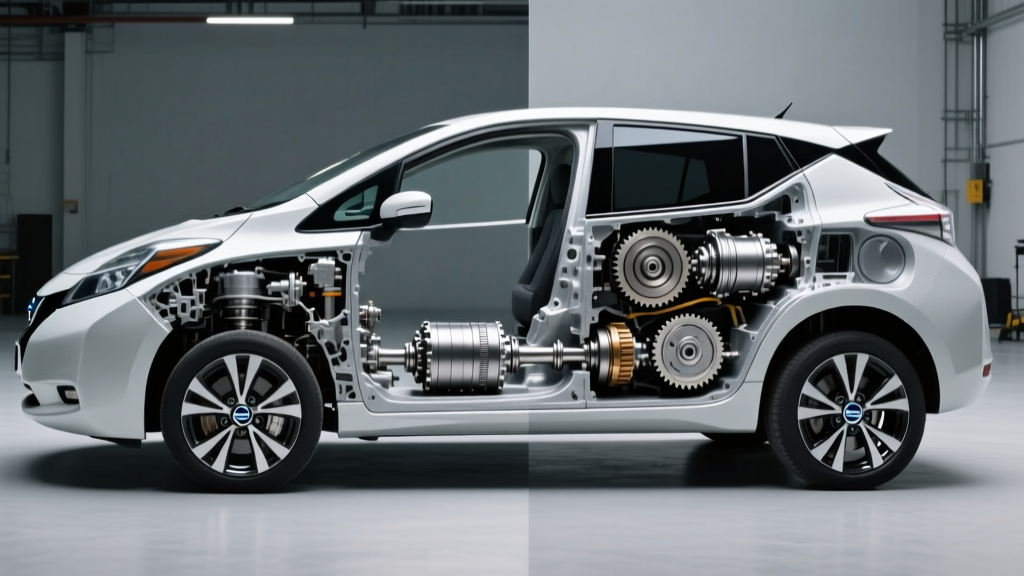
Contrasting these complex ICE systems is the elegant simplicity of the Nissan Leaf drivetrain. The Leaf utilizes a strictly FWD layout powered by a single-speed reduction gear assembly bolted directly to the EM57 (or EM61 in later ZE1 generations) synchronous electric motor. There is no transfer case, no center differential, and no clutch pack.
However, simplicity does not mean maintenance-free. The instantaneous torque delivery of an electric motor (up to 250 lb-ft available at 0 RPM in the e+ models) places immense shear stress on the helical-cut gears inside the reduction housing. Furthermore, the heavy reliance on regenerative braking via the e-Pedal feature subjects the drivetrain to constant directional load reversals, which can accelerate gear lash wear if lubrication is compromised.
According to the Nissan Technical Information System (NIST), the reduction gear requires specific dielectric-compatible lubricants to prevent degradation of the internal motor seals and resolver sensors.
Preventive Maintenance Matrix: 4WD, AWD, and Nissan Leaf
The following table outlines the critical maintenance intervals and specifications for these three distinct drivetrain layouts as of 2026.
| Drivetrain Layout | Component | Fluid Specification | Capacity | Service Interval | Avg. Dealer Cost |
|---|---|---|---|---|---|
| 4WD (e.g., GM BW4493) | Transfer Case | AutoTrak II (GM Spec) | 2.0 Liters | Every 50,000 miles | $120 - $160 |
| AWD (e.g., Haldex Gen 5) | Clutch Coupling | G 060 175 A2 | 0.65 Liters | Every 30,000 miles (with screen clean) | $200 - $280 |
| FWD EV (Nissan Leaf) | Reduction Gear | Nissan EV 75W-80 GL-4 | 2.4 Liters (ZE1) | Inspect at 60k; Replace at 105,000 miles | $90 - $130 |
| FWD EV (Nissan Leaf) | Inverter Coolant | Nissan EV Coolant (Blue) | ~5.5 Liters | Every 100,000 miles | $150 - $190 |
Critical Torque Specifications & Service Procedures
When performing DIY or independent shop maintenance, adhering to exact torque specifications is vital to prevent casing leaks or stripped aluminum threads.
- Nissan Leaf Reducer: The drain and fill plugs are M18x1.5. Nissan mandates a torque spec of 34 Nm (25 lb-ft). Always replace the aluminum crush washers (Part No. 11026-01M02) to prevent weeping.
- Haldex Gen 5 AWD: The drain plug requires 25 Nm (18 lb-ft). Crucially, the pump strainer screen must be removed and cleaned using the specialized Haldex tool (T10175) during every fluid change. Failure to clean the screen will starve the accumulator pump.
- BorgWarner 4WD Transfer Case: Drain and fill plugs are typically torqued to 20 lb-ft. Over-torquing can crack the magnesium or thin-wall aluminum casing.
Common Failure Modes & Edge Cases
Even with rigorous preventive maintenance, specific edge cases plague these systems. Recognizing the early symptoms can save thousands in catastrophic replacements.
4WD: Actuator and Chain Wear
In part-time 4WD systems, the most common failure is not internal gear destruction, but the external shift-on-the-fly encoder motor. Moisture ingress corrodes the internal PCB, leaving the vehicle stuck in 2WD. Internally, if the transfer case fluid is neglected, the Morse chain stretches. This manifests as a rhythmic "clunking" under load or the chain jumping teeth, which will destroy the planetary gearset.
AWD: The Haldex Pump Screen Trap
As documented in Haldex AWD engineering bulletins, the Gen 5 system eliminated the traditional inline filter in favor of a pump-mounted strainer. If owners simply drain and fill the fluid without dropping the pump to clean the strainer, the accumulated clutch material blocks the screen. The system detects low hydraulic pressure, triggers an AWD fault code, and defaults the car to FWD. The $1,200 pump assembly is often misdiagnosed as failed when it merely requires a $15 cleaning.
Nissan Leaf Drivetrain: Bearing Whine and Inverter Thermal Throttling
The Nissan Leaf drivetrain is remarkably robust, but it is not immune to physics. The most reported mechanical issue in high-mileage ZE0 and ZE1 models is reduction gear bearing degradation. Because the electric motor spins up to 10,390 RPM, the input shaft bearings endure extreme rotational speeds. If the 75W-80 GL-4 fluid is contaminated with moisture or sheared down from severe track/taxi use, the bearings develop a high-pitched whine between 40-60 mph.
Additionally, the drivetrain's power output is entirely dependent on the inverter cooling loop. If the electric water pump fails or the Nissan EV Coolant degrades and forms micro-bubbles, the inverter will thermally throttle. The vehicle will limit power to 40kW to protect the IGBT switching modules, a scenario often mistakenly blamed on the battery management system (BMS) rather than the drivetrain cooling circuit.
Final Synthesis for the Modern Garage
Whether you are servicing a heavy-duty 4WD transfer case, flushing a sensitive AWD clutch pack, or draining the reduction gear of a Nissan Leaf drivetrain, the core philosophy of 2026 preventive maintenance remains identical: fluid integrity dictates component longevity. By utilizing the correct dielectric-safe lubricants for EVs and strictly adhering to hydraulic fluid intervals for ICE AWD systems, you eliminate the vast majority of catastrophic drivetrain failures.
For further engineering specifications and OEM service bulletins, technicians should consult the Tremec Transfer Case Engineering Guides and manufacturer-specific EV technical portals.