The Paradigm Shift: Rethinking the Drivetrain in Cars
When evaluating the modern drivetrain in cars, the transition from internal combustion engines (ICE) to electric vehicles (EVs) represents the most significant architectural overhaul in a century. Traditional ICE setups rely on complex multi-speed transmissions, heavy flywheels, and mechanical differentials to manage narrow powerbands. In contrast, the EV drivetrain leverages the instant torque and wide RPM bands of electric motors, fundamentally altering how power is routed to the ground.
As we navigate the 2026 automotive landscape, buyers are no longer just choosing between front-wheel drive (FWD) and rear-wheel drive (RWD). They are selecting between single-motor reduction gearboxes, dual-motor torque-vectoring e-axles, and advanced Silicon Carbide (SiC) inverter integrations. This guide breaks down the technical realities of EV drivetrain layouts, providing the exact specifications, maintenance requirements, and engineering nuances you need to make an informed purchase.
Core EV Drivetrain Layouts: E-Axle Configurations
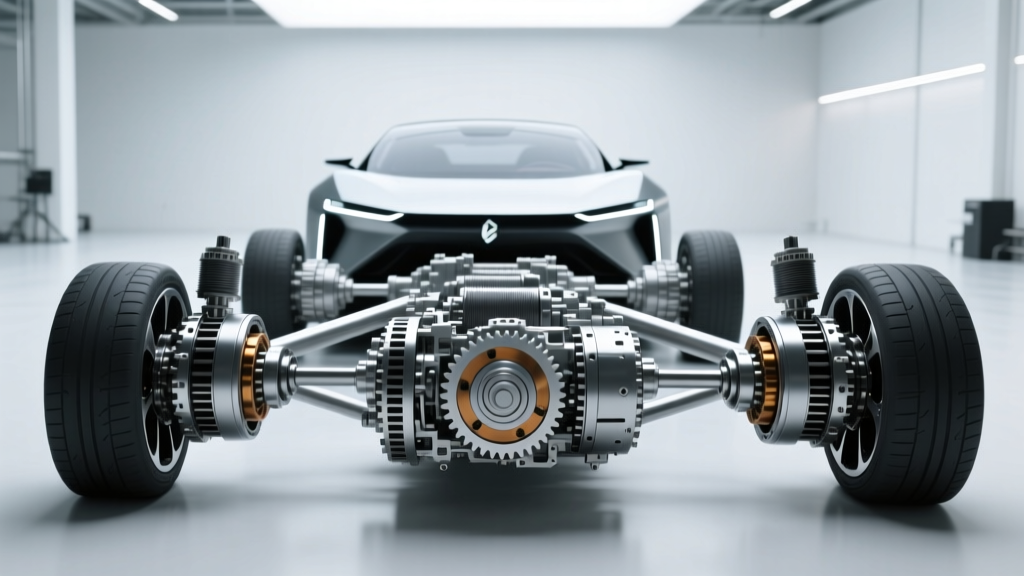
The cornerstone of modern EV architecture is the 'e-axle'—a highly integrated unit combining the electric motor, power inverter, and reduction gearbox into a single, compact housing. This integration reduces weight, minimizes high-voltage cabling, and improves thermal management. Below is a comparison of the dominant e-axle layouts available in 2026.
| Layout Type | Motor Config | Typical Gear Ratio | Efficiency Target | 2026 Platform Examples |
|---|---|---|---|---|
| Rear-Biased Single | 1x Rear e-Axle | 9.0:1 to 10.5:1 | 4.0+ mi/kWh | Tesla Model 3 Highland, Hyundai Ioniq 6 |
| Front-Biased Single | 1x Front e-Axle | 8.5:1 to 9.5:1 | 3.8+ mi/kWh | VW ID.4, Nissan Ariya (FWD) |
| Dual-Motor AWD | Front + Rear e-Axles | Split (e.g., 9:1 / 11:1) | 3.2 - 3.6 mi/kWh | BMW i4 xDrive, Polestar 2 |
| Tri/Quad-Motor | Independent Corner/axle | Variable per axle | 2.5 - 3.0 mi/kWh | Rivian R1T Tri-Motor, Mercedes G-Wagen EV |
The Efficiency Advantage of Disconnect Clutches
For buyers prioritizing range, dual-motor AWD systems equipped with front-axle disconnect clutches are the gold standard in 2026. Platforms like Hyundai's E-GMP and Volkswagen's MEB utilize a mechanical clutch to physically decouple the front motor's rotor from the drivetrain during steady-state highway cruising. This eliminates parasitic drag and electromagnetic cogging, yielding a 5% to 8% improvement in highway range compared to permanently engaged dual-motor setups.
Single-Speed vs. Multi-Speed EV Transmissions
The vast majority of EVs utilize a single-speed reduction gearbox. Because electric motors can safely spin from 0 to 15,000+ RPM while delivering peak torque from zero, a single fixed gear ratio (typically between 8:1 and 11:1) is sufficient to achieve both brisk acceleration and 80+ mph highway cruising.
The Case for Multi-Speed Gearboxes
However, single-speed gearboxes force a compromise between low-end launch acceleration and high-speed efficiency. Enter the multi-speed EV transmission. The most prominent production example remains the Porsche Taycan, which utilizes a 2-speed automatic transmission on the rear axle.
- First Gear: A massive 16:1 ratio designed exclusively for brutal launch control and low-speed hill climbing.
- Second Gear: An 8.05:1 ratio optimized for high-speed cruising and top-speed runs (up to 161 mph).
- Shift Point: The upshift typically occurs around 43 mph, managed by a wet clutch pack that ensures seamless torque handoff.
While ZF has developed a 2-speed transmission specifically for heavy commercial EVs to improve payload efficiency by up to 15%, the added weight, complexity, and $2,500+ replacement cost of multi-speed units have kept them largely confined to the ultra-premium performance segment for passenger cars.
Deep Dive: Inverters, Bearings, and NVH Engineering
Understanding the drivetrain in cars powered by electricity requires looking beyond the gears to the components that manage power and friction.
Silicon Carbide (SiC) Inverters
The inverter converts DC battery power into AC power for the motor. In 2026, the shift from traditional IGBT (Insulated-Gate Bipolar Transistor) chips to Silicon Carbide (SiC) MOSFETs is a major buyer differentiator. SiC inverters reduce switching losses by up to 70%, directly translating to a 3% to 5% increase in overall vehicle range and significantly faster thermal dissipation. When reviewing spec sheets, prioritize vehicles advertising SiC traction inverters.
Bearing Technology and EDM Pitting
EV motors routinely operate at 16,000 to 20,000 RPM (e.g., the Lucid Air motor hits 19,800 RPM). At these speeds, standard steel bearings are susceptible to Electrical Discharge Machining (EDM) pitting, where stray high-frequency currents arc through the bearing lubricant, micro-welding and flaking the steel races. Premium EV drivetrains mitigate this by using ceramic hybrid bearings or insulated bearing housings. If you are buying a used EV out of warranty, a high-pitched whine from the drive unit at 65+ mph is a primary indicator of EDM bearing failure—a $300 part that requires a $4,500 drive unit teardown to replace.
EV Drivetrain Fluids and Thermal Management
Unlike ICE vehicles that use separate engine oil and transmission fluid, many modern e-axles use a single, specialized dielectric fluid to cool the stator, lubricate the bearings, and protect the reduction gears. These fluids must possess high dielectric strength (breakdown voltage >30 kV) and ultra-low viscosity to minimize churning losses at high RPMs.
According to testing standards outlined by SAE International, maintaining the dielectric integrity of EV drivetrain fluids is critical to preventing internal short circuits within the e-axle housing.
Maintenance Specs and Torque Requirements
While often labeled 'lifetime' fluid by manufacturers, severe use (track days, frequent towing, extreme climates) degrades the fluid's dielectric properties. Here are real-world service specifications for popular platforms:
- Tesla Model 3/Y Rear Drive Unit: Capacity is approximately 2.4 Liters. OEM fluid is typically Pentosin ETF. The drain and fill plugs require a 10mm Allen bit. Torque Spec: 25 Nm (18.5 lb-ft) for the drain plug, 35 Nm (25.8 lb-ft) for the fill plug.
- Hyundai E-GMP (Ioniq 5/6): Utilizes an oil-cooled stator design requiring specialized low-viscosity EV gear oil (e.g., SK Eni EV Fluid). Capacity varies by axle but averages 3.0 to 3.5 Liters. Torque Spec: 28 Nm (20.6 lb-ft) on standard drain bolts.
Expect to pay between $150 and $250 for a professional e-axle fluid service, a fraction of the $5,500 to $8,500 cost of a complete out-of-warranty e-axle replacement.
2026 Buyer's Checklist: Evaluating the EV Drivetrain
When shopping for your next electric vehicle, use this technical checklist to evaluate the drivetrain's long-term viability and performance:
- Verify Inverter Tech: Confirm the vehicle uses SiC inverters for optimal efficiency and thermal headroom.
- Check for AWD Disconnects: If buying a dual-motor AWD, ensure the secondary axle features a mechanical disconnect clutch to preserve highway range.
- Review Cooling Architecture: Prefer e-axles with direct oil-to-stator cooling over water-jacket-only cooling, especially if you plan on repeated hard acceleration or towing.
- Understand the Warranty Nuance: Federal law mandates an 8-year/100,000-mile warranty on EV batteries, but the U.S. Department of Energy notes that e-axles and reduction gearboxes are sometimes classified under the standard 5-year/60,000-mile powertrain warranty depending on the manufacturer. Always read the fine print regarding drive unit coverage.
- NVH Testing: During the test drive, turn off the audio system and roll down the windows at 40 mph. Listen for high-frequency whining from the reduction gears. While some whine is normal, aggressive howling indicates poor helical gear cut tolerances or premature bearing wear.
Final Verdict
The EV drivetrain is a masterpiece of packaging and electromechanical integration. While it lacks the mechanical symphony of a ZF 8-speed automatic or the shifting drama of a dual-clutch transmission, the instant torque delivery, SiC-enhanced efficiency, and torque-vectoring capabilities of modern e-axles offer a superior daily driving experience. By understanding the underlying architecture—from gear ratios to dielectric fluid specs—buyers in 2026 can look past the marketing jargon and select an EV drivetrain that perfectly aligns with their performance and longevity requirements.