The Paradigm Shift: Redefining the Drivetrain
If you have ever researched traditional car drivetrain types explained by automotive engineers, you are likely familiar with the intricate dance of internal combustion engines, multi-speed transmissions, heavy steel driveshafts, and mechanical differentials. In 2026, the electric vehicle (EV) market has fundamentally rewritten these rules. The modern EV replaces dozens of heavy, friction-prone mechanical components with the 'e-axle'—a highly integrated, compact unit housing the electric motor, power inverter, and a single- or two-speed reduction gearbox.
For buyers navigating the 2026 EV landscape, understanding these configurations is no longer just about performance; it is about efficiency, tire wear, thermal management, and long-term maintenance costs. This guide breaks down the dominant EV drivetrain layouts, providing the technical depth and real-world data you need to make an informed purchase.
Core EV Drivetrain Configurations
Unlike ICE vehicles where the engine is almost always mounted longitudinally or transversely at the front, EV skateboard architectures allow motors to be placed precisely where they are needed. Here is how the primary layouts compare.
1. Single-Motor Front-Wheel Drive (FWD)
Once considered the domain of budget compacts, FWD EV layouts have evolved into highly efficient platforms for mass-market crossovers. By placing the e-axle over the front wheels, manufacturers maximize interior cabin space and optimize aerodynamics by eliminating rear subframe drag.
- Typical Applications: Chevrolet Equinox EV (FWD trims), Nissan Ariya (Venture+), Volvo EX30 (Single Motor).
- Technical Edge: Regenerative braking efficiency is maximized on the front axle, which handles up to 70% of a vehicle's braking load during deceleration.
- Buyer Caveat: Front tires bear the brunt of both steering and instant electric torque (often 250+ lb-ft), leading to accelerated front tire wear if not rotated every 5,000 miles.
2. Single-Motor Rear-Wheel Drive (RWD)
RWD remains the gold standard for driving dynamics and launch efficiency. Because weight transfers to the rear during acceleration, a rear-mounted e-axle provides superior traction without the torque-steer inherent in high-output FWD setups.
- Typical Applications: Tesla Model 3 (Long Range RWD), Ford Mustang Mach-E (Select RWD), Hyundai Ioniq 5 (Standard Range).
- Technical Edge: Allows for a tighter turning radius. The Tesla Model 3 RWD, for instance, utilizes a rear drive unit with a 9.73:1 reduction ratio, delivering immediate response without the parasitic loss of a front motor.
- Buyer Caveat: In severe winter conditions, RWD EVs require high-quality winter tires to compensate for the lack of a front-driven axle, as traction control can only cut power, not redirect it.
3. Dual-Motor All-Wheel Drive (AWD)
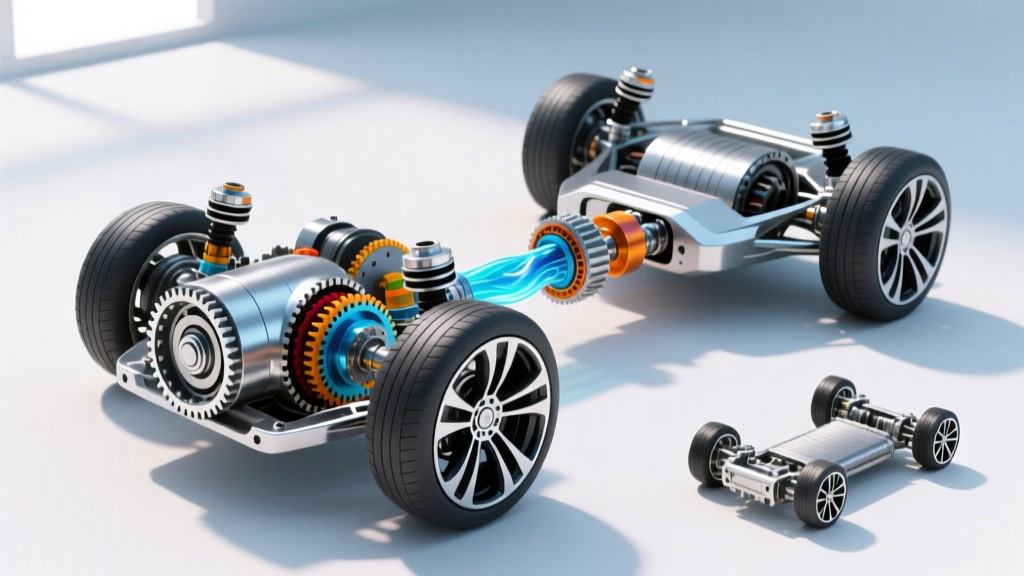
The dual-motor AWD layout is the most popular premium configuration in 2026. It utilizes independent front and rear e-axles. Crucially, there is no mechanical connection (driveshaft) between the axles; torque distribution is managed entirely via software and the respective inverters.
- Typical Applications: Tesla Model Y, BMW iX, Kia EV6 AWD.
- Technical Edge: Modern systems can disconnect the front motor via a clutch or simply cease sending current to the stator windings during highway cruising to reduce drag and boost range by 5-8%.
- Buyer Caveat: Dual-motor setups add 150-250 lbs of unsprung and sprung mass, slightly reducing ultimate cornering agility compared to RWD counterparts.
4. Tri-Motor and Quad-Motor Torque Vectoring
Reserved for hypercars, luxury flagships, and off-road trucks, these layouts offer true, independent wheel torque vectoring. By utilizing two rear motors (or four individual wheel-end motors), the vehicle can overdrive the outside wheels in a corner, creating a yaw moment that defies the vehicle's physical weight.
- Typical Applications: Tesla Model S Plaid (Tri-Motor), Rivian R1T/R1S (Quad-Motor), Mercedes-Benz G580 with EQ Technology (Quad-Motor).
- Technical Edge: The Rivian quad-motor system generates over 1,000 lb-ft of torque, with individual wheel-end gearboxes allowing for 360-degree tank turns. According to the U.S. EPA Green Vehicles database, these systems require advanced thermal management to prevent motor derating during sustained high-load scenarios.
2026 EV Drivetrain Comparison Chart
Use the table below to match drivetrain layouts with your specific driving profile and budget.
| Layout | Motor Count | Typical Efficiency (mi/kWh) | 0-60 mph Range | Drivetrain Maintenance Complexity | Best Use Case |
|---|---|---|---|---|---|
| FWD | 1 (Front) | 3.2 - 4.1 | 7.5 - 9.0 sec | Low (1 Reduction Gear, 2 CV Axles) | Urban commuting, budget-conscious buyers |
| RWD | 1 (Rear) | 3.0 - 3.9 | 5.0 - 7.5 sec | Low (1 Reduction Gear, 2 CV Axles) | Enthusiasts, highway cruising, mild climates |
| AWD | 2 (F/R) | 2.6 - 3.4 | 3.5 - 5.5 sec | Medium (2 Reduction Gears, 4 CV Axles) | All-weather capability, family hauling |
| Tri/Quad | 3 or 4 | 2.0 - 2.8 | 1.9 - 3.5 sec | High (Multiple Gearboxes, Complex Cooling) | Performance, heavy towing, extreme off-road |
Technical Deep Dive: The E-Axle and Reduction Gearbox
When the U.S. Department of Energy outlines EV architecture, the reduction gearbox is highlighted as a critical efficiency bottleneck. Unlike a traditional ZF 8-speed or GM 10-speed automatic transmission, most EVs use a single-speed helical gear reduction unit.
Gear Ratios and NVH Engineering
Electric motors operate efficiently at up to 20,000 RPM, but wheels turn at a maximum of 1,200 RPM at highway speeds. To bridge this gap, reduction gearboxes utilize steep ratios. For example, the Hyundai Ioniq 5 AWD uses a front reduction ratio of 4.706:1 and a rear ratio of 4.706:1, while high-performance setups like the Porsche Taycan utilize a two-speed transmission on the rear axle (8.05:1 for first gear launch, 16:1 equivalent for top speed efficiency) to balance brutal acceleration with high-speed range.
Expert Note: The primary failure point in early EV reduction gears was not the gears themselves, but the high-speed bearings. Whining or humming noises at 65+ mph often indicate bearing wear caused by inadequate early-generation EV thermal fluids. Modern 2026 models utilize dedicated EV fluids (like Castrol ON or Pentosin ATF 9) engineered with high dielectric strength to protect copper windings and withstand the extreme RPMs of the pinion shaft.
Maintenance Realities: What Buyers Must Budget For
While EVs eliminate oil changes, spark plugs, and timing belts, the drivetrain is not entirely maintenance-free. Here is what you need to know about long-term ownership costs:
- Reduction Gear Fluid Exchanges: Many manufacturers claim 'lifetime' fluid. As a senior drivetrain technician, I strongly advise draining and filling the reduction gear fluid every 60,000 to 80,000 miles. The fluid degrades from sheer stress and microscopic metal particulates. Cost: $150 - $250 per axle.
- CV Joints and Half-Shafts: Instant torque is brutal on Constant Velocity (CV) joints. A standard ICE CV joint is rated for roughly 250 lb-ft of continuous load. EV half-shafts use reinforced tripod or ball-type CV joints to handle 400+ lb-ft. If you hear a rhythmic 'clicking' on tight, full-lock turns, a CV joint is failing. Replacement Cost: $400 - $800 per axle.
- Drive Unit (e-Axle) Replacement: If the internal inverter fails or the motor windings short out, the entire sealed e-axle is usually replaced as a single unit. Cost: $3,500 to $7,500 out of warranty. Always verify the status of the manufacturer's 8-year/100,000-mile federal drivetrain warranty before purchasing a used EV.
2026 Buyer's Tip: When test-driving a used EV, perform a hard acceleration run from 30 mph to 60 mph, then abruptly lift off the accelerator to engage maximum regenerative braking. Listen closely for clunks or high-pitched whining from the e-axles. Excessive backlash in the reduction gears is a sign of severe wear and an impending $5,000 repair bill.
Final Verdict: Choosing Your Layout
The 'best' EV drivetrain layout is entirely dependent on your geographic location and driving habits. If you live in a temperate climate and prioritize maximum range per dollar, a single-motor RWD or FWD platform is mathematically superior. However, if you navigate snowy mountain passes or require maximum towing stability, the software-defined torque distribution of a Dual-Motor AWD system is an indispensable safety and performance upgrade. By understanding the mechanical realities behind these layouts, you can confidently select an EV that aligns with both your driving passions and your long-term financial goals.