Heavy-Duty Drivetrain Actuation: The Eaton Fuller System
In the realm of Class 8 heavy-duty trucks and severe-service vocational vehicles, the manual transmission remains a benchmark for durability and driver control. The Eaton Fuller 10, 13, and 18-speed manual transmissions rely on a robust, externally accessible clutch actuation mechanism. At the heart of this system is the Eaton clutch fork and the throw-out bearing (release bearing) assembly. When drivetrain anomalies arise, differentiating between a failing throw-out bearing and a worn clutch fork is critical for accurate diagnostics, preventing unnecessary transmission teardowns, and avoiding catastrophic bellhousing damage.
As of 2026, while automated manual transmissions (AMTs) like the Eaton Endurant have captured significant market share, thousands of legacy and purpose-built manual Eaton Fuller units remain in active fleet service. Understanding the acoustic signatures and mechanical wear patterns of these specific components is a mandatory skill for heavy-duty drivetrain technicians.
Acoustic Diagnostics: Isolating the Noise Source
Throw-out bearing noise and clutch fork clatter are frequently misdiagnosed because both originate from the bellhousing. However, their acoustic profiles and correlations to pedal position are distinctly different.
The "Pedal-Depressed" Squeal and Growl
A throw-out bearing operates under extreme axial load only when the clutch pedal is depressed. If you hear a high-pitched squeal, metallic growl, or low-frequency rumble that begins or worsens as the clutch pedal is pushed toward the firewall, the throw-out bearing is the primary suspect. The bearing's internal raceways and rolling elements are experiencing friction due to depleted grease, spalling, or cage failure. Once the pedal is released and the bearing unloads, the noise typically vanishes or reduces to a faint whisper.
The "Idle Rattle" and Metallic Clunk
Conversely, an Eaton clutch fork noise presents differently. A worn clutch fork, degraded cross-shaft bushings, or a galled pivot ball will produce a metallic clatter, rattle, or "clunk" when the clutch pedal is fully released (at idle in neutral). This occurs because the release bearing is not under axial load, allowing the fork to vibrate sympathetically with the engine's torsional harmonics. When you lightly rest your foot on the clutch pedal (taking up the free-play), the fork is tensioned against the pivot ball, and the rattling noise immediately ceases. If the noise persists even with light pedal pressure, the fork pads or the bearing carrier snap-ring may be compromised.
Master Technician Tip: Use a mechanic's stethoscope with a long steel probe. Place the probe on the clutch housing inspection cover or the bellhousing near the cross-shaft pivot. Have an assistant pump the clutch pedal. A scraping or grinding vibration transmitted through the steel probe during pedal depression confirms bearing failure, while a loose "ticking" vibration at idle points to fork and pivot wear.
Eaton Component Wear Limits and Part Reference
Precision measurement is non-negotiable when servicing heavy-duty clutch systems. Reusing a marginally worn Eaton clutch fork will lead to premature throw-out bearing failure and uneven pressure plate wear. Below is the definitive diagnostic matrix for Eaton Fuller heavy-duty applications.
| Component | Eaton / OEM Part Reference | Inspection Point | Service Limit / Replacement Threshold |
|---|---|---|---|
| Clutch Fork (Standard HD) | K-3466 / K-2518 | Fork Pad Thickness | Replace if worn below 0.250" (6.35mm) |
| Clutch Fork Pivot Ball | K-2815 | Spherical Surface Galling | Replace if any pitting, scoring, or flat spots are visible |
| Throw-Out Bearing (Carrier) | K-3459 / K-2824 | Axial Free-play & Raceway Smoothness | Zero tolerance for rough rotation or lateral wobble |
| Cross-Shaft Bushings | Various (Bronze/Composite) | Radial Clearance on Shaft | Replace if radial play exceeds 0.015" (0.38mm) |
Precision Measurement and Teardown Protocol
When the bellhousing is removed, the Eaton clutch fork must be evaluated using calibrated measurement tools, not just visual inspection.
1. Fork Pad and Slide Surface Evaluation
The fork pads that interface with the throw-out bearing carrier are subject to immense friction and heat. Using an outside micrometer, measure the thickness of both fork pads. Heat checking (micro-cracks on the surface) and asymmetric wear patterns indicate that the fork was operating at an angle, usually caused by a worn cross-shaft or misaligned bellhousing. According to Eaton Vehicle Group technical guidelines, any visible gouging or depth wear exceeding 0.060" on the slide surface mandates immediate fork replacement.
2. Pivot Ball and Socket Inspection
The pivot ball acts as the fulcrum for the clutch fork. Over hundreds of thousands of miles, the spherical surface can develop flat spots or severe galling. Run your fingernail across the pivot ball; if it catches on grooves, the socket inside the clutch fork is likely scored as well. In 2026, many fleet maintenance facilities are upgrading to heavy-duty ceramic-coated or hardened steel pivot balls to resist the extreme shear forces generated by high-torque diesel engines (e.g., Cummins X15 or Detroit DD15).
3. Throw-Out Bearing Carrier and Snap-Rings
Inspect the bearing carrier's engagement grooves. The Eaton clutch fork snaps into these grooves to pull the bearing back when the clutch is engaged. If the snap-rings are stretched or the carrier ears are rounded off, the fork will disengage under heavy RPM shifts, causing severe grinding and potential fork ejection.
2026 Installation Standards and Torque Specifications
Proper installation of the clutch fork, cross-shaft, and bellhousing is critical to maintaining the concentricity of the throw-out bearing relative to the transmission input shaft. Misalignment by as little as 0.010" can cause the bearing to cock on the bearing retainer collar, leading to catastrophic failure within 5,000 miles.
- Clutch Housing (Bellhousing) to Engine Block: 100 - 120 lb-ft (Verify thread size; typically 1/2"-13 UNC bolts). Always use a dial indicator to check bellhousing runout. Maximum allowable runout is 0.006".
- Cross-Shaft to Fork Pinch Bolt: 35 - 45 lb-ft. Apply medium-strength threadlocker (e.g., Loctite 243) to prevent vibration-induced backing out.
- External Clutch Lever to Cross-Shaft: 45 - 55 lb-ft. Ensure the master cylinder pushrod has exactly 1/8" to 1/4" of free-play before contacting the lever to prevent constant bearing load.
- Lubrication: The pivot ball and fork pads must be lubricated with a high-temperature, high-pressure grease. As recommended by heavy-duty bearing manufacturers like SKF Commercial Bearings, use an NLGI Grade 2 Lithium Complex grease with Molybdenum Disulfide (Moly) additives. Do not over-grease the pivot; excess grease will sling onto the clutch friction disc, causing severe clutch slip and chatter.
Sourcing and Replacement Economics
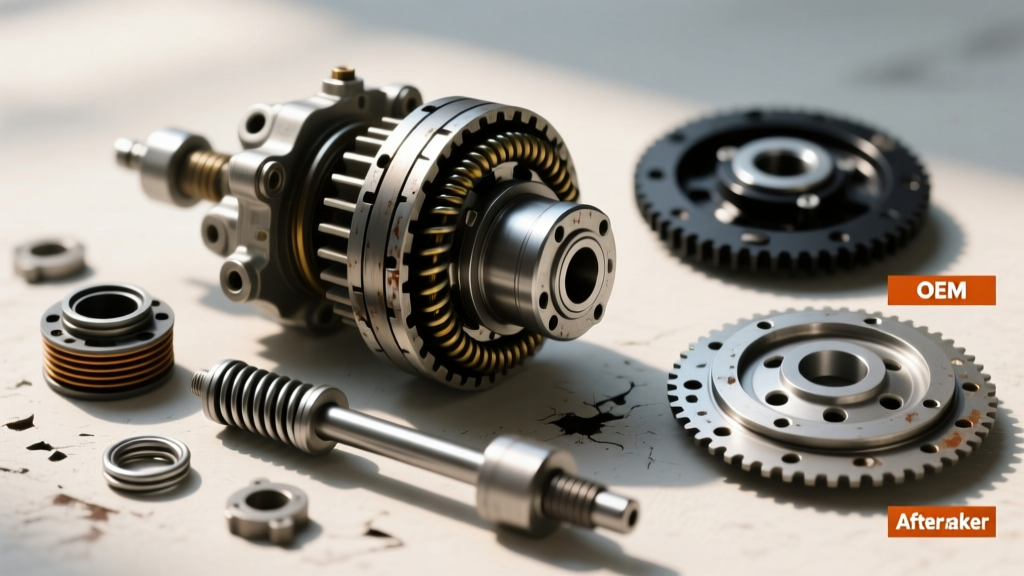
The commercial vehicle parts market in 2026 has seen a stabilization in supply chains, but counterfeit and out-of-spec aftermarket drivetrain components remain a threat to fleet uptime. When sourcing an Eaton clutch fork or throw-out bearing assembly, technicians must weigh the cost of OEM versus aftermarket alternatives.
An OEM Eaton heavy-duty clutch fork (e.g., K-3466) typically retails between $145 and $190, while a matched OEM throw-out bearing assembly ranges from $220 to $310. Aftermarket alternatives may be priced 30% to 40% lower, but they frequently suffer from inferior metallurgical hardening on the fork pads and substandard bearing seals that fail under the high-heat environment of a modern diesel bellhousing. Given that the labor to drop a heavy-duty transmission and bellhousing averages 8 to 12 hours at heavy-truck shop rates ($150-$200/hr), saving $80 on an inferior clutch fork is a false economy that guarantees a premature return to the bay.
For comprehensive service manuals, torque specs, and legacy Roadranger documentation, fleet managers should consult the Eaton commercial vehicle resource center or authorized heavy-duty transmission distributors to ensure exact model-match fitment for their specific Class 8 application.
Summary: The Diagnostic Decision Framework
Diagnosing throw-out bearing noise versus Eaton clutch fork failure requires a systematic approach: correlate the noise to pedal load, isolate the vibration with acoustic tools, and verify component wear with precision micrometers. By adhering to strict OEM torque specifications, utilizing high-temperature moly-fortified lubricants, and refusing to compromise on component quality, drivetrain specialists can ensure these vital manual transmission systems deliver another million miles of reliable, shift-perfect service.