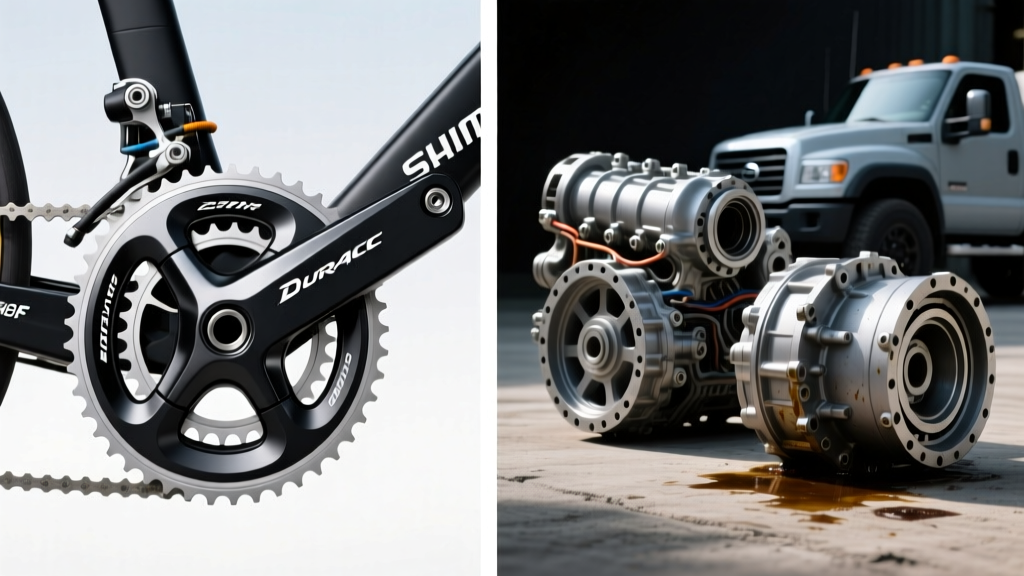
When discussing the pinnacle of mechanical efficiency, the Shimano Dura Ace drivetrain represents the absolute zenith of bicycle engineering. With its Di2 electronic shifting, titanium hardware, and microscopic tolerance stacking, it operates in a realm of ultra-lightweight precision. However, as we evaluate the 2026 landscape of heavy-duty truck and SUV platforms, automotive engineers face a vastly different mandate. Instead of shedding grams and optimizing for 250 watts of human power output, truck drivetrains must manage 1,000+ lb-ft of engine torque, tow 20,000-pound payloads, and survive catastrophic thermal loads. Yet, the fundamental principles of metallurgy, friction management, and preventative maintenance bridge the gap between these two extremes. By contrasting the micro-precision of high-end cycling groupsets with the macro-durability of heavy-duty automotive components, we can extract expert-level best practices for maintaining your truck or SUV's drivetrain.
The Engineering Dichotomy: Micro-Precision vs. Macro-Durability
A high-end bicycle groupset relies on ceramic bearings, carbon fiber derailleurs, and chains treated with sub-micron wax coatings to eliminate friction. The tolerances are measured in fractions of a millimeter. In contrast, heavy-duty truck and SUV drivetrain components are built around brute-force metallurgy. We are talking about forged steel, sintered iron clutch packs, and hypoid gear sets designed to endure immense shear forces. Where a bicycle chain might snap at 3,000 Newtons of tension, a Spicer 1350 U-joint in a lifted SUV must withstand over 2,500 lb-ft of torque without the bearing caps walking out of the yoke. The lesson here is not that one is superior, but that the maintenance philosophy must shift from 'clean and replace' to 'lubricate, torque, and monitor.'
Core Truck & SUV Drivetrain Components: Built for Brute Force
To understand best practices, we must dissect the primary load-bearing components of modern heavy-duty platforms.
Transmissions: The ZF 8HP and Allison 10L1000
In the half-ton SUV and light-duty truck segment, the ZF 8HP series (such as the 8HP75 found in Ram 1500s and various European SUVs) dominates. Its mechatronic unit integrates the valve body and TCM into a single oil-immersed module. The critical vulnerability here is the plastic mechatronic sleeve. Over time, heat and vibration cause the O-rings to degrade, leading to fluid leaks into the bell housing. Expert tip: Replace the sleeve (Part #68303523AA for Chrysler applications) every 80,000 miles, alongside a ZF LifeguardFluid 8 service.
Conversely, GM HD trucks utilize the Allison Transmission 10L1000. This 10-speed beast requires Mobil Delvac 1 ATF or an approved TES 668 equivalent. A common mistake is treating it like a standard passenger car transmission. The 10L1000 features a deep pan with an internal filter that is often neglected during 'drain and fill' services. A proper service requires dropping the pan, replacing the internal filter, and swapping the external spin-on filter to prevent clutch pack starvation during heavy towing.
Axles & Differentials: Dana 60 and AAM 11.5
The front axle of choice for heavy-duty 4x4s remains the Dana 60 (and its Super 60 variant). Unlike the delicate pawls in a bicycle freehub, the Dana 60 utilizes massive 35-spline inner axle shafts and a forged steel ring gear. When servicing the differential, the ring gear bolts must be torqued to exactly 125 lb-ft with a medium-strength threadlocker. The pinion nut requires upwards of 250-300 lb-ft to achieve proper bearing preload. If you are rebuilding a high-mileage Dana 60, upgrading to a Spicer SPL series U-joint at the axle yokes is a mandatory best practice to handle the torque multiplication of modern diesel engines.
In the rear, the AAM (American Axle & Manufacturing) 11.5-inch ring gear axle is standard on GM 2500/3500 trucks. This axle is notorious for consuming gear oil if the pinion seal is compromised by driveshaft harmonic vibration. Installing an aftermarket support bearing or a balanced aluminum driveshaft mitigates this wear pattern.
Driveshafts: U-Joints vs. CV Joints in IFS Setups
Modern independent front suspension (IFS) trucks and SUVs rely heavily on Constant Velocity (CV) joints rather than traditional U-joints for the front axle shafts. While a Spicer U-joint can handle extreme angular misalignment at low speeds, it induces cyclic vibrations at high speeds. CV joints solve this by maintaining constant rotational velocity. However, the rubber or thermoplastic CV boots are highly susceptible to tearing from debris, road salt, and heat cycling. Once a boot tears, the molybdenum disulfide grease is expelled, and water infiltrates the bearing cage. Expert best practice: Inspect CV boots every 15,000 miles. If you catch a torn boot early, a $40 boot kit and a thorough cleaning can save you from replacing a $1,200 complete axle assembly. For lifted trucks operating at steep driveline angles, upgrading to high-angle CV joints or converting to a solid front axle with 1410-series U-joints is the only reliable path to durability.
Specification & Torque Matrix
| Component | Model / Variant | Fluid / Capacity | Critical Torque Spec | Common Failure Mode |
|---|---|---|---|---|
| Transmission | ZF 8HP75 | ZF Lifeguard 8 (approx. 5.5L service fill) | Pan bolts: 8 Nm (6 lb-ft) | Mechatronic sleeve O-ring leak |
| Transmission | Allison 10L1000 | TES 668 ATF (10.6 qt dry fill) | Deep pan bolts: 24 lb-ft | Internal filter starvation during heavy towing |
| Front Axle | Dana Super 60 | 75W-140 Synthetic (approx. 3.5 pints) | Ring Gear Bolts: 125 lb-ft | Kingpin/Ball joint wear from oversized tires |
| Driveshaft | Spicer 1350 U-Joint | Mobilith SHC 220 Grease | Strap Bolts: 35 lb-ft | Cap walk and needle bearing brinelling |
What Truck Owners Can Learn from Bicycle Drivetrain Maintenance
While a Shimano Dura Ace drivetrain and a Dana 60 axle operate on opposite ends of the mechanical spectrum, the discipline required to maintain them is identical. High-end cyclists know that a single grain of sand in a derailleur pulley can ruin a race. Truck owners must adopt this same paranoia regarding contamination.
Contamination Control in Transfer Cases
Your transfer case (such as the BorgWarner 4493 or NP261HD) is essentially a massive, oil-bathed gearbox. When changing the fluid—typically an ATF like Dexron VI or Transfer Case Fluid LV—never use a pump that has previously been used for gear oil or hydraulic fluid. Cross-contamination of friction modifiers will cause the clutch packs in the transfer case to chatter or slip, leading to a $3,000 replacement bill. Furthermore, ensure the fill plug is removed before the drain plug. This golden rule of drivetrain maintenance saves you from being stranded with an empty transfer case and a stuck fill plug.
The Needle-Grease Adapter Technique
Most truck owners use a standard grease gun on U-joint zerks, which often results in blowing out the cap seals or failing to seat the grease into the needle bearings. Take a page from the precision lubrication world: use a needle-nose grease adapter. Insert the needle directly between the U-joint cap and the yoke ear, injecting synthetic grease until you see the old, contaminated grease purge from all four cap seals. This ensures the needle bearings are fully coated and pushes out abrasive metal particulates before they can cause brinelling.
Final Thoughts on Drivetrain Longevity
Whether you are tuning the electronic shifting of a racing bicycle or towing a 15,000-pound fifth-wheel with a 2026 heavy-duty diesel, the laws of physics remain undefeated. Friction, heat, and shear stress will eventually dismantle poorly maintained components. By applying meticulous, expert-level maintenance routines to your truck or SUV's drivetrain—respecting torque specs, utilizing exact fluid formulations, and preventing contamination—you ensure that your heavy-duty platform delivers power to the pavement as reliably and efficiently as the finest precision machinery on earth.