If you have ever sat in a dealership service lounge trying to decipher a repair estimate, you have likely encountered the terms powertrain and drivetrain. For beginners, these terms are often used interchangeably by casual enthusiasts, but in the automotive engineering world, they represent two distinct systems. As we navigate the increasingly complex vehicle architectures of 2026, understanding the boundary between these two systems is critical—especially when it comes to front-wheel-drive (FWD) vehicles and the elusive fwd differential.
Does your powertrain warranty cover a whining differential? If your transaxle is leaking, is that a drivetrain or powertrain failure? In this beginner-friendly explainer, we will break down the exact definitions, explore how the FWD differential blurs the traditional lines, and provide you with hard data on maintenance, torque specs, and repair costs.
The Core Debate: Powertrain vs. Drivetrain Defined
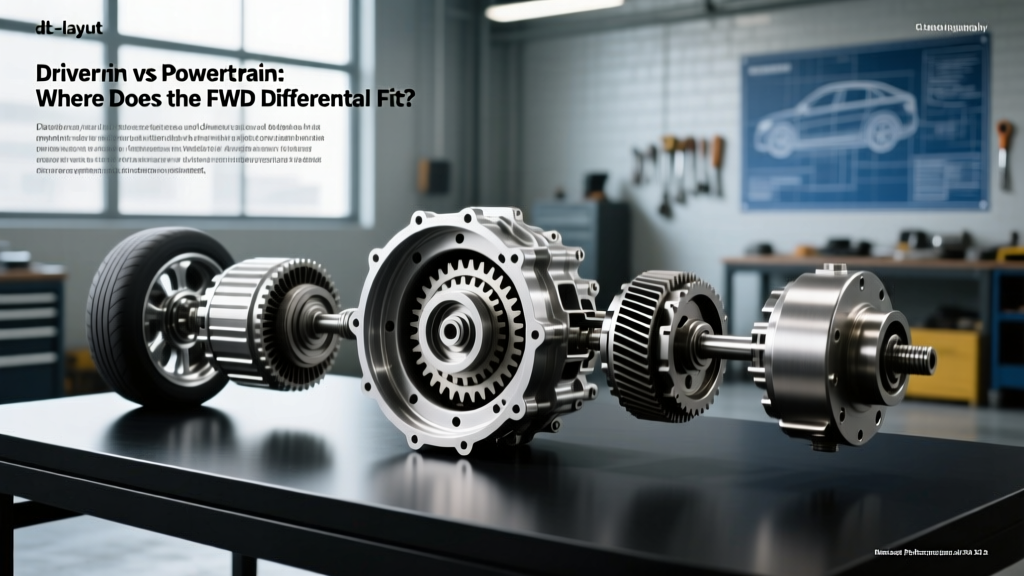
To understand the difference, it helps to use a simple analogy: the powertrain is the power plant, and the drivetrain is the delivery fleet.
- The Powertrain: This encompasses every component responsible for generating power and converting it into mechanical rotation. It includes the engine (or electric motors in EVs), the torque converter, and the transmission (or transaxle). If a component creates or multiplies torque, it is part of the powertrain.
- The Drivetrain: This includes every component responsible for delivering that rotational power from the transmission to the drive wheels. It includes driveshafts, CV axles, U-joints, wheel hubs, and the differential.
In a traditional Rear-Wheel Drive (RWD) vehicle like a Ford Mustang or a Chevrolet Silverado, the boundary is physically obvious. The powertrain ends at the back of the transmission. A long metal driveshaft (drivetrain) carries the power to the rear axle housing, which contains the rear differential (drivetrain).
The FWD Differential: The Ultimate Boundary Blurrer
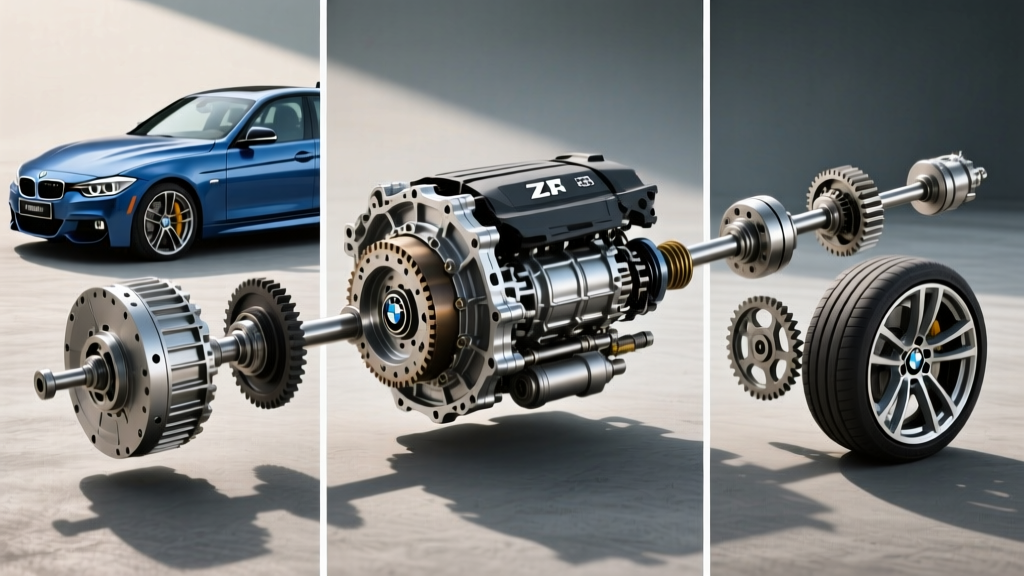
Here is where beginners get confused, and where dealership service advisors often have to step in. In a Front-Wheel Drive vehicle, there is no long driveshaft. Instead, the transmission and the fwd differential are merged into a single, compact housing known as a transaxle.
Transaxle Architecture: Where the Magic Happens
Popular FWD transaxles, such as the GM 6T40 6-speed, the Aisin TF-80SC, or Honda's Earth Dreams CVT, house the planetary gearsets, the clutch packs, and the final drive ring-and-pinion differential all inside one aluminum case. Because the fwd differential is physically bolted inside the transaxle housing, many consumers mistakenly believe it is a 'powertrain' component.
Expert Insight: According to engineering standards outlined by SAE International, the differential's function—splitting torque between two wheels while allowing them to rotate at different speeds during a corner—strictly categorizes it as a drivetrain component, regardless of its physical housing inside the powertrain's transaxle.
Open vs. Helical LSD in FWD Transaxles
Most standard commuter cars use an 'open' fwd differential, which sends power to the wheel with the least resistance (hence the classic 'one-tire fire' burnout in the snow). However, performance FWD cars like the Honda Civic Type R or the Hyundai Veloster N utilize a Helical Limited-Slip Differential (LSD) or an electronic LSD integrated directly into the transaxle's final drive section. These complex drivetrain components require precise lubrication to prevent the clutch packs or helical gears from binding under high-torque cornering loads.
Component Breakdown: What Belongs Where?
To visualize how a FWD vehicle is divided, refer to the breakdown table below:
| Component | System Classification | Physical Location in FWD | Primary Function |
|---|---|---|---|
| Engine / Motor | Powertrain | Engine Bay | Generates rotational torque. |
| Torque Converter / Clutch | Powertrain | Between Engine & Transaxle | Couples/decouples engine power. |
| Planetary Gearsets / Belts | Powertrain | Inside Transaxle Case | Multiplies torque and provides gear ratios. |
| Ring and Pinion Gears | Drivetrain (FWD Differential) | Inside Transaxle Final Drive | Final torque multiplication & 90-degree power redirect. |
| CV Axles / Halfshafts | Drivetrain | Outside Transaxle to Hubs | Transfers power to wheels while allowing suspension travel. |
| Wheel Hubs / Bearings | Drivetrain | At the Wheel Corners | Mounts the wheel and allows rotation. |
Fluids and Maintenance: Don't Cross the Streams
One of the most critical aspects of FWD ownership is understanding how the fwd differential is lubricated. Because it lives inside the transaxle, the maintenance schedule can vary wildly depending on the manufacturer's engineering philosophy.
Shared Sump vs. Separate Sump Designs
- Shared Sump (Most Common): In many modern automatic FWD transaxles (like the GM 6T40 or Toyota U-series), the fwd differential shares the exact same Automatic Transmission Fluid (ATF) as the transmission clutches and valve body. For example, the GM 6T40 requires roughly 6.3 quarts of Dexron VI. When you change the transmission fluid, you are simultaneously servicing the fwd differential.
- Separate Sump (Performance / Specific OEMs): Some manufacturers isolate the final drive to protect the differential gears from clutch-pack debris. Certain Honda and Acura FWD platforms require a separate fluid change for the final drive. For instance, some Honda manual transaxles and specific AWD-derived FWD systems require Honda Dual Pump II or a dedicated 75W-90 GL-5 gear oil just for the differential section, featuring its own dedicated drain and fill plug.
Crucial Torque Specs for DIYers: If you are servicing a shared-sump transaxle, the drain and fill plugs are typically secured with a 3/8-inch square drive. The factory torque specification for these aluminum-case plugs is usually around 33 lb-ft (45 Nm). Overtightening will crack the transaxle case, instantly turning a $40 fluid change into a $4,000 powertrain replacement. Always use a calibrated torque wrench.
Diagnosing Drivetrain vs. Powertrain Noises
Beginners often struggle to identify the source of a whining noise coming from the front of their FWD car. Is the transmission failing (powertrain), or is the fwd differential whining (drivetrain)? Here is the expert diagnostic framework:
- Transmission Whine (Powertrain): Usually changes pitch based on engine RPM and the specific gear you are in. It may disappear when the vehicle is shifted into Neutral while coasting.
- FWD Differential Whine (Drivetrain): The ring and pinion gears in the differential are directly tied to wheel speed. A differential whine will change pitch strictly based on vehicle speed (MPH), regardless of engine RPM. If you accelerate to 40 MPH, let off the gas, and coast in gear or neutral, a differential whine will persist and pitch down exactly as the car slows down. Furthermore, differential whine often changes tone between 'drive' (acceleration load) and 'coast' (deceleration load) due to the different sides of the gear teeth making contact.
Warranty Implications and Real-World Repair Costs
Because the fwd differential is a drivetrain component housed inside a powertrain casing, warranty claims can be a gray area. According to powertrain warranty guidelines from major automakers, the internal gears of the transaxle—including the final drive ring and pinion—are covered under the Powertrain Limited Warranty (typically 5 years/60,000 miles or 10 years/100,000 miles).
However, the CV axles that plug into the fwd differential are almost universally classified as external drivetrain wear-and-tear items and are usually only covered by the basic 3-year/36,000-mile bumper-to-bumper warranty.
2026 Repair Cost Estimates
- CV Axle Replacement (Drivetrain): If a CV joint fails or a boot tears, expect to pay between $300 and $700 per side (parts and labor). Pro Tip: The axle nut securing the CV axle to the wheel hub is a one-time-use torque-to-yield fastener. On most mid-size FWD sedans, this nut requires a massive 184 lb-ft to 250 lb-ft of torque. Never reuse an old axle nut.
- FWD Differential / Final Drive Rebuild (Drivetrain/Powertrain overlap): If the ring and pinion gears chip or the differential bearings fail, the entire transaxle must be removed and disassembled. Because specialized drivetrain machine work is required to set the gear backlash and bearing preload, shops rarely rebuild just the differential. They will replace the entire transaxle assembly with a remanufactured unit. Expect costs between $3,500 and $5,500 at a dealership.
Summary Checklist for Beginners
Understanding the distinction between the powertrain and the drivetrain empowers you to make better maintenance decisions and accurately interpret repair estimates. Remember these key takeaways:
- The Powertrain creates and multiplies power (Engine + Transmission).
- The Drivetrain delivers power to the road (Axles + Hubs + Differentials).
- The fwd differential is a drivetrain component, even though it lives inside the powertrain's transaxle housing.
- Always verify if your specific FWD transaxle uses a shared fluid sump or requires a dedicated final-drive gear oil.
- Use a torque wrench for all drain plugs and axle nuts to prevent catastrophic casing failures.
For more deep dives into transaxle engineering and drivetrain layouts, consult technical resources from industry leaders like ZF Group and Aisin Corporation. By mastering these fundamentals, you will ensure your vehicle's drivetrain delivers power smoothly for hundreds of thousands of miles.