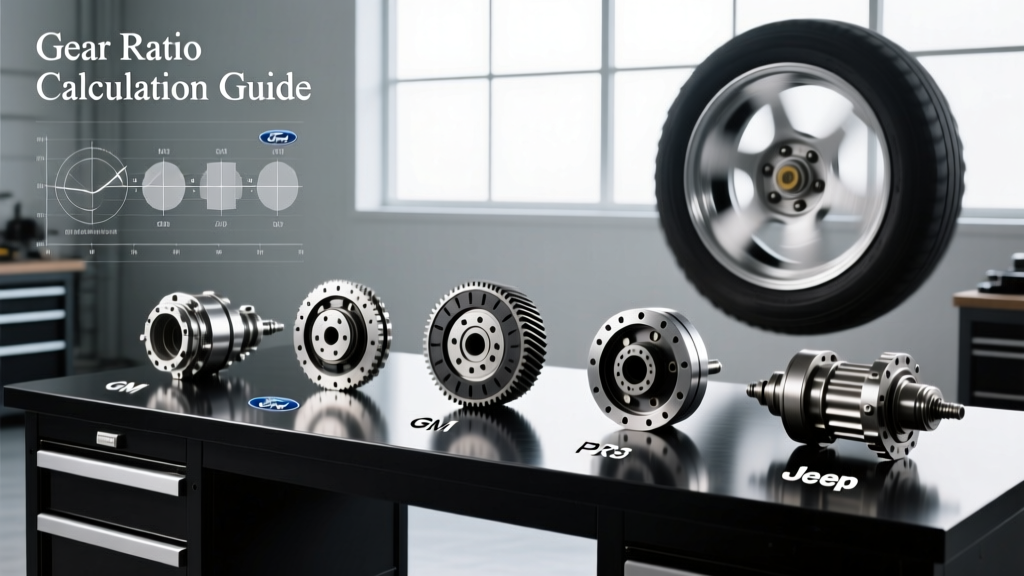
The Mechanics of Multiplication: From Fishing Reels to the Drag Strip
When anglers ask what do gear ratios mean on a baitcaster, they are looking at torque versus retrieval speed. A 5.3:1 baitcaster ratio means the spool rotates 5.3 times for every single turn of the handle, providing high torque to pull heavy fish from deep cover. Conversely, a 7.1:1 ratio sacrifices cranking power for rapid line retrieval. In the automotive world, specifically in drag racing, the differential ring and pinion operate on this exact same mechanical principle—but the stakes, forces, and mathematics are exponentially higher.
Instead of pulling a largemouth bass, a drag racing rear gear set must multiply engine torque to launch a 3,200-pound vehicle off the starting line without overpowering the tire's footprint. As we navigate the 2026 drag racing season, where radial tire classes and high-horsepower EV swaps are pushing traction limits, understanding how to calculate and set up your final drive ratio is the difference between a mid-pack finish and a holeshot victory. This step-by-step guide will walk you through the math, component selection, and precision installation required for a bulletproof drag racing differential.
Step 1: Calculating Your Target Trap Speed and RPM
Before ordering parts, you must define your vehicle's performance envelope. The rear axle ratio dictates where your engine will be in its powerband when you cross the finish line. If your gear is too tall (numerically low), you leave horsepower on the table. If it is too short (numerically high), you hit the rev limiter before the 1/4 mile mark.
The Drag Racing Gear Ratio Formula
To find your ideal rear gear ratio, use the standard drivetrain calculation formula:
Ratio = (RPM × Tire Diameter) / (MPH × 336)
Let us run a real-world scenario for a Super Street build:
- Target Engine RPM at Finish Line: 6,800 RPM (peak horsepower of a naturally aspirated small-block)
- Rear Tire Diameter: 28.0 inches (measured under load, not standing height)
- Target Trap Speed: 135 MPH
Ratio = (6800 × 28.0) / (135 × 336)Ratio = 190,400 / 45,360 = 4.197
The math dictates a 4.20:1 ratio. Since ring and pinion sets are manufactured in specific increments, you would select a 4.11:1 or 4.30:1 set depending on whether your engine makes power slightly below or above that 6,800 RPM peak. For precise modeling, drivetrain engineers often rely on Tremec's drivetrain calculators to factor in transmission overdrive and tire slip.
Step 2: Selecting the Ring, Pinion, and Spool
Street cars use limited-slip differentials (LSDs), but drag racing requires a locked rear end to ensure both tires receive equal torque simultaneously. For dedicated drag cars, this means installing a spool or a welded differential.
Component Recommendations for 2026
- Ring and Pinion Set: For a Ford 9-inch rear end, the Richmond Gear 4.30 Pro Gear Set (Part # 4.30-9F) is a staple. Cut from 8620 steel, it handles the shock loading of trans-brake launches. Expect to pay between $220 and $310.
- Differential Case/Spool: Replace the heavy cast-iron carrier with an aluminum Strange Engineering S-Trac Pro Spool (Part # S2801S). Priced around $380, it saves 8 lbs of rotating mass and eliminates the weak point of spider gears shattering under 800+ lb-ft of torque.
- Pinion Support: If running a Dana 60 or 12-bolt, upgrade to a nodular iron pinion support to prevent case flex, which alters gear mesh under heavy load.
Step 3: Precision Installation and Torque Specifications
A 4.56:1 gear set will whine, overheat, and grenade in three passes if the setup is sloppy. Drag racing differentials require specific tolerances that differ from street setups.
Setting Backlash and Pattern
Street vehicles typically run a tight backlash of 0.005 to 0.007 inches. However, drag racing axles experience massive torsional twist. Under hard acceleration, the ring gear attempts to climb the pinion. If the backlash is too tight, the gears will bind, generating catastrophic heat and tooth fracture.
- Target Drag Backlash: 0.010 to 0.014 inches.
- Gear Pattern: The contact pattern should be centered on the tooth face, biased slightly toward the heel under load. Use yellow gear marking compound and apply a drag brake to simulate load while turning the pinion.
Critical Torque Specs (Ford 9-Inch Example)
Do not guess with your fasteners. Use a calibrated torque wrench for the following:
- Ring Gear Bolts (7/16"-20): 85 ft-lbs. Apply Loctite 272 (Red) to the threads and safety-wire the bolt heads in pairs.
- Pinion Bearing Preload (Crush Sleeve): Tighten the pinion nut to 200-250 ft-lbs until the rotational drag reads 18-22 in-lbs on an inch-pound beam torque wrench.
- The Solid Spacer Upgrade: Crush sleeves deform over time, leading to gear failure. Spend $35 on a Ratech Solid Pinion Spacer Kit (Part # 4110). With a solid spacer, you torque the pinion nut to 150 ft-lbs and use shims to dial in exactly 15 in-lbs of rotational preload.
Pro-Troubleshooting Insight: If your gear pattern shows heavy contact on the toe of the tooth, your pinion depth is too shallow. You must remove the pinion, add a 0.002" shim behind the inner pinion bearing race, and re-press the bearing. Never attempt to adjust pinion depth via the carrier adjusters.
Step 4: Matching the Transmission Output
The rear gear does not work in isolation; it is the second half of the final drive multiplication equation. Your transmission's first-gear ratio drastically alters how the rear gear behaves off the line.
Final Drive Ratio = Transmission First Gear × Rear Axle Ratio
Consider two common drag racing transmissions:
- Reid Racing Powerglide (1.80:1 First Gear): Paired with a 4.56 rear gear, the final launch ratio is 8.208:1. This is ideal for heavy Pro Street cars or trucks needing massive torque multiplication.
- TH400 (2.48:1 First Gear): Paired with that same 4.56 rear gear, the launch ratio skyrockets to 11.30:1. This will instantly overpower a radial tire, causing severe tire shake and broken axles.
If you are running a TH400 or a 4L80E with a deep first gear, you must compensate by running a numerically lower (taller) rear gear, such as a 3.50:1 or 3.73:1, to keep the final drive ratio manageable and protect the tire.
2026 Drag Racing Gear Ratio Matrix by Class
Use this reference table as a baseline for your build. Always adjust based on your specific engine dyno sheet and tire compound.
| Racing Class | Target MPH | Tire Height | Transmission | Ideal Rear Gear | Final Drive (1st Gear) |
|---|---|---|---|---|---|
| Sportsman (Bracket) | 105 - 115 | 27.0" | Powerglide (1.80) | 4.56:1 | 8.20:1 |
| Super Street / Radial | 135 - 145 | 28.5" | TH400 (2.48) | 3.89:1 | 9.64:1 |
| Pro Mod (Turbo/Screw) | 190 - 210 | 33.0" | Liberty 5-Speed (2.20) | 3.20:1 | 7.04:1 |
| Top Sportsman | 155 - 170 | 29.0" | TH400 (2.48) | 4.11:1 | 10.19:1 |
Step 5: Fluid Selection and Break-In Protocol
Synthetic gear oils are standard for street cars, but dedicated drag differentials often require high-friction, non-synthetic extreme pressure (EP) oils to prevent the ring gear from skating across the pinion under shock loads. Fill the housing with 2.5 to 3 quarts of Lucas Heavy Duty 85W-140 Gear Oil mixed with a molybdenum friction modifier.
For the break-in procedure, elevate the rear tires, run the engine in gear at 2,000 RPM for 15 minutes to circulate the oil and mate the gear teeth, then immediately drain the fluid while hot to remove the metallic break-in paste. Refill with fresh oil before your first full-pass launch. Always consult the NHRA rulebook for safety requirements regarding aftermarket differential housings and axle retention loops when running sub-10-second times.
Final Thoughts on Drivetrain Math
Whether you are analyzing the retrieve speed of a baitcaster on the water or calculating the final drive multiplication for a 1,500-horsepower drag car, the physics of gear ratios remain absolute. By meticulously calculating your trap speed, selecting the correct spool and ring-and-pinion set, and adhering to strict drag-specific backlash tolerances, you ensure that every ounce of engine torque is efficiently translated into forward momentum. Visit Motive Gear or your local drivetrain specialist to pull the exact ratio needed to dominate your class this season.