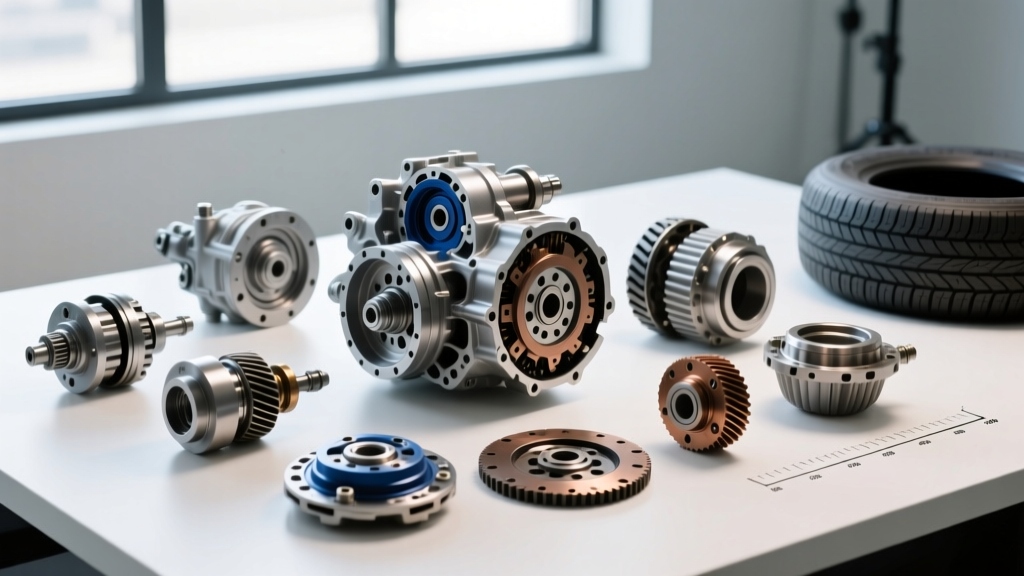
The Drivetrain Mismatch: Why Your Daily Driver Feels 'Wrong'
In 2026, modern daily drivers are equipped with complex 8-, 9-, and 10-speed automatic transmissions like the GM 10L90 or the ZF 8HP75. While these units offer incredible spread, they often mask underlying drivetrain mismatches. When a vehicle is used for daily commuting, light towing, or highway cruising, an incorrect final drive (axle) ratio can manifest as a series of frustrating, seemingly unrelated mechanical symptoms. Before condemning the transmission valve body, replacing the torque converter, or flashing the TCM, a skilled diagnostic technician must verify the axle ratio. Understanding how to check gear ratio is the critical first step in troubleshooting poor fuel economy, sluggish off-the-line acceleration, and chronic gear hunting.
Step 1: Identifying the Symptoms of an Incorrect Final Drive
When the factory axle ratio is mismatched to the vehicle's actual operating weight, tire diameter, or daily driving route, the powertrain control module (PCM) compensates by manipulating shift points. Look for these hallmark daily driving complaints:
- Highway RPM Hunting: The transmission constantly shifts between the top two gears (e.g., 8th and 9th on a Ford 10R80) on mild inclines, refusing to lock the torque converter in overdrive.
- Sluggish Off-the-Line Response: The vehicle feels lethargic from 0-30 mph, requiring heavy throttle input to merge onto highways, often accompanied by excessive downshifting.
- Poor City Fuel Economy: The engine operates outside its optimal BSFC (Brake Specific Fuel Consumption) map during stop-and-go traffic because the effective gearing is too tall (numerically low).
- Transmission Overheating Under Load: Even with light cargo, transmission fluid temperatures (TFT) exceed 210°F because the torque converter is continuously slipping to multiply torque.
Step 2: How to Check Gear Ratio (3 Diagnostic Methods)
To accurately diagnose these issues, you must confirm the physical ring and pinion ratio installed in the differential. Do not rely solely on the window sticker, as previous owners may have re-geared the axle. Here are the three most reliable methods to verify your setup.
Method A: Decoding Factory Axle Tags & RPO Codes
If the differential is suspected to be stock, decoding the manufacturer's build codes is the fastest non-invasive method. For General Motors trucks (Silverado/Sierra), locate the RPO (Regular Production Option) sticker in the glovebox. Codes like GU6 indicate a 3.42 ratio, while GT4 indicates a 3.73 ratio. For Ford vehicles, check the driver's door jamb B-pillar sticker for the 'AXLE' code. A code of '27' typically denotes a 3.73 limited-slip axle, whereas '19' denotes a 3.55 open differential. You can cross-reference these codes with the Ford Build & Price archives or GM dealer portals to confirm factory specifications.
Method B: The Physical Driveline Spin Test
When build tags are missing or a used replacement axle was installed, the physical spin test is mandatory. This is the most foolproof way on how to check gear ratio without opening the differential cover.
- Safely lift the drive axle so both tires are off the ground and support the vehicle on jack stands.
- Place the transmission in Neutral and release the parking brake.
- Make a chalk mark on the driveshaft and a corresponding mark on the bottom of one drive tire.
- Rotate the tire exactly two full revolutions (for open differentials) or one full revolution (for limited-slip/locking differentials) while counting the driveshaft rotations.
- If the driveshaft turns approximately 3 and 3/4 times, you have a 3.73 ratio. If it turns just over 4 times, you have a 4.10 ratio.
Method C: The Digital OBD2 Cross-Check
For advanced diagnostics on modern platforms, use a bi-directional scan tool (like an Autel MaxiSys or Snap-on Zeus) to monitor the Transmission Output Shaft Speed (TOSS) PID. Find a gear with a 1:1 ratio (typically 5th gear on the ZF 8HP, or 7th gear on the GM 10L90). At a steady 60 MPH cruise, compare the Engine RPM to the TOSS RPM. If the engine is turning 1,865 RPM and the output shaft is turning 500 RPM, the final drive ratio is 3.73 (1865 / 500 = 3.73). This method accounts for torque converter slip, provided the TCC (Torque Converter Clutch) PID confirms a fully locked state.
Diagnostic Matrix: Daily Driving Symptoms vs. Suspect Ratios
Use this troubleshooting matrix to correlate your OBD2 data and driving complaints with potential gearing mismatches. This data assumes a standard half-ton pickup (e.g., F-150 or Silverado 1500) equipped with 33-inch tires.
| Primary Symptom | OBD2 Data Clue | Current Suspect Ratio | Ideal Daily Driver Ratio | Recommended Fix |
|---|---|---|---|---|
| Highway RPM Hunting (65-75 MPH) | TCC slip > 40 RPM in top gear; frequent 9-10-9 shifts | 3.15 or 3.31 (Too Tall) | 3.55 or 3.73 | Re-gear to 3.73 to keep engine in V4 mode (AFM/DFM) |
| Sluggish City Acceleration | High throttle position (TPS > 40%) for 0-30 MPH | 3.08 or 3.15 | 3.73 or 4.10 | Re-gear to 4.10 if towing; 3.73 for mixed commuting |
| Poor MPG / High Cruise RPM | Engine RPM > 2,400 at 70 MPH in top gear | 4.10 or 4.30 (Too Short) | 3.55 or 3.73 | Re-gear to 3.55; verify tire size isn't undersized |
| Transmission Overheating (TFT > 215°F) | TCC unable to lock in 5th/6th gear under load | 3.15 with oversized tires | 4.10 or 4.30 | Re-gear to 4.30 to restore effective torque multiplication |
The Hidden Saboteur: Tire Diameter and Effective Gearing
You cannot troubleshoot daily driving gear ratio symptoms without factoring in tire diameter. According to the technical resources at Yukon Gear & Axle, altering your tire size fundamentally changes your effective final drive ratio, even if the physical ring and pinion remain untouched. The formula to calculate your effective gear ratio is:
Effective Ratio = (Original Tire Diameter / New Tire Diameter) x Original Axle Ratio
For example, if your daily driver left the factory with 31-inch tires and a 3.73 axle ratio, but you installed aggressive 35-inch all-terrain tires for weekend trails, your new effective ratio drops to a sluggish 3.30 (31 / 35 x 3.73). This explains why the transmission constantly downshifts on highway grades and why your city MPG has plummeted. To restore the factory driving dynamics with 35-inch tires, you must install a physical 4.10 or 4.30 ring and pinion set.
Re-Gearing Economics: Costs, Torque Specs, and Setup Realities
If your diagnosis confirms a mismatch, re-gearing the differential is the only permanent fix. For common daily driver axles like the Ford 8.8-inch or the GM 9.5-inch semi-float, a high-quality ring and pinion kit (such as those from Ring & Pinion Service) costs between $350 and $550. A master bearing and seal kit adds another $150 to $200. Professional installation labor typically ranges from $800 to $1,200 per axle, bringing the total investment to roughly $1,300 to $1,950.
For the DIY troubleshooter attempting the swap in a home garage, precision is non-negotiable. The industry standard for hypoid gear backlash is between 0.006" and 0.010". Furthermore, achieving the correct pinion bearing preload is critical. On a standard Ford 8.8 using a factory crush sleeve, you must torque the pinion nut to an immense 350 to 450 lb-ft to slowly crush the sleeve until you achieve 15 to 25 in-lbs of rotational drag. To avoid this nightmare, experts highly recommend purchasing a $40 crush sleeve eliminator kit, which uses precision machined shims to set preload without requiring a hydraulic press or massive torque wrenches.
Final Diagnostic Thoughts
Troubleshooting daily driving complaints requires looking past the engine and transmission to the final mechanical multiplication point: the axle. By mastering how to check gear ratio via physical spin tests, RPO decoding, and OBD2 data analysis, you can accurately diagnose whether a vehicle's sluggishness or poor fuel economy is a mechanical fault or simply a mathematical mismatch. Always verify your tire diameter, calculate your effective ratio, and consult authoritative drivetrain setup guides before ordering your next ring and pinion set.