The Baseline: How Do You Calculate the Gear Ratio on a Bicycle?
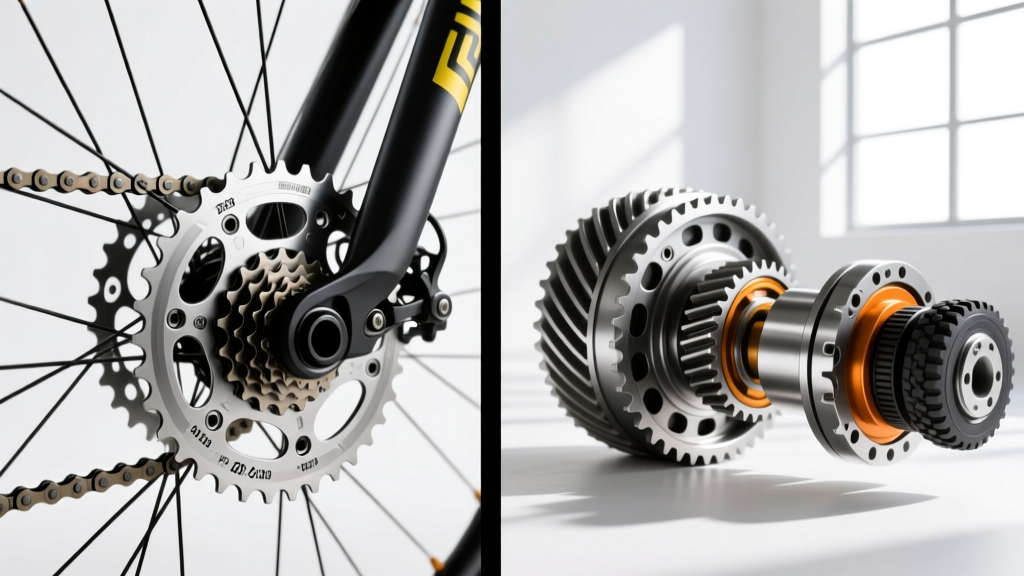
When enthusiasts first dip their toes into mechanical advantage, they often start with two wheels. If you are wondering how do you calculate the gear ratio on a bicycle, the math is remarkably straightforward. A bicycle drivetrain relies on a single-stage reduction system. You simply divide the number of teeth on the front chainring by the number of teeth on the rear cog.
For example, if your mountain bike is equipped with a 32-tooth (32T) front chainring and you are climbing in the largest 51T rear cog of a Shimano XT 12-speed cassette, the calculation is:
32 / 51 = 0.62:1
This means the rear wheel turns 0.62 times for every one full rotation of the pedals. This mechanical underdrive provides massive torque multiplication for steep, technical climbs. While bicycle math is an excellent introduction to torque and rotational speed, scaling this concept up to a 4,500-pound off-road vehicle requires a much deeper understanding of compound drivetrain reductions.
Scaling Up: Off-Road Vehicle Drivetrain Math
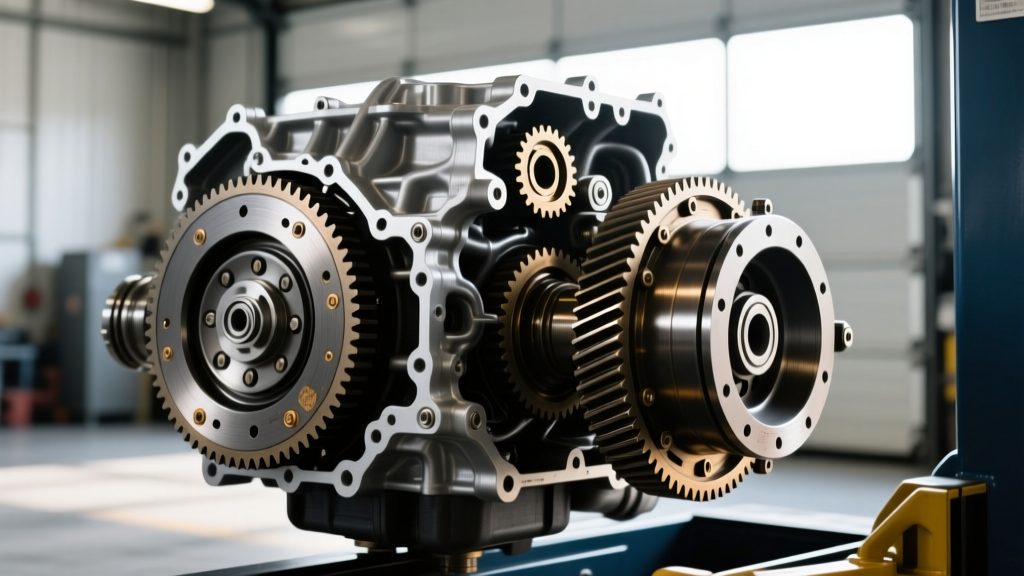
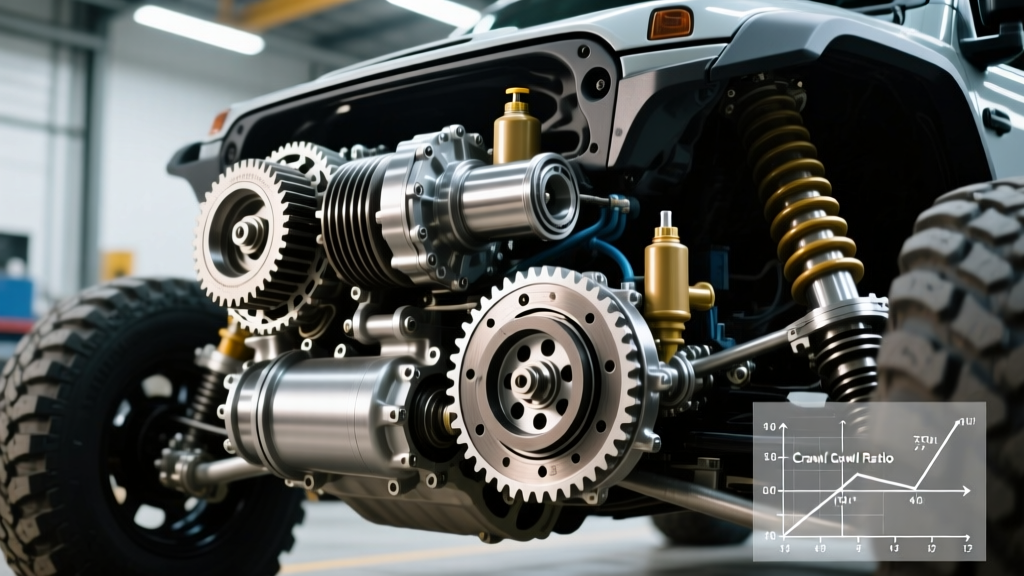
Unlike a bicycle, an off-road 4x4 does not rely on a single chain and sprocket. Instead, it utilizes a compound reduction system consisting of three primary stages: the transmission, the transfer case, and the axle differentials. To find the true mechanical advantage of an off-road rig—commonly known as the Crawl Ratio—you must multiply the reductions of all three stages together.
The Crawl Ratio Formula
Transmission 1st Gear × Transfer Case Low Range × Axle Ring & Pinion = Final Crawl Ratio
Let us break down a real-world scenario using the widely swapped Dana 44 axle and the ZF 8HP75 transmission found in late-model Jeep Wranglers. According to drivetrain specialists at Novak Conversions, understanding this compound multiplication is critical for selecting the right transfer case and axle gears for rock crawling.
- Transmission (ZF 8HP75 1st Gear): 4.71:1
- Transfer Case (NV241OR Rock-Trac Low Range): 4.0:1
- Axle (Dana 44 Ring & Pinion): 4.10:1
Calculation: 4.71 × 4.0 × 4.10 = 77.24:1
A crawl ratio of 77.24:1 means the engine's flywheel rotates 77.24 times to turn the off-road tires exactly one time. This extreme reduction allows the vehicle to idle over boulders without stalling or requiring excessive throttle modulation, mimicking the ultra-low 0.62:1 ratio of our mountain bike example, but multiplied to handle thousands of pounds of steel.
Real-World Off-Road Axle Configurations
Choosing the correct axle ratio depends heavily on your tire size, engine displacement, and intended use. Below is a comparison of popular off-road drivetrain configurations and their resulting crawl ratios.
| Vehicle Platform | Transmission (1st) | T-Case (Low) | Axle Ratio | Final Crawl Ratio |
|---|---|---|---|---|
| Jeep Wrangler Rubicon (392) | ZF 8HP75 (4.71) | NV241OR (4.0) | Dana 44 (3.73) | 70.27:1 |
| Ford Bronco Badlands (V6) | 10R80 (4.70) | EMOD (3.06) | Dana 44 AdvanTEK (4.70) | 67.62:1 |
| Toyota Tacoma TRD Pro | 8-Speed (4.36) | Chain-Drive (2.61) | Toyota 8.0 (4.30) | 48.94:1 |
| Custom Buggy (LS3 Swap) | TH400 (2.48) | Atlas II (4.3) | Dana 60 (5.38) | 57.35:1 |
Note: Vehicles equipped with manual transmissions often yield lower crawl ratios due to a taller first gear, requiring deeper axle gears or a lower transfer case to compensate.
Expert Setup: Torque Specs, Backlash, and Preload
Calculating the ratio is only the first step. Installing a new ring and pinion set requires precision machining and strict adherence to torque specifications. If you are re-gearing a Dana 44 or a Ford 8.8 axle for 35-inch or 37-inch tires, you must source high-quality components from trusted suppliers like Randy's Ring & Pinion or Yukon Gear.
Here are the critical setup parameters for a standard Dana 44 axle build:
- Ring Gear Bolt Torque: 70-90 lb-ft. Always apply a medium-to-high strength threadlocker (like Red Loctite 272) to these bolts. A backed-out ring gear bolt will instantly destroy the differential housing.
- Pinion Bearing Preload: Measured in inch-pounds (in-lbs) using a beam-type torque wrench. For a crush-sleeve Dana 44, you are typically targeting 15-25 in-lbs of rotating torque on a new bearing setup. This requires tightening the pinion nut to roughly 200-250 lb-ft while checking rotational drag.
- Backlash: The clearance between the ring gear and pinion gear teeth. Set this between 0.006" and 0.010" using a magnetic dial indicator. Adjust by moving the carrier bearing adjuster sleeves left or right.
- Gear Pattern: Apply yellow gear marking compound to the ring gear teeth. Under load, the pinion should contact the center of the tooth face. A pattern biased toward the toe or heel indicates incorrect pinion depth shim thickness.
Re-Gearing Costs and Sourcing Parts
Budgeting for an axle re-gear requires accounting for both parts and specialized labor. As of 2026, expect the following price ranges for a complete front and rear axle overhaul:
- Ring & Pinion Sets: $220 - $350 per axle (e.g., Yukon Gear YG D44TJ-488 for a 4.88 ratio).
- Master Bearing Kits: $180 - $250 per axle. Never reuse old bearings. Ensure the kit includes Timken or Koyo bearings, as cheap offshore bearings will whine and fail prematurely under off-road shock loads.
- Gear Oil & Additives: $80 - $120. Use a high-quality 75W-90 or 75W-140 synthetic gear oil. If your rig features a clutch-type limited-slip differential (LSD), do not forget the friction modifier additive.
- Professional Labor: $600 - $900 per axle. Setting up a ring and pinion takes an experienced drivetrain technician 4 to 6 hours per axle.
Matching Tire Diameter to Final Drive
The most common mistake off-road builders make is installing larger tires without recalculating the effective final drive ratio. Upsizing from a 31-inch tire to a 37-inch tire effectively raises your numerical gear ratio, robbing the engine of torque and causing the transmission to hunt for gears on the highway.
To find your new effective ratio, use this formula:
(Old Tire Diameter / New Tire Diameter) × Old Axle Ratio = Effective Ratio
If your Jeep originally had 31-inch tires and 3.21 gears, and you install 37-inch tires:
(31 / 37) × 3.21 = 2.68:1
An effective ratio of 2.68:1 is far too tall for off-roading and will severely strain your transmission and axle shafts. To restore the factory feel and torque multiplication, you would need to physically re-gear the axles to 4.88:1. By mastering the math that bridges simple bicycle drivetrains and complex 4x4 transfer cases, you can build an off-road vehicle that crawls effortlessly and cruises reliably.