The 'Differential Pressure Gauge' Misconception in Axle Diagnostics
When fleet managers and dedicated DIYers begin researching advanced drivetrain diagnostics, a common point of confusion arises: the search for a differential pressure gauge to monitor axle health. In industrial applications, HVAC systems, or diesel particulate filter (DPF) monitoring, a differential pressure gauge is a vital tool used to measure the pressure drop across a filter or membrane. However, applying this concept to standard automotive and light-duty truck axles is a fundamental misunderstanding of drivetrain engineering.
Unlike an engine oiling system or a heavy-duty transmission (such as the Allison 1000 or ZF 8HP) that relies on a pressurized hydraulic pump to force lubricant through galleries and clutch packs, standard automotive differentials—whether open, limited-slip, or locking—are splash-lubricated. The ring gear acts as a scoop, dipping into the gear oil sump and slinging fluid onto the pinion gear, bearings, and axle shafts. Because there is no pressurized oil circuit, there is no pressure delta to measure. Therefore, a differential pressure gauge has absolutely zero application in a standard Ford 10.5-inch, Dana 60, or GM 8.6-inch axle housing.
While some extreme heavy-duty Class 8 commercial axles (like certain Meritor models) utilize external forced-lube pumps that might employ pressure switches, passenger vehicles and light trucks rely on entirely different diagnostic methods for preventive maintenance. Understanding this distinction is the first step toward mastering differential fluid cost and service pricing.
Real Preventive Diagnostics: What to Use Instead
If you cannot use a differential pressure gauge to determine if your axle fluid is degraded or if your bearings are failing, what should you use? As of 2026, expert drivetrain technicians rely on three primary diagnostic pillars:
- Infrared Thermometry: Using an infrared thermometer to measure the axle housing temperature after a sustained highway drive. A temperature exceeding 200°F (93°C) above ambient, or a significant temperature delta between the left and right axle tubes, indicates bearing preload issues or severe fluid shear.
- Used Oil Analysis (UOA): The gold standard for preventive maintenance. By pulling a 3-ounce sample of gear oil and sending it to labs like Blackstone Laboratories, you can measure parts-per-million (PPM) of iron, copper, and chromium. High copper levels indicate thrust washer or synchronizer wear, while spiking iron levels point to ring and pinion gear degradation.
- Borescope Inspection: Removing the fill plug and inserting an articulating borescope to visually inspect the ring gear teeth for pitting, spalling, or improper backlash wear patterns without dropping the entire differential cover.
2026 Differential Fluid Service Pricing Breakdown
Proper preventive maintenance dictates that differential fluid should be changed every 30,000 to 50,000 miles for severe use (towing, off-roading, frequent stop-and-go), or up to 100,000 miles for light highway duty. The cost of this service varies wildly depending on your approach, the axle type, and the materials used.
| Service Method | Typical Parts & Fluids | Estimated Labor | Total Cost Range (2026) |
|---|---|---|---|
| DIY (Standard) | Conventional 80W-90, Cork Gasket, RTV | $0 (Self) | $35 - $55 |
| DIY (Premium) | Synthetic 75W-90, Reusable Gasket, Flush | $0 (Self) | $85 - $130 |
| Independent Shop | Bulk Synthetic 75W-90, Standard Gasket | $80 - $120 | $150 - $220 |
| Dealership | OEM Branded Fluid, OEM Gasket/Sealant | $150 - $250 | $280 - $450+ |
Fluid Selection and Part Numbers
The single biggest variable in your differential fluid cost is the lubricant itself. While conventional 80W-90 mineral oils (like Valvoline High Performance) cost around $8-$10 per quart, full synthetic options offer vastly superior shear stability and high-temperature oxidation resistance. For a 2026 preventive maintenance regimen, synthetics are highly recommended, especially for limited-slip differentials (LSDs) that generate immense friction heat.
- Mobil 1 Synthetic Gear Lube 75W-90: Part #104361. Excellent baseline synthetic, typically $12-$14/quart. Contains baseline friction modifiers, but additional modifier may be needed for clutch-type LSDs.
- Amsoil Severe Gear 75W-90 (SVG): Premium ester-based synthetic. Superior film strength for heavy towing. Costs roughly $18-$22/quart.
- Ford Motorcraft 75W-140 Synthetic: Part #XL-6. Required for late-model Super Duty 10.5-inch and 11.8-inch axles under heavy towing profiles. Costs $16-$20/quart.
The Gasket Debate: RTV vs. Reusable Elastomers
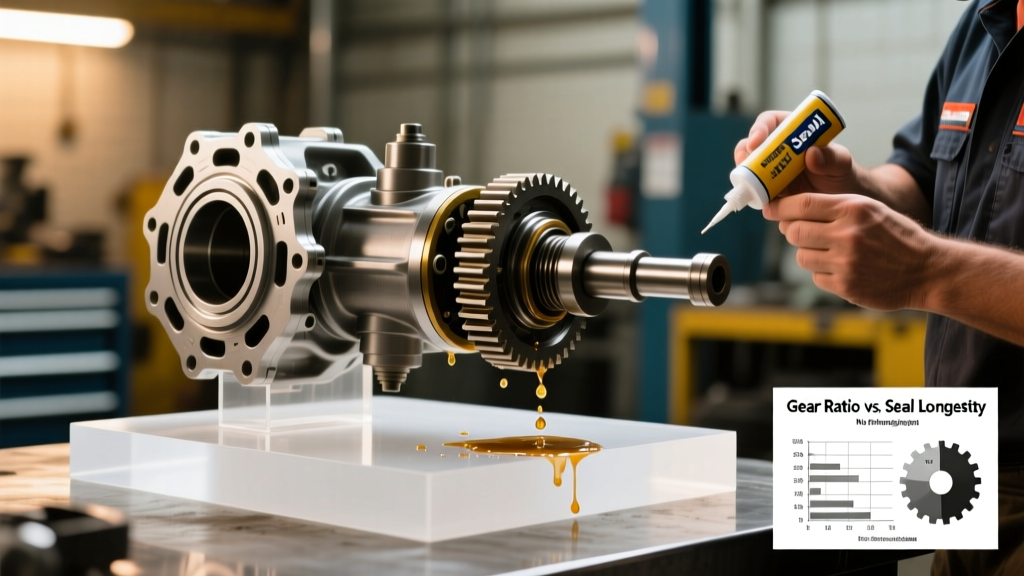
Historically, technicians relied on cork gaskets smeared with High-Tack sealant or beads of RTV silicone (like Permatex Ultra Black). However, RTV requires strict cure times and can easily lead to over-application, where excess silicone breaks off inside the housing and clogs axle shaft oiling passages. Modern preventive maintenance favors reusable elastomer gaskets. LubeLocker manufactures precision-molded gaskets with stainless steel cores and Viton O-rings. A LubeLocker for a Dana 44 (Part #LL-D44) costs around $35-$40, but it eliminates the need for scraping, solvent cleaning, and cure times, paying for itself after just two fluid changes.
Critical Torque Specifications and Service Procedures
A massive driver of differential failure post-service is improper fastener torque. Overtightening differential cover bolts distorts the housing, altering bearing preload and causing premature pinion bearing failure. Under-tightening leads to weeping and fluid loss. Always consult manufacturer specs, but reference this general guide for common axles (verified via Yukon Gear & Axle technical resources):
- Ford 10.5-inch (12-Bolt Cover): Cover bolts: 33 lb-ft. Fill/Drain plugs: 22-25 lb-ft.
- Dana 44 / Dana 60: Cover bolts: 25-30 lb-ft (tighten in a crisscross star pattern). Fill plug: 25-35 lb-ft.
- GM 8.6-inch / 9.5-inch (10-Bolt / 14-Bolt SF): Cover bolts: 22 lb-ft. Fill plug: 20-25 lb-ft.
Expert Warning: Never use an impact wrench to install differential cover bolts. The thin stamped-steel or cast-aluminum covers will warp instantly. Use a calibrated 1/4-inch drive torque wrench, and always ensure the mating surfaces are completely free of old RTV and oil residue using brake cleaner before installing the new gasket.
Addressing the Additive Requirement for Limited-Slip Axles
If your vehicle is equipped with a clutch-type limited-slip differential (such as the Ford Traction-Lok, GM Gov-Lok, or Eaton Positraction), the fluid cost calculation must include a friction modifier additive. When the clutch packs engage during cornering, they require a specific coefficient of friction to prevent 'chatter'—a violent grabbing and releasing sensation that damages the clutches and shakes the chassis.
Most modern synthetic 75W-90 gear oils claim to be 'Limited Slip Compatible,' but real-world testing shows that heavily used clutch packs often require a dedicated top-off. Products like Motorcraft XL-3 Friction Modifier (approx. $9 per 4oz bottle) or **ACDelco 10-4016** are essential. The standard procedure is to fill the axle with gear oil, add half a bottle of modifier, and perform a series of tight figure-eight turns in a parking lot to work the fluid into the clutch packs. If chatter persists, add the remaining half bottle. Do not exceed the recommended amount, or the clutches will slip entirely under heavy load.
When to Rebuild vs. Just Service
During your fluid drain, the condition of the oil dictates your next financial step. If the drained fluid contains fine, glitter-like metallic dust, this is normal wear from the break-in period or standard clutch pack degradation. However, if you find large, jagged metal shards or pieces of the ring gear teeth resting on the magnetic drain plug, a simple $100 fluid service will not save you.
A full ring and pinion rebuild—including master bearing kits, new gear sets, and professional setup (adjusting backlash to 0.006-0.010 inches and setting pinion depth via crush sleeves or solid spacers)—typically costs between $1,200 and $2,500 per axle at a specialized drivetrain shop in 2026. Recognizing the signs of catastrophic failure early through visual inspection and UOA is the ultimate goal of a robust preventive maintenance program.
Summary: Ditch the Gauge, Grab the Torque Wrench
Leave the differential pressure gauge for the HVAC technicians and diesel mechanics monitoring DPF filters. For automotive and light-duty truck axles, your preventive maintenance toolkit should consist of an infrared thermometer, a used oil analysis kit, a high-quality synthetic 75W-90 or 75W-140 gear oil, a reusable gasket, and a properly calibrated torque wrench. By understanding the true costs and mechanical requirements of your differential, you can easily extend the life of your ring and pinion gears well past the 200,000-mile mark.