The True Differential Service Meaning in Modern Diagnostics
When most vehicle owners hear the phrase "differential service," they assume it simply means draining old gear oil and refilling with fresh 75W-90. However, for drivetrain specialists, the differential service meaning extends far beyond a basic fluid swap. In 2026, with the increased torque outputs of modern turbocharged trucks and heavy-duty EV conversions, a true differential service encompasses a comprehensive NVH (Noise, Vibration, and Harshness) evaluation, gear pattern verification, and bearing preload analysis. Diagnosing differential noise is the first critical step in this process. Ignoring early auditory warnings often transforms a $150 fluid and seal service into a $2,500 complete axle rebuild. This guide breaks down expert-level noise diagnosis and troubleshooting for open, limited-slip (LSD), and locking differentials.
Auditory Triage: Decoding Differential Noises
Differential components operate under extreme shear and compressive loads. When tolerances degrade, the housing acts as an acoustic amplifier. Accurate diagnosis requires isolating the noise by load state (drive, coast, or float) and vehicle speed.
1. Drive vs. Coast Whine (Gear Mesh Issues)
A whining noise that changes pitch with vehicle speed—but specifically alters in volume when you let off the throttle—is the hallmark of ring and pinion gear wear.
- Drive-Side Whine: Occurs under acceleration. This indicates wear on the convex (drive) side of the ring gear teeth. It is often caused by insufficient gear oil, excessive preload, or a tight gear mesh setup.
- Coast-Side Whine: Occurs when decelerating or engine braking. This points to wear on the concave (coast) side of the teeth, frequently resulting from a loose pinion bearing preload or excessive backlash.
2. Deceleration Howl (Pinion Bearing Failure)
A low-frequency howl or rumble during deceleration (typically between 40-60 mph) almost always points to a failing inner pinion bearing. In popular axles like the GM 8.5-inch 10-bolt or the Ford 8.8-inch Sterling, the inner pinion bearing carries the brunt of the deceleration load. When the crush sleeve loses tension or the bearing races spall, the pinion gear deflects away from the ring gear under coast loads, creating a distinct howl.
3. Low-Speed Chatter (Limited-Slip Differential Clutch Wear)
If you hear a rhythmic "chatter," "clunk," or binding sensation during low-speed, tight-radius turns, your Limited-Slip Differential (LSD) clutches are failing to engage and disengage smoothly. This is rarely a mechanical hard-part failure; rather, it is a chemical friction issue. Clutch-type LSDs (like the Eaton Posi or Ford Traction-Lok) require specialized friction modifiers (e.g., GM EOS 1051342 or Motorcraft XL-3). If a previous technician neglected to add the modifier during a fluid change, the clutches will glaze, grab, and chatter.
4. The "Clunk" on Load Reversal (Backlash & Side Gear Wear)
A distinct metallic clunk when shifting from Reverse to Drive, or when abruptly lifting off the throttle, indicates excessive rotational backlash. While some backlash is necessary to prevent gear binding, excessive play means the differential side gears, spider gears, or cross-pin shafts are worn. In high-mileage trucks, the aluminum or steel thrust washers behind the side gears disintegrate, allowing the side gears to walk outward and creating slop in the driveline.
Diagnostic Data Matrix: Noise vs. Component Failure
Use the following matrix to cross-reference auditory symptoms with likely mechanical failures before tearing down the axle.
| Noise Type | Condition / Trigger | Primary Suspect Component | Verification Test |
|---|---|---|---|
| Pitch-Variable Whine | Changes volume on throttle lift | Ring & Pinion Gear Set | Check gear contact pattern with marking compound |
| Constant Rumble | Present in Drive, Coast, and Float | Carrier or Axle Shaft Bearings | Spin wheels on lift; listen with chassis ear |
| Deceleration Howl | Coast load between 30-60 mph | Inner Pinion Bearing / Crush Sleeve | Measure pinion rotational torque (in-lbs) |
| Turn Chatter | Low-speed, tight-radius steering | LSD Clutch Packs / Missing Modifier | Perform 10 figure-eight turns in a parking lot |
| Load Reversal Clunk | Shifting Park/Drive/Reverse | Side Gears, Spider Gears, Thrust Washers | Measure rotational backlash with dial indicator |
Expert Troubleshooting: Measurements & Tolerances
Once a noise has isolated the suspect component, precision measurement is required. Guesswork leads to repeat failures. According to Dana Spicer engineering guidelines, proper setup relies on three critical metrics:
Backlash Specifications
Backlash is the amount of rotational play between the ring and pinion gears. Using a magnetic base dial indicator mounted to the axle housing, measure the play at the ring gear.
- OEM Replacement Gears: Typically require 0.006" to 0.010" of backlash.
- Aftermarket Performance Gears (e.g., 4.10 or 4.56 ratios): Often require slightly looser tolerances, around 0.008" to 0.012", to account for thermal expansion under heavy load.
Pinion Bearing Preload
Pinion preload ensures the pinion gear does not deflect under load. This is achieved by crushing a steel sleeve (on older or standard axles) or using precision shims (on high-performance setups). For a Ford 8.8 axle, the target rotational preload for new bearings is typically 14-19 inch-pounds. Achieving this requires a specialized pinion nut torque sequence, often pulling upwards of 250 ft-lbs on the pinion nut to crush the sleeve incrementally. Always use a new crush sleeve and pinion nut during a rebuild.
Gear Contact Pattern Reading
Apply a thin layer of yellow gear marking compound to the ring gear. Rotate the pinion to load the gears and inspect the pattern. As detailed in Ring-Pinion's technical support archives, a proper pattern should be centered vertically on the tooth face and slightly biased toward the toe (inner edge) of the gear. If the pattern is high on the tooth, increase pinion depth; if low, decrease pinion depth.
Fluid Forensics: What the Drained Oil Tells You
The true differential service meaning begins the moment you pull the fill plug. The condition of the drained 75W-90 GL-5 gear oil is a direct window into the axle's internal health.
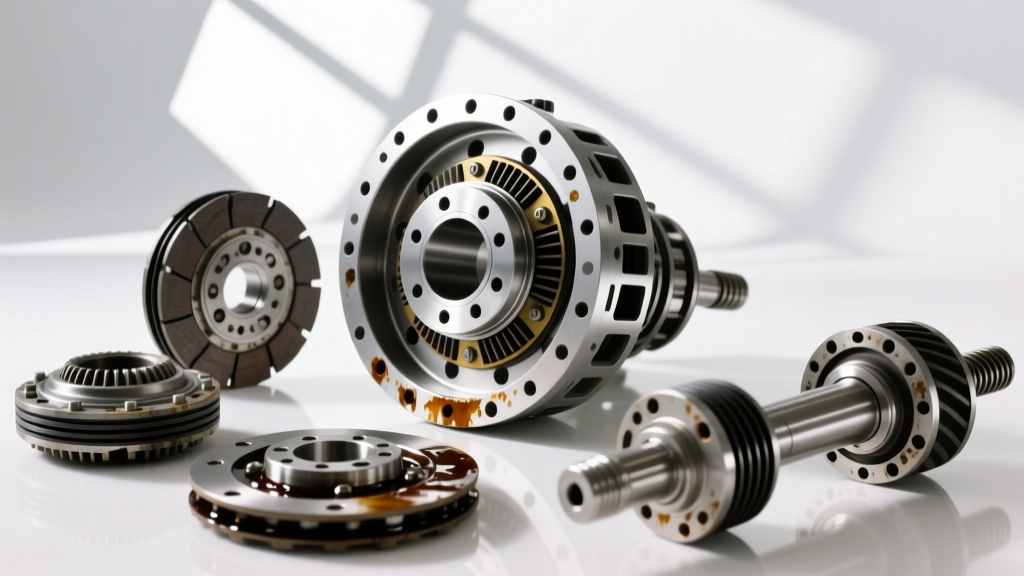
- Fine Metallic Glitter: Normal for the first 10,000 miles of a new gear set. If found on a high-mileage axle, it indicates active bearing or gear surface degradation.
- Large Metal Chunks or Shards: Catastrophic failure. This usually means a spider gear cross-pin has sheared, or a bearing cage has disintegrated. A full teardown and housing flush are mandatory.
- Milky or Chocolate-Milk Fluid: Water intrusion. This is common in off-road vehicles (like Jeep Wrangler Dana 44s) where the axle breathers are not extended, causing the housing to suck in water when hot axles hit cold puddles. Water destroys the extreme-pressure (EP) additives in GL-5 fluid, leading to rapid gear scoring.
Cost Analysis: Rebuild vs. Remanufactured Crate Axles
When diagnosis confirms severe internal damage, shop owners and DIYers must weigh the cost of a rebuild versus replacement. In 2026, supply chain stabilization has made remanufactured crate axles highly competitive.
- Complete Rebuild (Parts & Labor): $900 - $1,600. This includes a master rebuild kit (Timken bearings, seals, shims, crush sleeve) costing $150-$300, a new ring and pinion set ($250-$450), and 4-6 hours of specialized labor. Rebuilding is preferred when the axle housing is custom, narrowed, or features specialized brackets.
- Remanufactured Crate Axle: $1,200 - $2,200. Swapping in a pre-assembled, dyno-tested crate axle (such as a Currie or Spicer reman unit) reduces labor time to under two hours. This is the best practice for fleet vehicles or daily drivers where minimizing downtime is more critical than preserving the original matching-numbers housing.
Understanding the comprehensive differential service meaning transforms a routine maintenance task into a proactive diagnostic strategy. By mastering auditory triage, adhering to strict measurement tolerances, and interpreting fluid forensics, you can accurately diagnose axle noise and execute repairs that restore factory-quiet operation and long-term drivetrain durability.