Differential noise is rarely an isolated event; it is a mechanical symphony of failing tolerances, degraded lubricants, or improper assembly. For automotive technicians and hardcore DIYers, diagnosing a whining, howling, or clunking axle requires a systematic approach. More importantly, the repair process—specifically how you reseal the housing—dictates the longevity of the rebuild. Selecting the correct differential gasket maker and applying it with precision is just as critical as setting the ring and pinion backlash. In this guide, we break down the acoustic signatures of differential failure, outline exact diagnostic procedures, and provide expert best practices for sealing the housing to prevent future fluid starvation.
The Acoustic Matrix: Decoding Differential Noise
Before pulling the differential cover, you must categorize the noise based on vehicle dynamics. Differential noises are load-sensitive and speed-dependent. Misdiagnosing the source often leads to unnecessary parts replacement, such as swapping a perfectly good ring and pinion when a simple pinion bearing is the culprit.
Drive, Coast, and Float Signatures
- Drive Noise: Occurs under acceleration. If the howl intensifies as you press the throttle, the drive side of the ring gear teeth is worn or the pinion depth is set too shallow.
- Coast Noise: Heard when decelerating with your foot off the throttle. This indicates wear on the coast (convex) side of the ring gear teeth, often caused by excessive backlash or a loose carrier bearing preload.
- Float Noise: A steady whine or rumble at a constant cruising speed (typically between 45-60 mph). This is the hallmark of improper gear contact patterns or mismatched gear sets.
Bearing vs. Gear Failure Signatures
Not all differential noise originates from the gears. Bearings produce distinct acoustic frequencies that differentiate them from gear whine:
- Pinion Bearings: Produce a continuous whirring or high-pitched whine that changes strictly with vehicle speed, not engine RPM. A failing outer pinion bearing will often leak fluid past the seal before making noise.
- Carrier Bearings: Emit a low-frequency rumble or growl that correlates with wheel speed. If the rumble changes pitch when turning (loading and unloading the side gears), the carrier bearings or spider gear cross-pins are compromised.
- Spider Gears: Cause a rhythmic clunking or clicking noise specifically during low-speed, tight-radius turns, indicating stripped cross-pin bores or chipped spider gear teeth.
The Teardown: Inspection, Backlash, and Gear Patterns
Once the noise is categorized, the diagnostic teardown begins. Drain the fluid into a clean pan and inspect the residue. Fine, metallic 'glitter' is normal wear for high-mileage differentials. However, chunky metal shavings, brass-colored flakes (indicating side gear thrust washer failure), or cracked magnetic drain plug debris signal catastrophic internal failure requiring a full master rebuild kit (typically ranging from $180 to $350 for brands like Yukon Gear or Motive Gear).
Measuring Backlash and Runout
Before removing the carrier, mount a magnetic dial indicator to the housing and measure the ring gear backlash. For most street-driven passenger vehicles and light trucks (e.g., GM 8.5-inch 10-bolt, Ford 8.8-inch), the target backlash is between 0.006" and 0.010". Backlash exceeding 0.015" will cause a distinct 'clunk' on throttle tip-in and accelerate coast-side gear wear.
Analyzing the Contact Pattern
Apply a liberal coat of yellow gear marking compound to three or four ring gear teeth. Rotate the pinion yoke back and forth under light braking pressure to transfer the pattern. According to Dana Spicer technical guidelines, a proper pattern should be centered on the tooth flank, slightly biased toward the heel (inner edge) of the tooth. If the pattern is high on the face, the pinion depth must be increased via thicker pinion depth shims.
Why Sealing Matters: The Link Between Leaks and Noise
A massive percentage of differential noise complaints are actually secondary symptoms of fluid starvation. A slow leak at the differential cover or pinion seal drops the fluid level below the ring gear's splash-lubrication threshold. Without adequate oil sling, the carrier bearings overheat, lose their temper, and begin to howl within a few thousand miles. Therefore, the resealing process is not merely an afterthought; it is a critical noise-prevention step.
Choosing the Correct Differential Gasket Maker
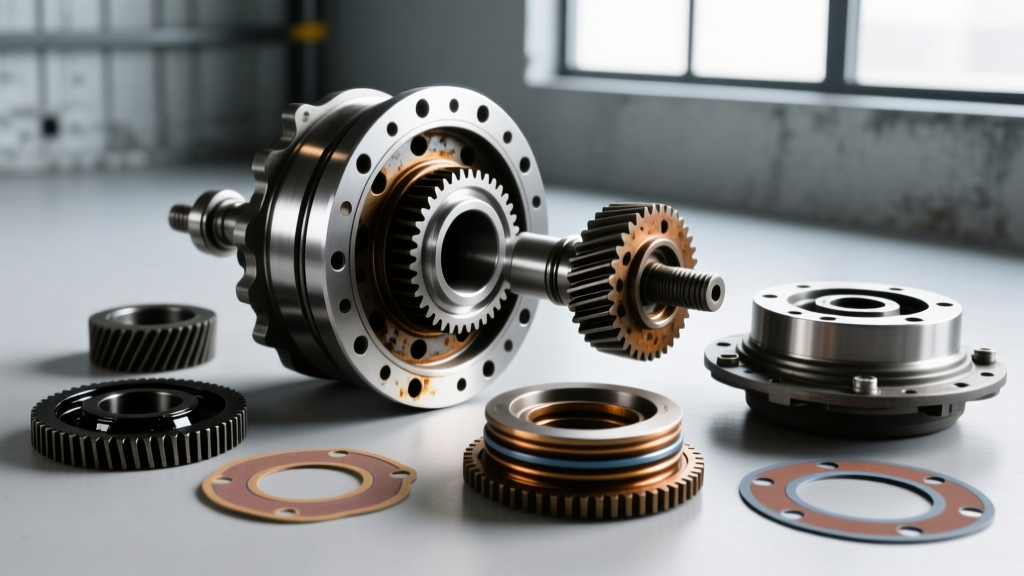
While pre-cut cork or rubber gaskets are convenient, they often compress unevenly under high-torque clamping forces, leading to weeping. Modern best practices favor high-quality RTV (Room Temperature Vulcanizing) silicone or specialized anaerobic flange sealants. When selecting a differential gasket maker, you must prioritize oil resistance, vibration tolerance, and sensor safety.
| Product | Part Number | Chemistry / Type | Cure Time | Best Application | Est. Price |
|---|---|---|---|---|---|
| Permatex Ultra Black | 81173 | Neutral Cure RTV | 24 Hours | Stamped steel diff covers, high-flex housings | $9 - $12 |
| Permatex The Right Stuff | 29208 | Neutral Cure Elastomer | 90 Minutes | Quick return-to-service fleet repairs, heavy-duty axles | $18 - $22 |
| Loctite 518 | 37467 | Anaerobic Flange Sealant | 12-24 Hours | Machined aluminum housings (IRS/IFS diffs, ZF rear axles) | $15 - $20 |
Note: Always use neutral-cure RTV (like Ultra Black) rather than acetoxy-cure RTV (which smells like vinegar). Acetoxy sealants release acetic acid during curing, which can corrode internal differential components and damage ABS tone rings located inside the housing on modern independent rear suspension setups. For deeper technical data on sealant chemistry, refer to the Permatex Gasket Maker Technical Database.
Expert Application: Avoiding the Squeeze-Out Catastrophe
The most common mistake made during differential resealing is applying too much RTV. When the cover bolts are torqued, excess silicone 'squeezes out' into the interior of the housing. Over time, vibration and thermal cycling cause these internal silicone ribbons to break off. They are then sucked into the bearing journals or wedge themselves between the ring gear and the differential housing, causing catastrophic binding and immediate noise.
The Proper Bead Technique
- Prep: Clean both mating surfaces with brake cleaner, followed by an isopropyl alcohol wipe. Surfaces must be bone-dry and oil-free.
- Apply: Lay a continuous, 2mm to 3mm bead of RTV on the inside edge of the bolt holes. Circling the inside of the bolt holes ensures that when the cover is compressed, the silicone squeezes outward rather than inward.
- Timing: Assemble the cover and hand-tighten all bolts within 10 minutes of application. Do not let the RTV skin over before clamping.
- Torque: Use a calibrated torque wrench in a crisscross star pattern. Reference the Spicer Technical Resources portal for exact axle specifications.
Common Differential Cover Torque Specifications
- GM 8.5" / 8.6" 10-Bolt: 25 lb-ft
- Ford 8.8" 10-Bolt: 28 - 38 lb-ft
- Dana 60 (Standard Cover): 25 - 30 lb-ft
- Chrysler 8.75": 30 - 35 lb-ft
Refilling and Post-Repair Road Testing
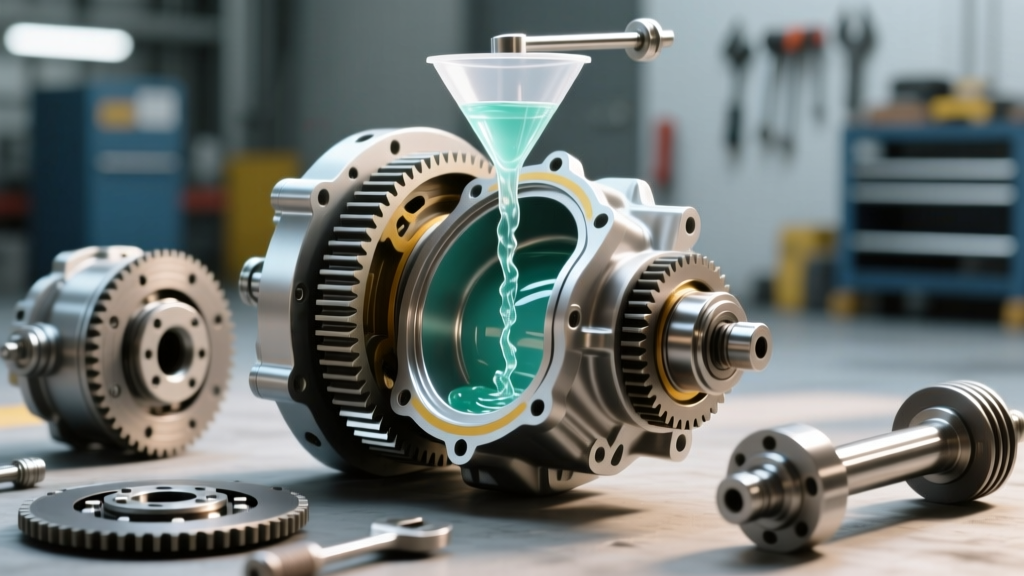
Once the RTV has fully cured (minimum 12 hours for standard silicones, 90 minutes for 'The Right Stuff'), fill the differential to the bottom of the fill plug hole. As of 2026, full synthetic 75W-90 gear oils (such as Amsoil Severe Gear or Royal Purple Max-Gear) are the industry standard for both open and limited-slip differentials, offering superior shear stability and thermal protection compared to conventional 80W-90 mineral oils.
Expert Pro-Tip: If your axle is equipped with a clutch-type Limited Slip Differential (LSD) like the Ford Trac-Lok or Auburn Gear cone-style, you MUST add the manufacturer-specified friction modifier (typically 2 to 4 oz) before topping off with gear oil. Failure to do so will result in aggressive 'chatter' and clunking noises during low-speed turns, which is frequently misdiagnosed as a gear or bearing failure.
After refilling, perform a 20-mile road test. Bring the axle up to operating temperature (approximately 140°F to 160°F at the pinion bearing) and re-evaluate the acoustic matrix. A properly diagnosed and expertly sealed differential should operate in near-silence, with the only audible sound being a faint, uniform gear whine that is completely masked by road and tire noise at highway speeds.