The Acoustic Fingerprint of Drivetrain Failure
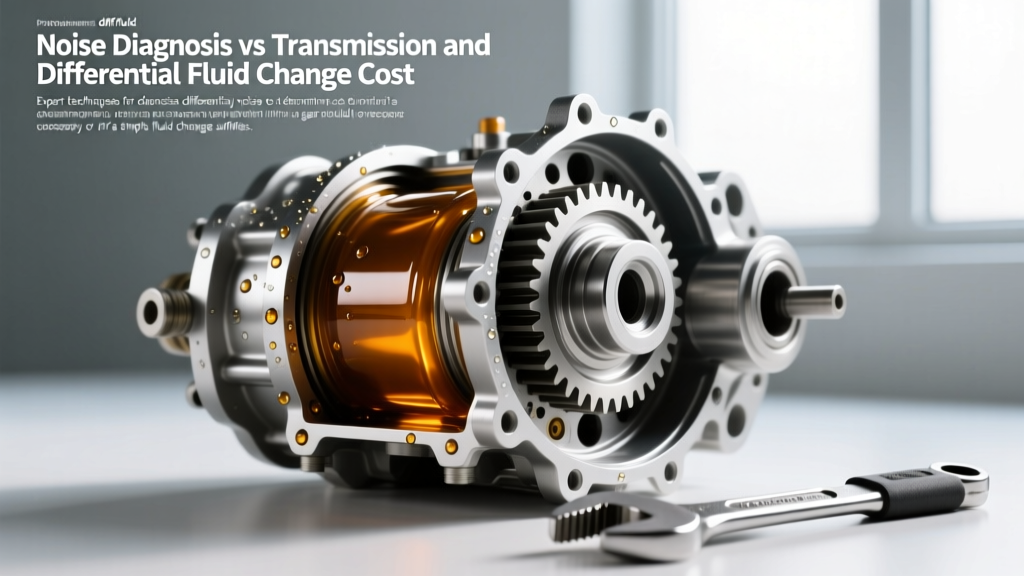
When a customer rolls into the shop complaining of a whining rear end or a clunking front axle, the immediate instinct for many quick-lube technicians is to quote a drain and fill. However, as a drivetrain specialist, understanding true differential noise diagnosis is critical before committing to a standard transmission and differential fluid change cost. A $250 fluid service will not fix a failing pinion bearing, and throwing heavy gear oil at a mechanical failure only masks the symptom until the axle catastrophically seizes on the highway.
In 2026, with average specialist drivetrain shop labor rates climbing to $165–$240 per hour, accurately diagnosing the root cause of differential noise is no longer just about mechanical integrity; it is about financial triage. Owners need to know if they are looking at a simple friction modifier flush or a complete ring-and-pinion overhaul. This guide breaks down the acoustic signatures of axle failure, the chemistry of limited-slip chatter, and the exact diagnostic protocol experts use to separate fluid degradation from hard-part destruction.
Decoding Gear Whine: Drive, Coast, and Float
Hypoid ring and pinion gears—whether they are housed in a classic GM 8.5-inch 10-bolt, a Ford 8.8-inch, or a heavy-duty Dana 60—produce distinct acoustic signatures based on load and rotational direction. Pinpointing when the noise occurs is the first step in avoiding an unnecessary transmission and differential fluid change cost when a rebuild is actually required.
Drive Whine (Acceleration)
If the differential howls under load (when the throttle is applied and the driveshaft is transmitting torque to the wheels), the wear is typically isolated to the drive side of the ring and pinion gear teeth. This is often caused by excessive backlash, improper pinion depth, or a worn carrier bearing allowing the ring gear to deflect away from the pinion under torque. According to Ring-Pinion.com Tech Tips, drive-side wear that produces audible whining usually indicates that the gear pattern has shifted beyond the acceptable contact ellipse, meaning new fluid will not quiet the axle.
Coast Whine (Deceleration)
A whine that appears when you let off the throttle and the vehicle is coasting points to the coast side of the gear teeth. This is frequently linked to a loss of pinion bearing preload. If the pinion nut has backed off even slightly, or if the crush sleeve has fatigued, the pinion gear will migrate microscopically, altering the mesh depth.
Float Whine (Cruising)
Whining while maintaining a steady speed on flat ground (zero torque load) usually indicates general gear wear, poor factory lapping, or the wrong gear oil viscosity. This is the only scenario where a high-quality synthetic fluid upgrade might yield acoustic improvements.
Bearing Frequencies: Pinion, Carrier, and Axle
Gears whine; bearings rumble, growl, or hum. Differentiating between the two is paramount.
- Pinion Bearings: Because the pinion gear rotates at driveshaft speed (e.g., 2,500 RPM at 70 MPH), a failing pinion bearing produces a high-pitched whine or hum that changes pitch directly with vehicle speed, regardless of the gear ratio. It is often most audible right behind the transmission tunnel or under the front seats.
- Carrier Bearings: The carrier rotates at axle shaft speed, which is divided by the gear ratio. For example, with a 3.73:1 ratio, the carrier spins roughly three times slower than the driveshaft. A bad carrier bearing produces a lower-frequency rumble or rhythmic knocking that correlates directly to wheel speed. It is often heard when turning, as the load shifts from one side bearing to the other.
- Axle Shaft Bearings: These produce a grinding or growling noise that is isolated to one side of the vehicle and changes distinctly when swerving left or right to shift the vehicle's weight.
Expert Rule of Thumb: Never use an impact wrench to remove or install a pinion nut on a crush-sleeve axle (like the Ford 8.8 or GM 10-bolt). The sudden torque spikes will collapse the crush sleeve, ruining your pinion bearing preload and forcing a complete teardown. Always use a beam-style torque wrench and a flange-holding tool to achieve the exact rotational torque spec (typically 220–250 lb-ft for the pinion nut, but always verify rotational drag in lb-in).
The Limited-Slip Chatter: Fluid or Clutches?
Not all differential noise is a whine or a rumble. If a vehicle exhibits a violent shudder, chatter, or binding sensation during tight, low-speed turns (like pulling into a parking space), the issue is almost always related to the Limited-Slip Differential (LSD) clutch pack.
Clutch-type LSDs (such as Ford's Trac-Lok or GM's Positraction) rely on specific friction modifiers to allow the clutches to slip smoothly during cornering. Over time, these modifiers shear and degrade. Before condemning the clutch pack or quoting a massive repair, the first step is a fluid exchange with the correct additive.
OE Friction Modifier Part Numbers
| Manufacturer | OEM Additive Part Number | Aftermarket Equivalent | Base Oil Spec |
|---|---|---|---|
| General Motors | 88900333 (POSI Additive) | Red Line Limited Slip Friction Modifier | 75W-90 GL-5 |
| Ford | A2C2Z19579A (XL-3) | Motorcraft XL-3 or Lubegard LSD Additive | 75W-140 or 80W-90 GL-5 |
| Stellantis (Jeep/Dodge) | 68218655AA | Mopar Trac-Lok Lubricant | 75W-85 GL-5 |
Note: Helical gear-type LSDs (like the Torsen or Quaife) do not use clutch packs and do not require friction modifiers. Using a friction modifier in a Torsen unit will not harm it, but it is an unnecessary expense.
Financial Triage: 2026 Service vs. Rebuild Costs
Understanding the true transmission and differential fluid change cost versus a mechanical overhaul helps set proper expectations. Below is a realistic breakdown of 2026 drivetrain specialist pricing for a standard light-duty truck or SUV (e.g., Silverado 1500, F-150, or Tacoma).
| Service / Repair Type | Parts & Fluid Cost | Estimated Labor | Total Shop Cost (2026) | Indication |
|---|---|---|---|---|
| Standard Diff Fluid Change | $60 - $120 | 1.0 - 1.5 Hours | $225 - $450 | Routine maintenance, mild LSD chatter |
| Pinion Seal & Bearing | $120 - $250 | 2.5 - 3.5 Hours | $550 - $1,100 | High-pitch whine, fluid leaking from yoke |
| Carrier Bearing Replacement | $150 - $300 | 3.0 - 4.0 Hours | $650 - $1,250 | Low rumble, gear deflection under load |
| Full Ring & Pinion Rebuild | $600 - $1,200 | 5.0 - 8.0 Hours | $1,450 - $3,100+ | Drive/Coast whine, chunky metal in fluid |
The 4-Step Expert Diagnostic Protocol
Before turning a single wrench or draining a drop of 75W-90, follow this exact diagnostic sequence to protect your wallet and your axle.
- The Load-Varying Road Test: Drive the vehicle at the speed where the noise is most prominent (usually 50-65 MPH). Accelerate hard, coast with your foot off the gas, and maintain a steady speed. Note exactly when the noise changes. Swerve gently left and right to load and unload the wheel bearings.
- Chassis Ear / Stethoscope Isolation: Put the vehicle on a lift. Run it up to speed in gear (safely secured). Use an automotive electronic stethoscope to probe the pinion housing, the carrier bearing caps, and the axle tubes. As noted by Spicer Technical Support, isolating the exact bearing housing vibrating at the frequency of the noise saves hours of unnecessary teardowns.
- The Fluid Autopsy: Drain the differential into a clean, white drain pan.
- Glitter/Silver Sheen: Normal wear for high-mileage axles. A fluid change is appropriate.
- Brass/Gold Flakes: Thrust washer or LSD clutch disc wear. Requires carrier teardown.
- Chunky Steel Fragments: Catastrophic gear or bearing cage failure. A full rebuild is mandatory; do not just change the fluid.
- Dial Indicator Backlash Test: If the fluid is clean but gear whine is present, mount a magnetic dial indicator to the axle tube with the plunger resting on a ring gear bolt head. Lock the pinion yoke and rock the ring gear. Standard OEM backlash specs usually fall between 0.005" and 0.009". If you measure 0.015" or more, the gears are worn beyond their service limit, and no amount of fresh synthetic oil will quiet the axle.
Final Verdict: Don't Mask Mechanical Failure
The transmission and differential fluid change cost is a necessary line item in your vehicle's maintenance budget, but it is not a cure-all for acoustic drivetrain complaints. By learning to differentiate between a high-pitched pinion bearing whine, a coast-side gear howl, and simple LSD clutch chatter, you can accurately prescribe the right fix. Whether it requires a $40 bottle of synthetic GL-5 and a friction modifier, or a $2,000 precision gear setup, accurate diagnosis is the only way to keep your drivetrain turning smoothly for the next 100,000 miles.