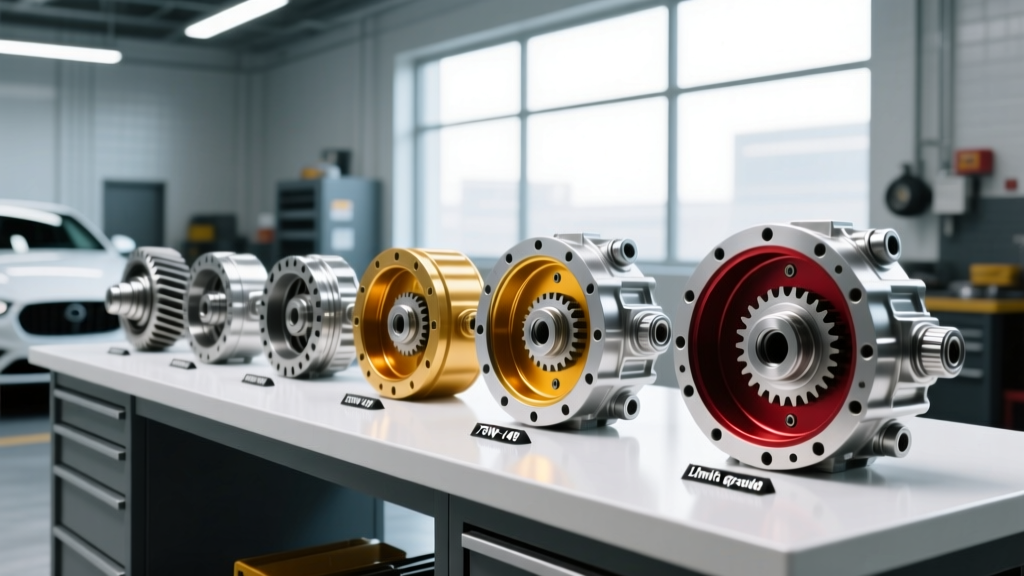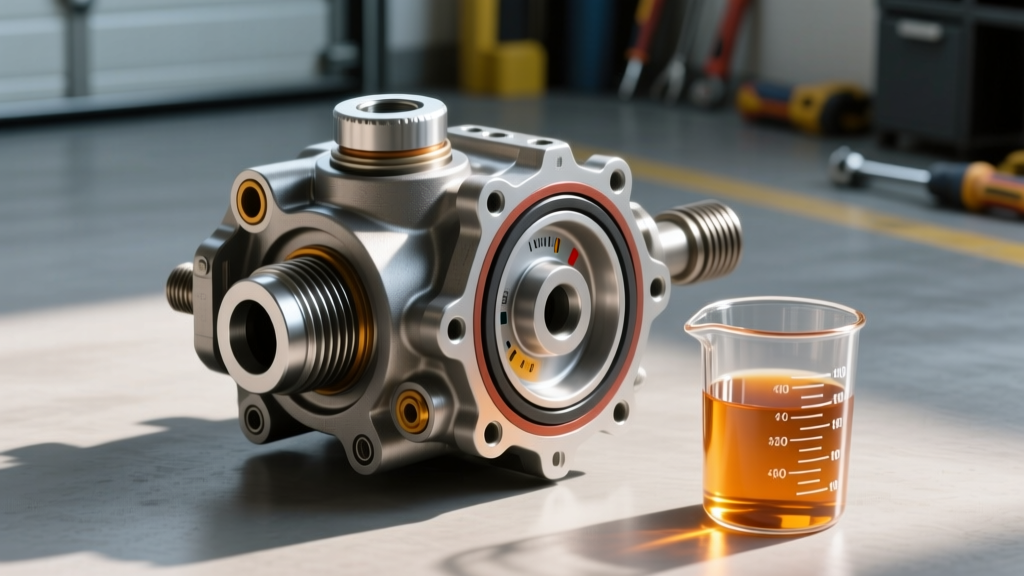
Decoding the Core Question: What Is Differential Service?
When automotive enthusiasts, off-roaders, and fleet managers ask, what is differential service, the answer extends far beyond simply draining old oil and pouring in new fluid. A differential translates longitudinal driveshaft rotation into lateral axle rotation via hypoid ring and pinion gears. This unique gear geometry involves a severe sliding and rolling action that generates immense shear forces and localized heat.
True differential service is the systematic evacuation of degraded gear oil, inspection of internal wear via magnetic drain plug analysis, and replenishment with fluid that matches exact OEM tribological specifications. Neglecting this service leads to accelerated gear pitting, bearing failure, and catastrophic ring-and-pinion seizure. In this 2026 buyer’s guide, we break down the precise fluid types, API specifications, and torque requirements needed to execute a flawless differential service.
API Service Classifications: GL-4 vs. GL-5 Chemistry
The American Petroleum Institute (API) categorizes gear oils based on their Extreme Pressure (EP) additive packages. Understanding these API Automotive Gear Oil Classifications is critical to avoiding metallurgical damage.
- API GL-4: Contains moderate levels of EP additives. It is primarily designed for manual transmissions and older, low-offset hypoid or spiral bevel gears. GL-4 is safe for 'yellow metals' (brass, bronze, and copper) often found in synchronizers and thrust washers.
- API GL-5: Contains roughly twice the sulfur-phosphorus EP additives of GL-4. It is the mandatory specification for modern high-offset hypoid differentials found in 99% of rear-wheel-drive cars, trucks, and SUVs. The sulfur-phosphorus chemistry creates a sacrificial boundary layer that prevents metal-to-metal contact under extreme sliding pressures.
CRITICAL WARNING: Never use GL-5 fluid in a GL-4 rated manual transmission or transfer case unless explicitly approved by the manufacturer. The high sulfur content in GL-5 will corrode yellow metal synchronizers under high operating temperatures, leading to gear grinding and shifting failure.
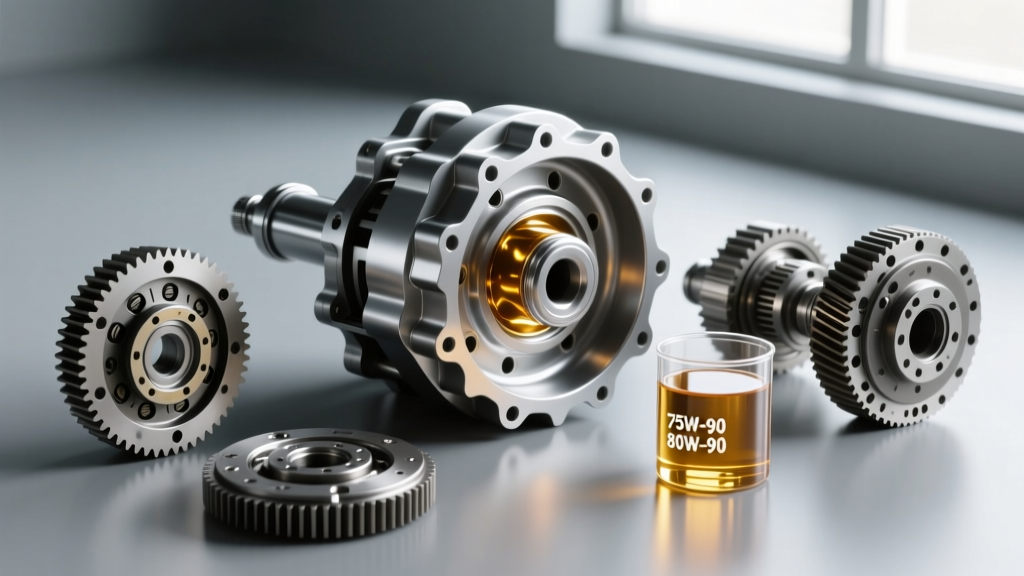
SAE Viscosity Grades: 75W-90, 80W-90, and 75W-140
Gear oil viscosity is governed by the SAE International J306 Standard. Unlike engine oil, gear oil viscosity numbers are much higher, but a 75W-90 gear oil is actually similar in true kinematic viscosity to a 10W-40 engine oil. The numbers represent flow characteristics at cold temperatures (the 'W') and high-temperature shear stability.
75W-90 Synthetic
The gold standard for modern daily drivers, light-duty trucks, and cold-climate applications. Synthetic 75W-90 offers superior cold-flow properties, reducing gear whine during winter startups and improving fuel economy by minimizing parasitic drag. It maintains a stable protective film up to 300°F (149°C).
80W-90 Conventional/Synthetic Blend
Traditional conventional gear oil. It is thicker at startup and is typically found in older heavy-duty applications or moderate climates. While cost-effective (usually $8-$12 per quart), it oxidizes faster than full synthetics under high-heat towing conditions.
75W-140 Full Synthetic
Designed for severe-duty applications, such as 3/4-ton and 1-ton trucks towing heavy loads (e.g., 5th-wheel trailers over 12,000 lbs). The higher high-temperature viscosity prevents the oil film from shearing and thinning out when differential temperatures exceed 250°F. However, using 75W-140 in a light-duty commuter vehicle will increase rolling resistance and reduce fuel efficiency.
2026 Buyer’s Guide: Top Synthetic Gear Oils Compared
Based on current market pricing, additive packages, and shear stability testing, here is a comparison of the top-tier differential fluids available for your next service.
| Brand & Product | Viscosity | API Spec & Features | Est. Price (2026) |
|---|---|---|---|
| Amsoil Severe Gear | 75W-90 | GL-5, High-zinc, synthetic esters for extreme towing | $21.99 / qt |
| Royal Purple Max Gear | 75W-90 | GL-5, Synerlec additive, includes LSD modifier | $24.50 / qt |
| Mobil 1 Synthetic Gear Lube | 75W-90 | GL-5, Excellent cold-flow, widely available OEM fill | $16.50 / qt |
| Valvoline SynPower Full Synthetic | 75W-140 | GL-5, Heavy-duty shear stability for 1-ton axles | $14.99 / qt |
| Red Line ShockProof Heavy | 75W-250 | GL-5, Solid film lubricant for competition/off-road | $32.00 / qt |
Note: For comprehensive technical data on baseline formulations, refer to Valvoline Gear Oil Technical Data sheets.
The Limited Slip Differential (LSD) Variable
If your vehicle is equipped with a clutch-type Limited Slip Differential (LSD)—such as the Ford Traction-Lok, Auburn, or Eaton Posi-Traction—you must address friction modifiers. Clutch-type LSDs rely on alternating friction and steel discs to transfer torque. Without a specialized friction modifier, these clutch packs will chatter, bind, and destroy themselves during low-speed turns.
Do You Need a Friction Modifier?
- YES: Clutch-type LSDs. Use OEM-specific modifiers like Motorcraft XL-3, Mopar 4318060AD, or GM ACDelco 10-4013. Add 2 to 4 ounces during the fill process.
- NO: Open differentials, Torsen (helical gear) differentials, and locking differentials (e.g., Detroit Locker, ARB Air Locker, Eaton E-Locker). These rely on gear meshing or pneumatic/mechanical locking mechanisms and do not contain clutch packs. Adding a friction modifier to a Torsen diff can actually reduce its torque-biasing effectiveness.
- MAYBE: Some premium synthetic oils (like Royal Purple Max Gear) claim to have friction modifiers pre-blended. However, for severe chatter issues, draining and adding a dedicated OEM modifier is the only guaranteed fix.
Differential Service Torque Specifications & Capacities
A proper differential service requires precision. Over-torquing drain plugs can crack the cast aluminum or stamped steel differential cover, while under-torquing leads to leaks and subsequent gear failure. Always replace the crush washer on the drain plug, or use a high-quality RTV/Gasket if removing the entire cover.
| Axle Model | Fill/Drain Plug Torque | Cover Bolt Torque | Fluid Capacity (Approx.) |
|---|---|---|---|
| Ford 8.8-inch | 33 lb-ft | 24 lb-ft (Cover) | 2.5 - 3.0 Pints |
| Dana 44 (Jeep/Truck) | 35 lb-ft | 30 lb-ft (Cover) | 3.5 - 4.0 Pints |
| GM 9.5-inch (14-Bolt SF) | 25 lb-ft | 22 lb-ft (Cover) | 5.5 Pints |
| Chrysler 8.25-inch | 25 lb-ft | 30 lb-ft (Cover) | 4.0 Pints |
| Toyota 8-inch (Solid Axle) | 36 lb-ft | N/A (Third Member) | 3.2 - 3.8 Pints |
Pro-Tips for Execution and Edge Cases
To elevate your differential service from a basic fluid swap to a professional-grade maintenance procedure, follow these industry-standard protocols:
1. The 'Fill Plug First' Rule
Never remove the drain plug until you have successfully broken loose the fill plug. Differential fill plugs are notoriously prone to seizing due to galvanic corrosion between the steel plug and the aluminum or cast-iron housing. If you drain the fluid and cannot remove the fill plug, your vehicle is immobilized. Use a 6-point socket or a high-quality 3/8-inch drive Allen bit to prevent rounding the plug head.
2. RTV vs. Reusable Gaskets
If your differential requires cover removal (e.g., older GM 10-bolt or Ford 8.8 without a drain plug), avoid cheap cork gaskets or cheap RTV silicones that can swell and block oil return channels. Use Permatex Ultra Black (81878) for a permanent, oil-resistant seal, or invest in a reusable gasket like the LubeLocker LL D44-2 for Dana 44 axles, which features a steel core with elastomer sealing beads and requires no RTV.
3. Diagnosing Wear via Fluid Analysis
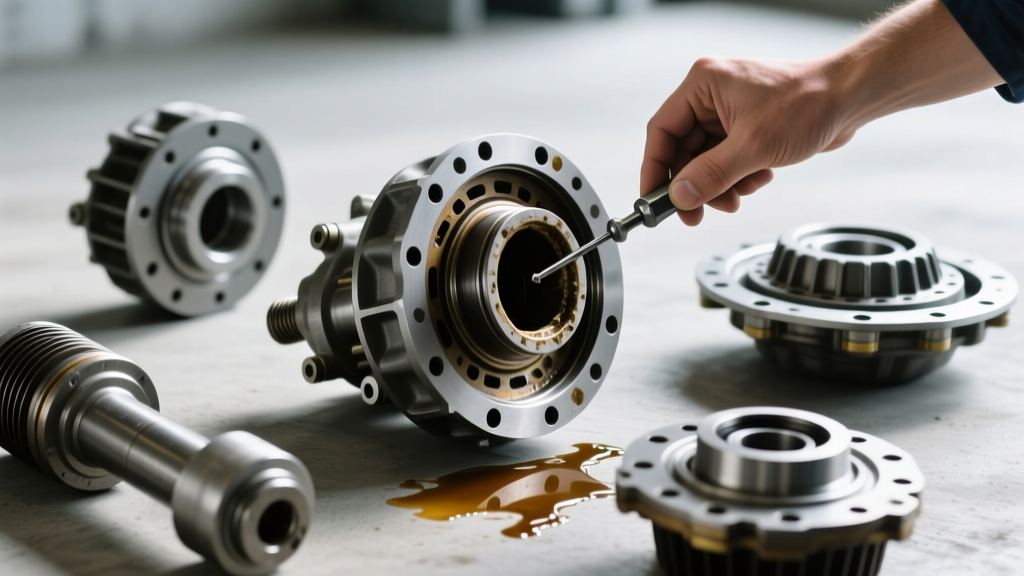
When you drain the old fluid, inspect it under a bright light. A fine, metallic 'glitter' suspended in the oil is normal wear from the hypoid gear break-in process. However, if you find jagged metal chunks, needle bearing fragments, or a thick, gritty sludge on the magnetic drain plug, your pinion or carrier bearings are failing. In these edge cases, a simple fluid change will not mask the underlying mechanical whine; a full differential rebuild with new Timken bearings and a master install kit is required.
Final Verdict: Choosing Your Fluid
Understanding what is differential service ultimately comes down to matching the fluid to the vehicle's operational demands. For daily driving and light towing, a premium 75W-90 synthetic like Mobil 1 or Amsoil provides the best balance of protection and efficiency. For heavy-duty towing in mountainous terrain, step up to a 75W-140 to maintain film strength. Always verify your LSD status, adhere strictly to OEM torque specs, and remember to service both the front and rear differentials simultaneously to maintain balanced drivetrain health.