Automotive vs. Medical Diagnostics: The Drivetrain Puzzle
Medical professionals spend years of residency mastering the anterior mediastinal mass differential—memorizing the "4 Ts" (Thymoma, Teratoma, Thyroid neoplasm, and Terrible Lymphoma) to diagnose chest anomalies. Fortunately for automotive technicians and DIY gearheads, diagnosing the correct differential fluid for your axle doesn't require a medical degree or an MRI. However, choosing the wrong gear oil can result in catastrophic ring and pinion failure, limited-slip clutch chatter, and thousands of dollars in rebuild costs.
As we navigate the 2026 automotive landscape, the divergence between traditional internal combustion engine (ICE) solid axles and modern electric vehicle (EV) reduction gearboxes has never been wider. This buyer's guide cuts through the marketing noise, providing exact OEM part numbers, API GL-5 chemical breakdowns, and precise torque specifications for your next differential service.
The Chemistry of Extreme Pressure (EP) Gear Oils
Unlike engine oil, which relies heavily on zinc and phosphorus (ZDDP) for boundary lubrication, differential fluid operates under immense sliding and shearing forces. Hypoid gear sets—found in 99% of rear-wheel-drive and four-wheel-drive axles—feature a pinion gear that sits below the centerline of the ring gear. This offset creates a severe sliding motion that would instantly wipe out standard motor oil.
To survive this, API GL-5 rated gear oils utilize sulfur-phosphorus Extreme Pressure (EP) additives. When the gear teeth mesh and temperatures spike above 200°F (93°C), these additives react chemically with the steel surfaces, forming a sacrificial iron sulfide/iron phosphate glass-like film. This prevents metal-to-metal contact and microwelding. According to API's official lubricant standards, GL-5 fluids contain up to 4% of these EP additives by volume, which is why they possess that distinct, pungent sulfur odor.
Viscosity Breakdown: 75W-90 vs. 80W-90 vs. 75W-140
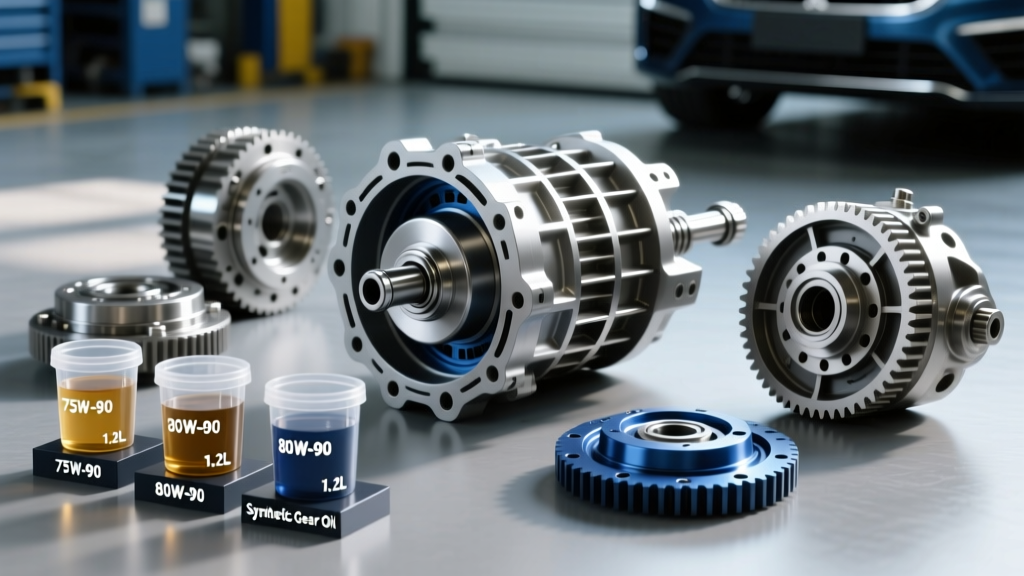
Governed by the SAE J306 standard, gear oil viscosity ratings are entirely different from engine oil ratings (SAE J300). A 75W-90 gear oil has a similar kinematic viscosity to a 10W-30 engine oil, but it is formulated with heavy shear-stable polymers.
- 75W-90 Synthetic: The modern gold standard for daily drivers and light trucks. It offers superior cold-weather flow (down to -40°C), reducing parasitic drivetrain drag and improving fuel economy by 1-2% compared to conventional oils.
- 80W-90 Conventional/Blend: Best reserved for older, high-mileage axles with looser bearing tolerances, or heavy-duty commercial trucks operating in consistently warm climates. It provides a thicker fluid film at the cost of cold-start sluggishness.
- 75W-140 Synthetic: Mandatory for heavy towing, off-road crawling, and high-horsepower applications (e.g., Ford Super Duty Dana 80 or GM 11.5-inch AAM axles). The higher high-temperature viscosity prevents the fluid film from being squeezed out under extreme shock loads.
2026 Differential Fluid Comparison & Pricing Matrix
| Fluid Type | API Rating | Base Stock | Best Application | Avg Price/Qt (2026) |
|---|---|---|---|---|
| ACDelco Dexron 75W-90 | GL-5 | Group IV PAO | GM 8.5/8.6 10-Bolt, 9.5 Semi-Floating | $16 - $19 |
| Motorcraft XL-3 75W-140 | GL-5 | Group III/IV Blend | Ford 8.8, 9.75, 10.5 (Towing) | $22 - $26 |
| Amsoil Severe Gear 75W-90 | GL-5 | Group IV/V | Aftermarket LSDs (Eaton Truetrac, Detroit Locker) | $24 - $29 |
| Red Line 75W-90 NS | GL-5 | Ester/PAO | Transaxles & Syncros (No Friction Modifiers) | $28 - $32 |
OEM Part Numbers & The Friction Modifier Dilemma
One of the most critical mistakes made during a differential service is ignoring the limited-slip differential (LSD) friction modifier requirement. Clutch-type LSDs (like the Auburn, Eaton Positraction, and Ford Traction-Lok) require a specialized friction modifier (usually an ester-based long-chain molecule) to allow the clutches to slip slightly during tight cornering.
If you omit the modifier, the clutches will bind, resulting in violent "chatter," tire hop, and premature clutch pack disintegration. Conversely, adding a modifier to a helical-gear LSD (like the Torsen or Eaton Truetrac) or an open differential is unnecessary and can reduce the fluid's overall load-bearing capacity.
Essential OEM Reference Numbers:
- GM / ACDelco: Part #88862624 (75W-90 Synthetic). For Eaton G80 locking differentials, GM explicitly states no friction modifier is required, as the G80 relies on a mechanical flyweight and pawl mechanism, not friction clutches.
- Ford / Motorcraft: Part #XZ-75W140 (75W-140 Synthetic). Requires Motorcraft Friction Modifier XL-3 (Part #U5MZ-19546-A) for Traction-Lok axles.
- Stellantis / Mopar: Part #68218655AA (75W-85 API GL-5). Used in newer Ram 1500 and Jeep Wrangler axles to meet strict CAFE fuel economy targets.
Service Intervals, Capacities, and Torque Specifications
While many modern OEMs claim differential fluid is "lifetime," independent tribologists and drivetrain engineers universally recommend draining and filling hypoid gear sets every 50,000 to 100,000 miles for street use, and every 15,000 to 30,000 miles if the axle is submerged in water or subjected to heavy towing. When performing the service, adhering to exact torque specifications is vital to prevent stripped threads in aluminum differential housings or deformed steel pans.
Common Axle Service Data
- GM 8.5 / 8.6-Inch 10-Bolt (Semi-Floating)
- Capacity: 2.1 Quarts
- Fill Plug Torque: 24 lb-ft
- Cover Bolt Torque: 25 lb-ft (Use RTV Silicone, not a pre-cut cork gasket, to prevent micro-leaks)
- Ford 8.8-Inch (Super 8.8 / IRS / Solid)
- Capacity: 2.5 to 3.0 Quarts (Varies by IRS vs Solid)
- Fill Plug Torque: 28 - 38 lb-ft
- Cover Bolt Torque: 28 - 38 lb-ft (Ford 8.8 uses a 12-bolt pattern; tighten in a crisscross star pattern)
- Dana 44 (Jeep Wrangler JL / Gladiator)
- Capacity: 2.0 Quarts (Front), 2.4 Quarts (Rear)
- Fill Plug Torque: 25 - 35 lb-ft
- Note: Rear Dana 44s on Rubicon trims feature an electronic locker. Ensure the fluid level is exactly at the bottom of the fill hole threads; overfilling can cause fluid to migrate past the axle seals into the brake backing plates.
The EV Paradigm Shift: Reduction Gear Fluids
As we look at the 2026 market, the rise of electric vehicles has introduced a new category: EV reduction gear fluids. Unlike traditional hypoid axles, EVs use helical or spur reduction gears spinning at upwards of 20,000 RPM. These require ultra-low viscosity fluids (often equivalent to a 5W-30 or dedicated ATF-like formulations) with high dielectric strength to prevent shorting the electric motors. Never substitute API GL-5 gear oil into an EV drive unit; the high sulfur content will corrode the copper windings and the high viscosity will cause catastrophic parasitic drag and overheating.
Final Verdict: Buy Based on Specs, Not Marketing
You don't need to memorize the anterior mediastinal mass differential to keep your vehicle's drivetrain healthy, but you do need to respect the chemistry of hypoid gear lubrication. Always verify the API GL rating, match the SAE viscosity to your climate and towing profile, and strictly follow the OEM's limited-slip additive requirements. By investing $60 to $100 in premium synthetic gear oil and a $12 tube of RTV sealant, you will easily extend the life of your ring and pinion well past the 200,000-mile mark.