The Diagnostic Framework: Beyond Basic Visual Inspections
When evaluating the health of a vehicle's drivetrain, the differential is often the most neglected component until a catastrophic failure occurs. Hypoid ring and pinion gears operate under extreme sliding friction and sheer pressure, relying entirely on a microscopic hydrodynamic wedge of gear oil to prevent metal-on-metal contact. As of 2026, while modern synthetic lubricants like Amsoil Severe Gear and Mobil 1 Synthetic have extended service intervals, the physical degradation of extreme pressure (EP) additives and friction modifiers remains an unavoidable reality. To standardize the evaluation of differential fluid color and condition, meticulous technicians and fleet managers are increasingly adopting structured diagnostic methodologies.
Applying Semantic Differential Survey Questions to Gear Oil
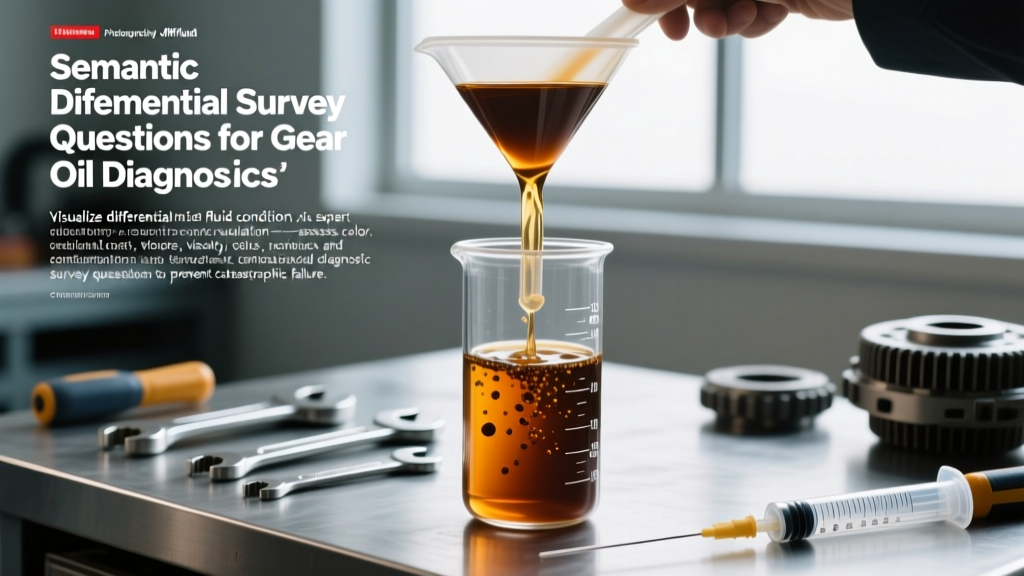
Originally a psychological measurement tool, the concept of using semantic differential survey questions has been brilliantly adapted for automotive diagnostics. By rating drained differential fluid on a scale between two opposing bipolar adjectives, technicians can eliminate subjective guesswork and create a repeatable, data-driven condition report. Instead of simply noting that the oil 'looks bad,' a semantic differential survey forces the evaluator to quantify the fluid's state across multiple vectors:
- Viscosity: Syrupy (1) ——— Watery (5)
- Color/Opacity: Translucent (1) ——— Opaque (5)
- Olfactory: Sweet/Sulfuric (1) ——— Acrid/Burnt (5)
- Particulate: Smooth (1) ——— Gritty (5)
By documenting these semantic differential survey questions during every preventive maintenance service, you establish a historical baseline. A sudden shift from a '2' to a '5' on the particulate scale between two 30,000-mile service intervals immediately flags an internal bearing or gear lapping issue before it results in a shattered pinion shaft.
Decoding Differential Fluid Color Profiles
The visual and olfactory cues of hypoid gear oil are direct indicators of the chemical state of the sulfur-phosphorus EP additives. Here is how to interpret the fluid once it is in the drain pan.
Translucent Amber to Honey (The Baseline)
Fresh 75W-90 or 75W-140 synthetic gear oil is naturally amber or light honey-colored. It should be highly translucent, allowing light to pass through easily. The smell is distinctly sulfurous—often compared to rotten eggs—which is entirely normal and indicates that the active EP additives are present and ready to sacrificially coat the gear teeth under high loads.
Opaque Black and Burnt (Thermal Degradation)
When gear oil turns pitch black and loses its translucency, it has undergone severe thermal oxidation. This is common in heavy-duty towing applications where the differential housing exceeds 250°F, causing the base oil to break down and the EP additives to deplete. If the semantic differential survey yields a 'Burnt' rating on the olfactory scale, the fluid has lost its shear stability. Continuing to run degraded oil will lead to accelerated pitting on the convex side of the ring gear teeth.
Milky or Chocolate Milk (Water Intrusion)
A milky, emulsified appearance indicates that water has mixed with the gear oil. This typically occurs when a clogged or missing axle tube breather cap creates a vacuum as the housing cools after a hot run, sucking in ambient moisture or puddle water. Water destroys the hydrodynamic lubrication wedge, leading to rapid rusting of the roller bearings and differential carrier. If you find milky fluid, a complete flush with a cheap mineral-based GL-5 oil, followed by a refill with premium synthetic, is mandatory.
Silver Glitter or Metallic Flakes (Mechanical Wear)
Fine silver glitter suspended in the oil indicates normal wear of the thrust washers or clutch packs in a limited-slip differential. However, if you find distinct metallic chunks or heavy ferrous sludge clinging to the magnetic fill plug, you are witnessing active catastrophic failure. This is usually a failing pinion bearing or a chipped ring gear tooth. No fluid change will fix this; a complete teardown and rebuild are required.
The Fluid Condition Diagnostic Matrix
Use the following table to cross-reference your semantic survey results with probable root causes and required actions.
| Fluid Condition | Semantic Rating | Root Cause | Required Action |
|---|---|---|---|
| Amber, Sulfur Smell | Viscous / Translucent / Sweet | Healthy EP Additives | Reinstall plug, monitor interval |
| Black, Acrid Smell | Thin / Opaque / Burnt | Thermal Oxidation, Towing | Flush and refill with 75W-140 |
| Milky Emulsion | Syrupy / Cloudy / Damp | Breather Clog, Submersion | Flush, replace breather, check seals |
| Heavy Metal Flakes | Gritty / Opaque / Metallic | Bearing Cage Failure, Gear Lapping | Teardown, inspect ring/pinion backlash |
Limited-Slip Differentials: The Friction Modifier Variable
When servicing clutch-type limited-slip differententials (LSDs) like the Ford Trac-Lok or the GM Gov-Lok, fluid condition takes on an additional layer of complexity. These units rely on specific friction modifiers (such as Ford XL-3 or GM EOS) to prevent clutch pack chatter during low-speed cornering.
Over time, the friction modifier depletes. If a customer reports a 'chattering' or 'binding' sensation when turning, the semantic differential survey of the drained fluid might reveal a normal amber color, but the mechanical symptom points to additive depletion. In these cases, draining the fluid, cleaning the clutch packs with brake cleaner, and refilling with a dedicated LS fluid (like Amsoil Synthetic Severe Gear with built-in friction modifier) is the most cost-effective first step before replacing the $150-$250 clutch pack assembly.
Note: Gear-type LSDs, such as the Eaton Truetrac or Torsen differentials, do not use clutch packs and therefore do not require friction modifiers. Using standard GL-5 75W-90 is perfectly adequate and preferred for these units.
Preventive Maintenance: Torque Specs and Capacities
Executing a differential fluid service requires precision. Over-torquing cover bolts on a stamped steel differential cover will warp the flange, guaranteeing a slow, persistent leak that will eventually run the axle dry. Below are exact specifications for common light-truck and SUV axles.
Ford 8.8-Inch Rear Axle (Super 8.8)
- Fluid Capacity: 2.5 to 3.0 quarts (depending on cover depth)
- Recommended Fluid: 75W-140 Synthetic GL-5 (Heavy towing) or 75W-90 (Daily driving)
- Cover Bolt Torque: 28 - 38 lb-ft (Use a crisscross pattern)
- Fill Plug Torque: 35 - 45 lb-ft
Dana Spicer 44 / Dana 44 HD
- Fluid Capacity: 2.0 to 2.5 quarts
- Recommended Fluid: 75W-90 or 80W-90 GL-5
- Cover Bolt Torque: 30 - 40 lb-ft
- Fill Plug Torque: 25 - 35 lb-ft
GM 9.5-Inch / 10.5-Inch 14-Bolt Semi-Float
- Fluid Capacity: 3.5 to 4.0 quarts
- Recommended Fluid: 75W-90 Synthetic GL-5
- Cover Bolt Torque: 45 - 50 lb-ft
- Fill Plug Torque: 25 - 30 lb-ft
For comprehensive rebuild procedures and carrier specifications, always refer to the official Spicer Differentials service manuals or the Eaton Automotive Differentials technical guides.
The Economics of Differential Preventive Maintenance
In 2026, the cost of a complete axle replacement or a professional ring-and-pinion setup ranges from $1,800 to $3,500, driven by the high cost of matched gear sets and precision machine shop labor. Conversely, a DIY differential fluid service costs between $45 and $80 for high-quality synthetic gear oil and a new RTV silicone gasket (or pre-cut LubeLocker gasket). Even if you take the vehicle to an independent shop, a standard drain-and-fill service typically runs between $120 and $180.
By integrating semantic differential survey questions into your routine maintenance logs, you transition from reactive repairs to predictive maintenance. Catching water intrusion early saves the $200 wheel bearings; catching thermal breakdown early saves the $800 ring and pinion set. Treat your gear oil as a diagnostic fluid, and your axles will easily outlast the vehicle itself.