The Quick Answer: How Long Does It Take to Change Differential Fluid?
For truck and SUV owners pushing their rigs to the limit—whether towing heavy trailers, navigating off-road trails, or hauling payload—the drivetrain takes a massive beating. If you are wondering exactly how long does it take to change differential fluid, the baseline answer is 60 to 90 minutes for a rear solid axle and 30 to 45 minutes for a front independent suspension (IFS) differential. However, this timeline fluctuates based on your axle type, whether your housing uses a removable cover or a drain plug, and the RTV silicone curing time required for a proper seal.
Modern trucks from the 2024–2026 model years, such as the Ford F-150 with the Max Trailer Tow Package or the Ram 2500 with the High-Output Cummins, generate immense heat at the ring and pinion. Upgrading your differential fluid is not just routine maintenance; it is a critical performance modification. In this guide, we break down the exact timelines, torque specifications, and synthetic fluid upgrades necessary to protect your investment.
Time Breakdown by Truck and SUV Axle Type
The architecture of your axle dictates the complexity of the service. Front IFS differentials on modern half-ton trucks typically feature simple drain and fill plugs, while heavy-duty rear axles require cover removal, thorough cleaning, and gasket resealing.
| Axle Type | Common Applications | Estimated Service Time | Complexity & Notes |
|---|---|---|---|
| Front IFS Differential | F-150, Silverado 1500, Tacoma | 30 - 45 Minutes | Low. Uses drain/fill plugs. Requires fluid pump. |
| Rear Solid Axle (Cover) | Ford 8.8, GM 9.5", Toyota 8" | 60 - 90 Minutes | Medium. Requires cover removal, scraping, and RTV cure time. |
| Heavy Duty (Dana 60/70) | Ram 2500, F-250 Super Duty | 90 - 120 Minutes | High. Large fluid volume (up to 4 qts), heavy cover, deep cleaning. |
| Front Solid Axle (Dana 44) | Jeep Wrangler, Ram Power Wagon | 60 - 90 Minutes | Medium. Often requires steering linkage clearance. |
Why Truck and SUV Owners Must Upgrade Their Diff Fluid
Factory-fill gear oils are designed for cost-efficiency and standard commuting, not for sustained 250°F+ temperatures generated during steep-grade towing or rock crawling. When gear oil exceeds its thermal threshold, it suffers from viscosity shearing, leading to metal-on-metal contact and catastrophic bearing failure.
Viscosity Upgrades: Moving to 75W-140 Synthetic
For trucks routinely towing over 8,000 lbs or operating in extreme ambient heat, upgrading from a standard 75W-90 to a 75W-140 full synthetic is highly recommended. Products like Royal Purple Max Gear 75W-140 (Part #01514) or Amsoil Severe Gear provide a thicker hydrodynamic film that resists shearing under extreme shock loads. While a 75W-140 fluid might slightly increase rolling resistance in sub-zero climates, the trade-off in gear protection for heavy-duty trucks is undeniable.
Friction Modifiers for Limited-Slip and Locking Diffs
If your SUV or truck is equipped with a clutch-type limited-slip differential (LSD) like the Ford Traction-Lok or Eaton Truetrac, you must address friction modifiers. Many premium synthetic oils include modifiers out of the bottle, but for severe use, adding a dedicated modifier (such as Ford XL-3 or GM EOS) during the fill process prevents clutch chatter during low-speed cornering. Always consult your specific axle manufacturer's documentation via resources like Dana Spicer's technical library to verify additive requirements.
Step-by-Step Performance Fluid Swap Guide
To execute a professional-grade differential service, precision and cleanliness are paramount. Here is the exact workflow for a rear solid axle cover removal.
Phase 1: Preparation and Drain (20 Minutes)
- Safety First: Chock the front wheels and support the rear axle on jack stands. Never rely on a hydraulic floor jack alone.
- Loosen the Fill Plug: Critical Step. Always remove the fill plug before draining the fluid. If the fill plug is seized, you do not want to be stuck with an empty differential.
- Break the Seal: Place a high-capacity drain pan (minimum 5-quart capacity for HD trucks) beneath the housing. Use a 10mm or 13mm socket to remove the cover bolts, leaving the top two bolts loosely threaded to let the housing pivot and drain into the pan.
Phase 2: Cleaning and Inspection (25 Minutes)
Once drained, remove the cover entirely. Use a plastic scraper and aerosol brake cleaner to remove all old RTV silicone from both the axle housing and the cover. Do not use metal scrapers, as scoring the mating surface will guarantee future leaks. Inspect the magnetic drain plug or the internal ring gear for excessive metallic paste; fine glitter is normal, but chunks of metal indicate bearing or gear failure.
Phase 3: RTV Application and Torque (25 Minutes)
For trucks and SUVs, standard cork gaskets often fail under high-heat towing conditions. We recommend using a high-temp, oil-resistant RTV silicone like Permatex Ultra Black (Part #81878). Apply a continuous 1/8-inch bead around the cover, encircling every bolt hole. Allow the RTV to skin over for 10 minutes before mating it to the housing.
Crucial Torque Specifications:
- Ford 8.8 / 9.75-inch Cover Bolts: 33 lb-ft
- GM 9.5-inch / 10-Bolt Cover Bolts: 25 lb-ft
- Dana 60 Cover Bolts: 35 lb-ft
Use a star-pattern tightening sequence and a calibrated inch-pound or foot-pound torque wrench. Over-torquing will distort thin stamped-steel covers and cause immediate leaks.
Phase 4: The Fill (15 Minutes)
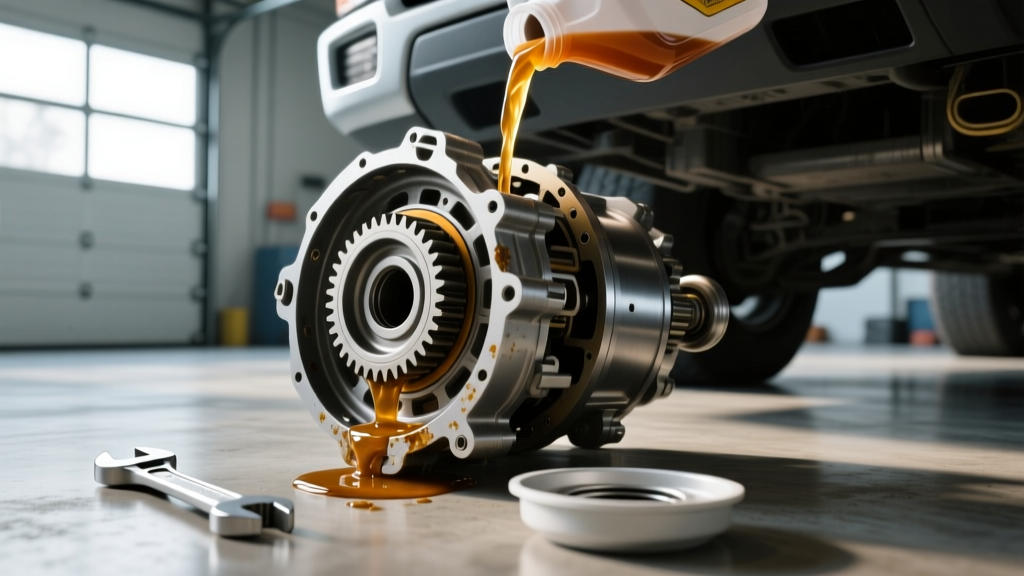
Attach a high-quality fluid transfer pump to your synthetic gear oil bottles. Pump the fluid into the fill hole until it reaches the exact bottom lip of the opening. For a Ford Sterling 10.5-inch rear axle, expect to use roughly 3.5 to 4.0 quarts. For a standard Ford 9.75-inch, capacity is approximately 2.5 to 3.0 quarts. Reinstall the fill plug and torque to 22-30 lb-ft.
Real-World Costs and Interval Recommendations
Understanding the financial and temporal investment helps you plan your garage time. A complete front and rear differential service on a modern 4x4 truck requires between 4 to 6 quarts of synthetic gear oil, one tube of RTV, and potentially a friction modifier.
- Synthetic Gear Oil (75W-90 or 75W-140): $18 - $28 per quart
- Friction Modifier (if required): $10 - $15
- RTV Silicone & Brake Clean: $12 - $18
- Total DIY Cost: $100 - $160
Compare this to a dealership charge of $350 to $500+, and the DIY route pays for itself immediately. For performance trucks and SUVs subjected to heavy towing or off-road water crossings, we recommend changing the differential fluid every 30,000 to 50,000 miles. If you submerge your axles in deep water, the thermal shock will instantly suck moisture past the axle seals into the gear oil, turning it into a milky emulsion that destroys bearings. In these cases, an immediate fluid swap is mandatory.
Diagnosing Gear Oil Degradation Early
Don't wait for the mileage interval if your truck exhibits warning signs. A whining noise from the rear axle that changes pitch during deceleration often points to pinion bearing wear exacerbated by degraded fluid. Furthermore, if you detect a sulfurous, burnt odor near the rear differential after a towing run, your fluid has exceeded its thermal limits and lost its extreme-pressure (EP) additive efficacy. Upgrading to a dedicated synthetic racing or severe-duty gear oil will mitigate these symptoms and extend the lifespan of your ring and pinion set.