The Architecture Gap: Gas V8 vs. Heavy-Duty Diesel Cooling
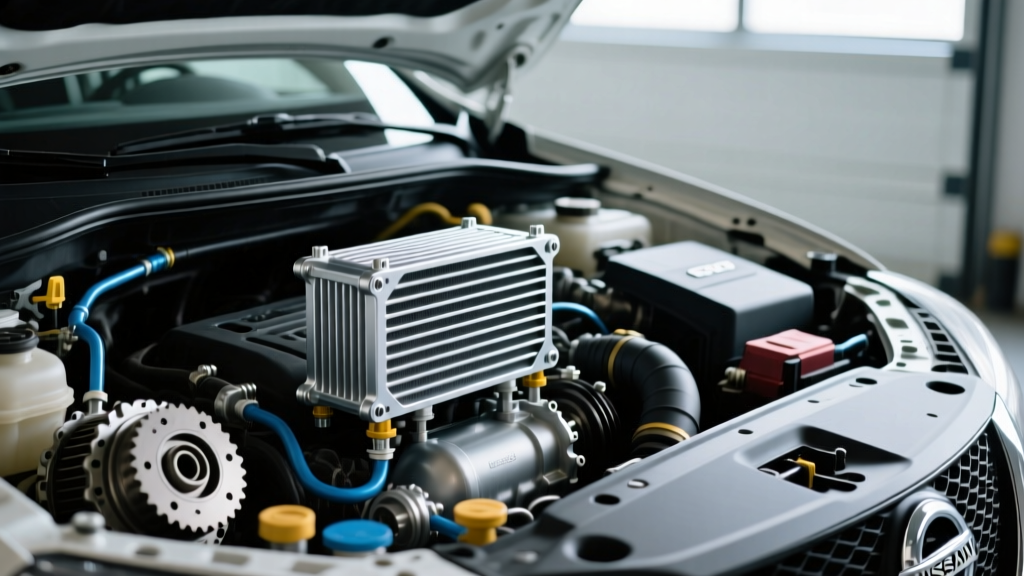
The 5.3L Chevy V8—whether the older LM7/L59 iron-block variants or the newer EcoTec3 L83/L3G aluminum blocks—is a legendary powerplant. However, when paired with the 4L60E or 7E/6L80 automatic transmissions and tasked with towing 8,000+ pound trailers, the factory cooling architecture quickly reveals its limits. In 2026, as trailer weights and aerodynamic drag coefficients continue to climb, gas truck owners are increasingly looking toward heavy-duty diesel truck cooling solutions to prevent catastrophic ATF (Automatic Transmission Fluid) shear and clutch pack glazing.
Diesel trucks, such as those equipped with the 6.6L Duramax and Allison 1000 transmissions, operate under immense continuous torque loads. To manage this, diesel platforms utilize massive stacked-plate transmission coolers with high-flow 5/8-inch or 3/4-inch lines. In contrast, the factory 5.3L gas truck setup relies on a smaller tube-and-fin or basic plate-and-fin auxiliary cooler fed by restrictive 3/8-inch lines. By understanding the factory routing and adapting diesel-spec cooling components, you can bulletproof your 5.3L Chevy for extreme duty.
Decoding the 5.3 Chevy Transmission Cooler Lines Diagram
Before splicing into your system or deleting thermal bypass valves, it is critical to understand the OEM fluid routing. When referencing a standard 5.3 chevy transmission cooler lines diagram, you will notice a specific serial flow designed to balance warm-up times with peak-load cooling.
OEM Routing Sequence
- Transmission Outlet (Pressure Side): Hot fluid exits the transmission case (typically the upper or rear-facing fitting on the 6L80, and the upper fitting on the 4L60E) under high pressure.
- Radiator Bottom Tank: The fluid routes, this acts as a thermal buffer, preventing the transmission from overcooling in winter while providing moderate heat exchange during summer driving.
- Auxiliary Cooler: Fluid then routes to the front-mounted auxiliary heat exchanger (if equipped from the factory with the Z82 or NHT trailering package) via rubber hose segments.
- Return Line: Cooled fluid re-enters the transmission at the lower/front fitting, passing through the lube circuit to cool the clutch packs and planetary gears.
Expert Note: Never reverse the flow on a 6L80 or 8L90 transmission. The internal lube regulator valve relies on return-line pressure to feed the torque converter and clutch cooling circuits. Reversing the lines based on an misinterpreted 5.3 chevy transmission cooler lines diagram will result in immediate converter ballooning and clutch failure.
The 6L80 Thermal Bypass Valve Dilemma
Modern 5.3L Chevys equipped with the 6L80 feature a thermal bypass valve located on the transmission case or integrated into the cooler lines. This valve restricts flow to the auxiliary cooler until the ATF reaches approximately 180°F to 190°F (82°C - 88°C). While thisA) while towing heavy grades. Many diesel truck owners delete these valves entirely to ensure maximum flow to the cooler at all times. For a 5.3L gas truck doing diesel-level work, bypassing this valve and routing directly to a high-capacity diesel-style cooler is a highly recommended 2026 upgrade.
Sizing a Diesel-Spec Stacked-Plate Cooler for the 5.3L
When upgrading to a transmission cooler for diesel trucks to use on your gas V8, you must transition from cheap tube-and-fin designs to stacked-plate architecture. Stacked-plate coolers (like those used on Cummins and Duramax platforms) offer up to 30% more surface area and significantly lower pressure drop than tube-and-fin equivalents.
Because the 6L80 transmission pump can push upwards of 4 to 5 gallons per minute (GPM) at higher RPMs, restricting flow with an undersized cooler will trigger the converter clutch (TCC) to slip or fail to apply. You need a cooler rated for at least a 30,000 to 40,000 Gross Vehicle Weight (GVW).
| Specification | OEM 5.3L Gas (6L80) | Heavy-Duty Diesel (Allison 1000) | Upgraded 5.3L (Diesel-Spec) |
|---|---|---|---|
| Cooler Type | Tube-and-Fin / Basic Plate | Massive Stacked-Plate | High-Flow Stacked-Plate |
| Line Diameter | 3/8" (9.5mm) | 5/8" to 3/4" (15.8-19mm) | 1/2" (12.7mm) AN-8 |
| GVW Rating | 10,000 - 15,000 lbs | 30,000 - 40,000 lbs | 30,000+ lbs |
| Pressure Drop | Moderate to High | Very Low | Low |
| Target Temp (Towing) | 210°F - 230°F (Danger) | 180°F - 195°F | 175°F - 190°F |
Plumbing the Upgrade: AN Fittings and Line Pressures
Adapting a diesel-truck transmission cooler to a 5.3L Chevy requires abandoning the factory push-lock rubber hose clamps, which are prone to blowing off under the 6L80's peak line pressures (which can spike to 250+ PSI in lower gears under heavy load).
Required Hardware and Specs
- Cooler Selection: Derale 13740 Hyper-Cool or Mishimoto MMTC-U Universal Stacked-Plate. Both offer -8 AN (1/2") O-ring boss (ORB) ports.
- Transmission Case Adapters: You will need 5/16-24 UNF or 1/4-18 NPT to -6 AN or -8 AN male adapters, depending on your specific transmission case year. Torque Spec: 18-22 lb-ft for case fittings. Do not over-torque, as the aluminum case threads will strip easily.
- Radiator Adapters: The radiator bottom tank typically uses a 1/2-20 UNF or 5/8-18 UNF inverted flare / O-ring fitting. Torque Spec: 12-15 lb-ft. Use a backup wrench on the radiator neck to prevent twisting the plastic tank.
- Hose: Use PTFE-lined, stainless steel braided -8 AN hose. PTFE is mandatory in 2026, as traditional rubber AN hoses can degrade when exposed to the aggressive detergents in modern Dexron VI or Dexron ULV synthetic fluids over long periods.
Real-World Costs and Installation Insights
Upgrading your 5.3L to a diesel-grade cooling system is an investment in longevity. A complete kit, including a high-end stacked-plate cooler, PTFE braided lines, and aluminum AN fittings, typically ranges from $350 to $600. While this is significantly higher than the $60 tube-and-fin kits found at local auto parts stores, the cost is negligible compared to a $3,500+ 6L80 rebuild caused by glazed clutches and warped separator plates.
When mounting the diesel-spec cooler, ensure it is placed in front of the A/C condenser but behind the primary engine radiator fan shroud if possible,I: Derale Performance Transmission Coolers for GVW sizing charts and stacked-plate flow data.
By treating your 5.3L gas truck with the same thermal management respect as a heavy-duty diesel, you ensure that your transmission will survive the steepest grades and heaviest payloads without breaking a sweat.