Is It a Bad Torque Converter or the Wrong Stall Speed?
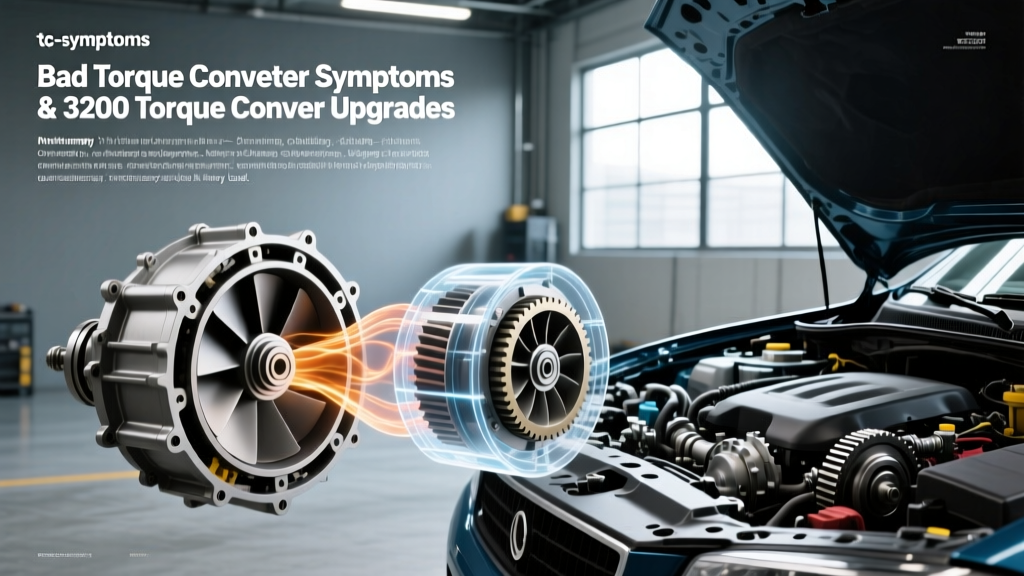
When your automatic transmission vehicle begins to exhibit erratic behavior off the line, shudders at highway speeds, or refuses to lock up, the immediate suspicion often falls on a failing torque converter. However, for performance enthusiasts running modified engines—particularly those with aggressive camshafts or forced induction—the line between a bad torque converter and an inadequate one is frequently blurred. Understanding the true bad torque converter symptoms versus the performance bottleneck of a stock unit is critical before you drop the transmission and invest in a 3200 torque converter upgrade.
In the performance transmission world, misdiagnosing a stock converter's inability to handle a built engine as a 'mechanical failure' leads to wasted time and money. This guide will break down the definitive mechanical symptoms of a failing torque converter, explain the 'false failure' phenomenon in cammed vehicles, and detail why stepping up to a 3200 torque converter is often the ultimate fix for street/strip platforms like the GM 4L60E, 4L80E, and Ford 4R70W.
4 Definitive Symptoms of a Mechanically Bad Torque Converter
Before assuming your stock converter is simply inadequate for your horsepower goals, you must rule out actual mechanical degradation. A torque converter is a complex fluid coupling containing a pump, turbine, stator, and a Torque Converter Clutch (TCC). When these internal components fail, they present distinct symptoms.
1. TCC Shudder and Lockup Failure
The most common bad torque converter symptom is a rhythmic shudder felt between 35 and 50 MPH under light throttle. This occurs when the TCC friction material degrades or the apply valve in the transmission valve body wears out, causing the clutch to rapidly apply and release. If your transmission fluid smells burnt and contains excessive metallic or friction clutch debris, the TCC piston is likely compromised. According to Sonnax Transmission Tech Resources, ignoring TCC shudder will eventually contaminate the transmission's solenoid pack and valve body, leading to catastrophic line pressure failures.
2. Severe Slipping and Stator Sprag Failure
If your vehicle feels incredibly sluggish off the line and RPMs flare wildly without a corresponding increase in vehicle speed, the internal stator sprag (one-way clutch) may have failed. The stator is responsible for redirecting fluid flow to multiply torque. When the sprag breaks, the stator freewheels in both directions, eliminating torque multiplication entirely. This is a definitive mechanical failure, not a tuning issue.
3. Needle Bearing Whine and Turbine Fin Damage
A high-pitched whining noise that changes with engine RPM (not vehicle speed) often points to failing Torrington needle bearings inside the converter. Furthermore, if you have subjected a stock converter to high-horsepower drag radials or trans-brake launches, the internal turbine fins can physically bend or shear off, resulting in a sudden, massive loss of hydraulic efficiency and violent driveline vibrations.
4. Overheating and Fluid Degradation
While some heat is normal, a stock converter that is constantly slipping due to internal wear will push transmission fluid temperatures past 220°F (104°C) during normal cruising. This rapidly breaks down the fluid's shear stability, leading to varnish buildup on the clutch packs.
The 'False Failure': When Your Stock Converter Bottlenecks Your Build
Here is where the performance enthusiast gets tricked. You install a 224/228 duration camshaft in your 5.3L LS or 5.0L Coyote, and suddenly the car feels terrible off the line. It bucks, it hesitates, and it feels like the transmission is slipping. Your torque converter is not broken; it is just mathematically wrong for your engine.
Stock torque converters typically feature a stall speed between 1600 and 1800 RPM. They are designed to load the engine at the exact RPM where a stock camshaft produces peak manifold vacuum and low-end torque. When you introduce a performance camshaft with high overlap, the engine produces virtually zero usable torque below 2500 RPM. The stock 1800-stall converter tries to load the engine in this 'dead zone,' causing the engine to bog down, the ECU to pull timing, and the driver to feel a massive hesitation. To the untrained seat-of-the-pants dyno, this feels exactly like a bad torque converter slipping.
Why the 3200 Torque Converter is the Street/Strip Sweet Spot
To resolve the false failure symptom and properly match your drivetrain, upgrading to a 3200 torque converter is the industry standard for mild-to-wild naturally aspirated and low-boost setups. A 3200 RPM flash stall allows the engine to bypass the lazy 1500-2500 RPM range and load the motor exactly where the camshaft begins to make aggressive power.
Experts at Vigilante Performance Torque Converters note that a billet 3200-stall unit provides a dramatic improvement in 60-foot times and eliminates the off-the-line bucking associated with cammed engines, while still maintaining enough coupling efficiency for comfortable highway driving and TCC lockup.
Diagnostic Table: Failing Unit vs. Wrong Stall vs. 3200 Upgrade
| Symptom / Behavior | Mechanically Bad Stock TC | Stock TC on Cammed Engine | Properly Tuned 3200 TC |
|---|---|---|---|
| Off-the-Line Response | Flares wildly, no torque multiplication (Sprag failure) | Bogs down, feels heavy, hesitates | Instant loading, aggressive launch, no bog |
| Highway Cruising (45-65 MPH) | Rhythmic shudder, TCC fails to lock | Locks up fine, but downshifts frequently | Smooth lockup, holds gear, lower RPM cruising |
| Transmission Fluid Temp | Consistently over 210°F due to internal slip | Normal (170°F - 190°F) | Requires auxiliary cooler, runs 180°F - 195°F |
| Debris in Pan | Heavy metallic flakes, burnt friction material | Normal fine metallic paste | Normal fine metallic paste |
Supporting Mods: Cooling, Fluids, and Tuning Your 3200 Setup
Upgrading to a 3200 torque converter is not a simple drop-in replacement. Because a higher stall speed inherently generates more heat due to increased fluid shear before the TCC locks, you must address the supporting systems to prevent destroying your transmission.
1. Mandatory Auxiliary Cooling
The factory radiator cooler is insufficient for a 3200-stall converter in a vehicle seeing track time or heavy stop-and-go traffic. You must install an auxiliary cooler with a minimum rating of 24,000 GVW, such as the Tru-Cool 40k (LPD4544). Plumb this in series after the radiator cooler to ensure the fluid is returned to the transmission at an optimal 180°F.
2. Fluid Selection
High-stall converters demand fluid with superior shear stability and high flash points. Step away from standard Dexron VI or Mercon LV if your transmission builder permits, and opt for a dedicated synthetic racing ATF like Amsoil Signature Series or Mobil 1 Synthetic ATF. These fluids resist foaming under the high-RPM centrifugal forces inside a 3200-stall billet cover.
3. TCC Tuning and Line Pressure
If you are running a modern transmission like the GM 6L80E or 8L90E, the ECU's factory TCC apply tables will clash with a 3200-stall converter. Using software like HP Tuners, you must raise the TCC apply speed. Attempting to lock a 3200 converter at 1800 RPM in 4th gear will cause the engine to lug, misfire, and eventually shatter the converter hub. Furthermore, increasing base line pressure by 10-15% in the lower gears is critical to prevent the transmission clutches from slipping while the converter is multiplying torque during a hard launch.
4. Installation Torque Specs
When installing your new billet 3200 torque converter, precision is mandatory. Always measure the converter seating depth (typically 1/2 to 5/8 inch past the bellhousing mating surface) to ensure the transmission oil pump gears are fully engaged. When mating the converter to the flexplate, use Grade 10.9 or ARP bolts. For standard GM M10x1.5 flexplate bolts, the torque spec is 35 lb-ft with a medium-strength threadlocker. For M12 bolts, torque to 45 lb-ft. Never use impact guns to seat these bolts, as you risk warping the converter cover and inducing immediate TCC drag.
Conclusion: Diagnose Before You Upgrade
Identifying bad torque converter symptoms requires a critical eye. If your fluid is clean, your line pressures are stable, and your TCC locks smoothly on the highway, your converter isn't bad—it's just holding your cammed engine back. Upgrading to a 3200 torque converter bridges the gap between your engine's powerband and the pavement, transforming a sluggish, bucking drivetrain into a responsive, tire-shredding machine. Just remember to pair your new stall speed with the requisite cooling and ECU tuning to ensure your transmission lives to see the next racing season.