The First Step in Axle Diagnostics: Reading the Drain Pan
When a customer or enthusiast complains of a whining, howling, or clunking rear end, the instinct is often to immediately tear down the differential to inspect the ring and pinion. However, as any seasoned drivetrain specialist knows, the most critical diagnostic evidence is often drained into the pan before a single wrench is turned. The color of differential fluid acts as a chemical black box, recording the thermal, mechanical, and environmental history of the axle assembly.
Modern gear oils, whether conventional 80W-90 or full synthetic 75W-140 formulations, are engineered with extreme pressure (EP) additives, anti-wear agents, and rust inhibitors. When an axle begins to fail, these additives deplete, and the base oil degrades in highly specific ways. By correlating the fluid's visual and olfactory condition with specific acoustic symptoms, you can accurately pinpoint whether you are dealing with a simple friction modifier deficiency, a blown pinion seal, or catastrophic bearing spalling.
Expert Insight: Never diagnose a differential noise without first performing a fluid inspection. Replacing a $2,000 ring and pinion set won't fix a howl caused by water-contaminated fluid, and tearing down a healthy carrier won't solve limited-slip chatter caused by depleted friction modifiers.
The Diagnostic Matrix: Fluid Color vs. Axle Noise
Use the following matrix to cross-reference the physical state of your drained gear oil with the acoustic symptoms present during your road test.
| Fluid Color / Condition | Associated Noise Profile | Probable Failure Mode | Recommended Action |
|---|---|---|---|
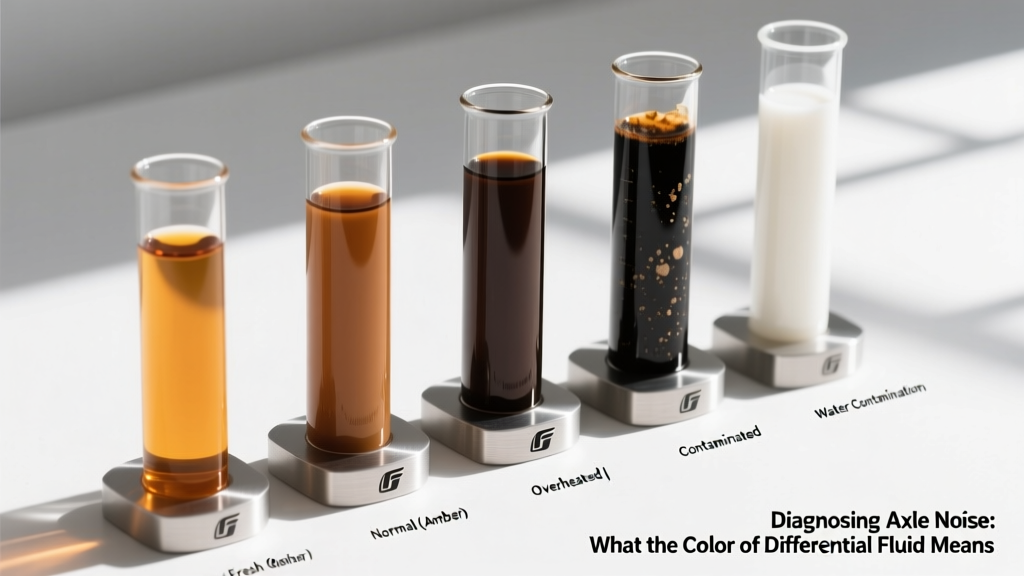
| Translucent Amber / Honey | High-pitched whine on deceleration | Pinion bearing preload loss or improper gear pattern | Check pinion preload and gear backlash; fluid is healthy. |
| Opaque Black / Burnt Smell | Howling under heavy load or towing | Thermal breakdown; extreme pressure (EP) additive depletion | Flush axle, inspect gears for pitting, upgrade to synthetic 75W-140. |
| Milky / Chocolate Milk | Grinding or constant low-speed howl | Water intrusion via axle seals or clogged breather vent | Replace axle seals, clean breather, inspect bearings for rust. |
| Dark Gray with Metallic Glitter | Rhythmic clunking or rotational vibration | Catastrophic bearing cage failure or gear tooth spalling | Complete differential rebuild; replace all bearings and races. |
| Normal Amber, but 'Chattering' | Low-speed binding or tire chirp in turns | Limited-slip clutch pack friction modifier depletion | Add 4 oz of LS friction modifier (e.g., GM EOS 1052358). |
Decoding the Color of Differential Fluid
1. Translucent Amber (The Baseline)
Fresh 75W-90 or 80W-90 gear oil is typically a clear, translucent amber or honey color. If you drain the fluid and it looks relatively new, but the axle is still whining, your issue is mechanical, not chemical. A whine that changes pitch exactly with vehicle speed (not engine RPM) usually points to the ring and pinion. If the noise occurs strictly on coast-down (foot off the throttle), the pinion bearing preload may have relaxed, or the gear pattern is biased too heavily toward the toe of the gear tooth.
2. Opaque Black and Burnt (Thermal Death)
When gear oil turns jet black and smells like burnt toast, it has exceeded its thermal threshold. This is incredibly common in 3/4-ton and 1-ton trucks (like those with AAM 11.5 or Dana 80 axles) used for heavy towing without auxiliary differential coolers. Once the fluid surpasses 250°F consistently, the sulfur-phosphorus EP additives shear and carbonize. The resulting loss of film strength allows microscopic asperities on the ring and pinion gears to weld and tear apart, creating a permanent howl. According to Red Line Oil's gear lubricant specifications, upgrading to a high-ester synthetic like a 75W-140 can increase thermal stability by over 40% in these severe-duty applications.
3. Milky or Emulsified (Water Intrusion)
If your fluid looks like a chocolate milkshake, water has entered the housing. This happens when axle seals fail, or more commonly, when the axle breather tube becomes clogged with mud. As the axle cools after driving through deep water, it creates a vacuum that sucks moisture past the seals. Emulsified fluid loses nearly all of its load-bearing capacity. If left unchecked, the water will cause the carrier and pinion bearings to rust and pit, leading to a gritty, grinding noise that is most noticeable at speeds under 20 MPH.
4. Silver Glitter and 'Sparkles' (Mechanical Destruction)
While a very fine, almost invisible metallic paste on the drain plug magnet is normal wear for a high-mileage axle, visible silver glitter or metallic flakes suspended in the fluid is a death sentence for the current gear set. This indicates that the needle bearings inside the pinion gear (common in Dana 44 and Ford 8.8 axles) or the carrier bearing cages are actively disintegrating. If you see chunks of metal larger than a grain of rice, a full teardown and replacement of the master rebuild kit is mandatory.
Correlating Fluid Condition to Specific Differential Noises
To properly diagnose the axle, you must combine the fluid analysis with a dynamic road test. Here is how to isolate the noise based on driving conditions:
- Drive Whine (Under Load): Usually indicates wear on the drive side of the ring gear teeth. Often accompanied by dark, degraded fluid due to the high friction loads on the drive flank.
- Coast Whine (Deceleration): Points to pinion bearing wear or an improperly set gear pattern. The fluid may look surprisingly clean because the load on the coast side is significantly lower.
- Constant Howl (Load and Unload): Typically a failed carrier bearing or a pinion bearing that has completely lost its crush sleeve preload. Check for milky fluid, as water ingress often attacks the carrier bearings first due to their position at the bottom of the sump.
- Limited-Slip Chatter: If you have an Eaton Truetrac, Auburn, or OEM clutch-type LSD, a chattering or binding sensation during tight parking lot turns means the clutch packs are sticking. The color of differential fluid might be perfectly normal, but the chemical friction modifiers have sheared. Adding a specific modifier like Motorcraft XL-3 or GM EOS (Part #1052358) usually resolves this within 50 miles of driving.
Expert Troubleshooting Protocol: From Drain Pan to Teardown
Follow this exact workflow when a vehicle arrives with suspected differential noise:
Step 1: The Drain and Inspect
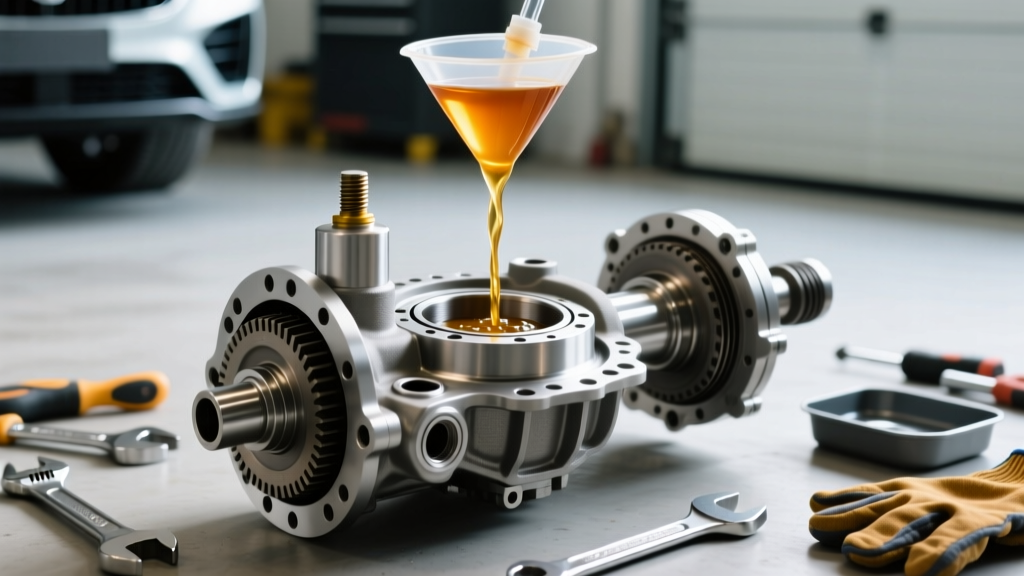
Remove the differential cover (or drain plug). For a Ford 8.8-inch rear end, remove the 10 cover bolts and carefully pry the cover loose. Inspect the fluid immediately in a well-lit area. Note the color, smell, and the size of the debris on the magnetic plug. Pro Tip: Run your finger through the fluid. If you feel distinct ridges or grit, the bearings are scored.
Step 2: Acoustic Isolation (The Road Test)
Drive the vehicle on a smooth, newly paved road (to eliminate tire tread noise). Perform a sweep from 30 to 60 MPH. Note if the noise changes when you load the gears (accelerate) versus unload them (coast). Tire noise will remain constant or change with road surface; differential noise will change strictly with throttle position and vehicle speed.
Step 3: Mechanical Verification
If the fluid was burnt or glittery, or if the noise persists after a fresh fluid fill, you must measure the internal tolerances. Using a dial indicator and magnetic base, check the ring gear backlash. Most standard street differentials (like the GM 10-bolt or Chrysler 8.25) require a backlash between 0.006" and 0.010". Next, check the pinion bearing preload using an inch-pound torque wrench. For a used pinion bearing setup, the rotational preload should typically read between 15 and 25 in-lbs. If the pinion spins freely with zero resistance, your crush sleeve has collapsed or the pinion nut has backed off, guaranteeing a howling noise and eventual gear destruction.
Fluid Specifications, Torque Specs, and Real-World Costs
When reassembling or servicing the differential, precision is non-negotiable. Below are standard specifications for common axle platforms encountered in the shop:
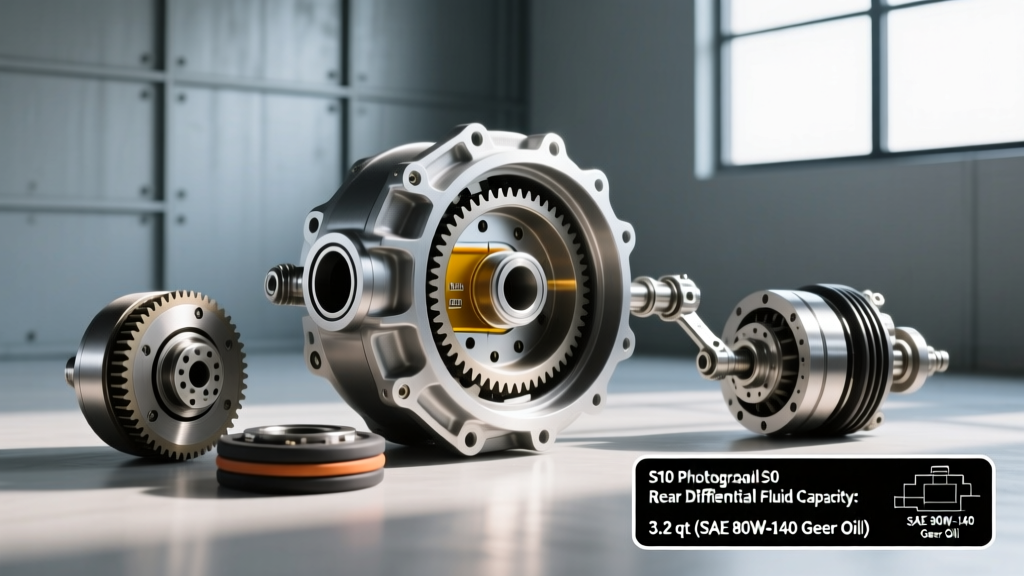
- Ford 8.8-Inch: 10 cover bolts. Torque to 35 ft-lbs. Fluid capacity: ~2.0 quarts of 75W-140 Synthetic. Requires 4 oz friction modifier if equipped with Trac-Lok.
- Dana 44: Fill plug torque: 25-35 ft-lbs. Fluid capacity: ~1.75 quarts of 75W-90. Pinion nut torque (for new crush sleeve): 200-250 ft-lbs until target preload is reached.
- GM 8.6 / 9.5-Inch (10-Bolt / 14-Bolt SF): Fill plug torque: 25 ft-lbs. Requires strict adherence to GM EOS friction modifier for G80 locking differentials to prevent premature clutch pack wear.
Cost Expectations (2026 Market Rates):
A standard differential fluid service using premium synthetics (like Amsoil Severe Gear or Mobil 1) and OEM friction modifiers will cost between $60 and $90 in materials. If professional labor is required, expect to pay $150 to $225 depending on shop rates. However, if your fluid inspection reveals metallic glitter and a full rebuild is required, a master overhaul kit (bearings, races, crush sleeve, pinion nut, seals) costs $150 to $300, while professional labor for a complete ring and pinion setup and rebuild will range from $1,200 to $2,500.
For further reading on setting proper gear patterns and interpreting marking compound, consult the technical archives at Summit Racing's Expert Advice portal, which provides excellent visual guides on drive-side versus coast-side pattern interpretation.
Final Thoughts
The color of differential fluid is the most underutilized diagnostic tool in the drivetrain specialist's arsenal. By taking five extra minutes to properly analyze the drained gear oil, you can save hours of misdirected labor, avoid unnecessary parts replacements, and accurately identify whether an axle needs a simple fluid flush, a friction modifier top-off, or a complete bench rebuild. Treat your drain pan like a crime scene—every drop of oil tells a story about the mechanical health of your differential.