The Physics of Hypoid Gear Noise and Lubrication Failure
Differential noise is rarely just an annoyance; it is an acoustic telemetry system broadcasting the internal health of your axle assembly. Unlike traditional spur gears that primarily roll, the hypoid ring and pinion gears found in 95% of modern rear-wheel-drive and four-wheel-drive axles rely heavily on sliding friction. This extreme sliding action generates immense localized heat and shear forces, demanding gear oils fortified with sulfur-phosphorus extreme pressure (EP) additives.
When these additives deplete or the base oil shears out of grade, boundary lubrication fails. The resulting metal-on-metal contact causes micropitting on the gear flanks, which manifests as a high-frequency whine or howl. Before initiating a costly teardown of the third member, master technicians must accurately isolate the noise source and determine if it is time to replace rear differential fluid or if mechanical intervention is required.
Differential Noise Diagnostic Matrix
Accurate diagnosis requires correlating the acoustic frequency and driving condition with specific internal components. Use the following matrix to isolate the failure point:
| Noise Type | Driving Condition | Probable Cause | Action Required |
|---|---|---|---|
| Whine on Deceleration | Coast (foot off throttle) | Pinion bearing preload loss or coast-side gear wear | Check pinion nut torque; inspect fluid for brass shavings |
| Howl on Acceleration | Drive (under load) | Carrier bearing wear or drive-side micropitting | Replace carrier bearings; upgrade to high-viscosity synthetic |
| Rumble / Chatter | Low-speed cornering | Limited-slip clutch stick-slip or spider gear binding | Drain, flush, and add friction modifier; replace clutches if unresolved |
| High-Pitch Siren | All speeds (matches driveshaft RPM) | Pinion bearing cage failure | Immediate axle rebuild required; do not drive |
| Clunk on Engagement | Shifting from Park to Drive/Reverse | Excessive backlash or worn slip yoke | Check gear backlash with dial indicator (spec: 0.006-0.010 in) |
Coast vs. Drive Noise: Isolating the Pinion Angle
Understanding the difference between drive-side (convex) and coast-side (concave) gear loading is critical. If your axle whines only when you lift off the throttle at highway speeds, the coast side of the ring and pinion is wearing. This is often exacerbated by improper pinion depth settings during a previous gear swap or severe fluid degradation. Conversely, a howl under heavy acceleration points to the drive side. According to the Spicer Parts Troubleshooting Guide, misinterpreting these two conditions is the leading cause of unnecessary ring and pinion replacements.
Is It Time to Replace Rear Differential Fluid?
Many enthusiasts and technicians ask whether they should replace rear differential fluid when early-stage whining begins. The answer depends entirely on the fluid's service history and the severity of the noise. Gear oil does not "burn off" like engine oil; it degrades through mechanical shearing and thermal oxidation. Over 50,000 to 100,000 miles, the long-chain polymers that maintain the 75W-90 or 75W-140 viscosity index break down.
If the noise is a mild, consistent whine that has developed gradually over tens of thousands of miles, draining the old fluid and refilling with a premium synthetic gear oil can restore the hydrodynamic wedge, quieting the axle significantly. However, if the noise is accompanied by a rhythmic grinding or sudden onset howling, fresh fluid will only act as a temporary band-aid for catastrophic bearing or gear failure.
Fluid Degradation Symptoms vs. Mechanical Failure
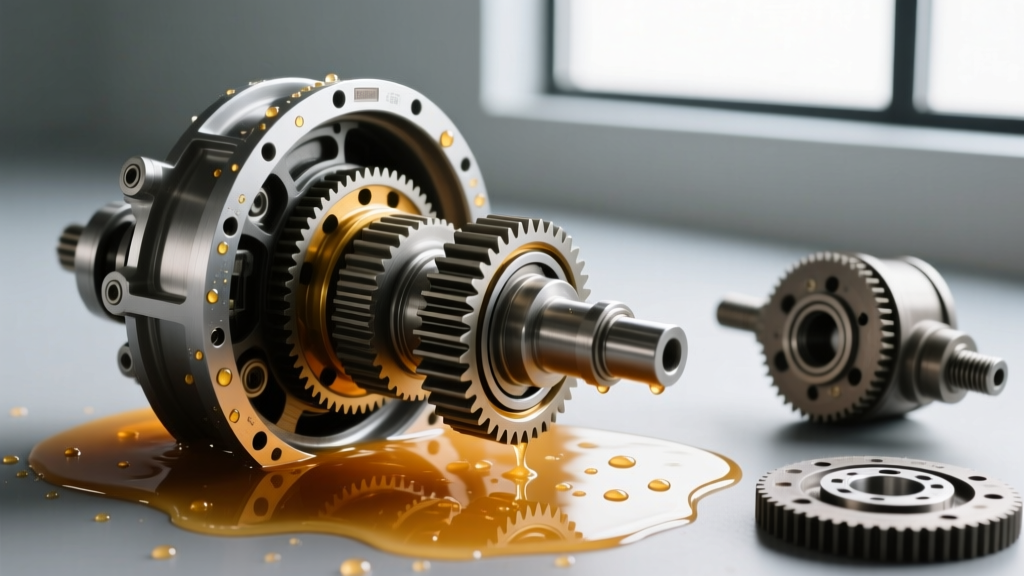
When you pull the differential cover, the condition of the drained fluid tells a definitive story:
- Dark, opaque, and sulfurous (normal): The EP additives are actively working. If the fluid is near 60,000 miles, it is time for a standard service.
- Glitter/Silver sheen (warning): Normal wear of the ring, pinion, and thrust washers. A fluid change with a high-detergency synthetic can extend axle life.
- Chunky metallic particles on the magnetic plug (critical): Bearing cage disintegration or gear tooth spalling. Fluid replacement is useless; a full rebuild is mandatory.
- Chocolate milk consistency (fatal): Water ingress through a breached axle seal or submerged breather vent. Emulsified oil destroys gear surfaces in under 500 miles.
Expert Best Practices: Draining, Inspecting, and Refilling
Proper servicing goes beyond simply unbolting the cover and pouring in new oil. Let us look at a real-world application: servicing the ubiquitous Ford 8.8-inch rear axle, commonly found in F-150s, Mustangs, and Explorers.
Real-World Application: Servicing the Ford 8.8 Axle
- Preparation: Clean the exterior of the 10-bolt differential cover with brake cleaner to prevent contaminating the housing. The Ford 8.8 holds approximately 2.5 to 3.0 pints (1.2 to 1.4 liters) of fluid.
- Removal: Loosen the ten 1/2-inch (or 12mm) cover bolts. Leave the top two bolts slightly threaded to act as a hinge, then gently pry the cover loose from the bottom notch using a flathead screwdriver. Drain the fluid into a catch pan.
- Inspection: Wipe the magnetic drain plug (if equipped) or the internal magnet. Evaluate the swarf against the diagnostic matrix above.
- Sealing: Scrape all old RTV silicone from the housing and cover using a plastic gasket scraper. Wipe both surfaces with acetone or brake cleaner. Apply a continuous 3mm bead of Permatex The Right Stuff (Part #29090) to the cover. This specific elastomer cures rapidly and resists the high shear forces of gear oil.
- Torque Specs: Reinstall the cover and torque the 10 bolts in a crisscross star pattern to 32 lb-ft. Allow the RTV to cure for the manufacturer's specified time (usually 90 minutes for The Right Stuff) before refilling.
- Refilling: Remove the upper fill plug (typically a 3/8-inch square drive or 15mm hex). Pump in 75W-140 synthetic gear oil until it reaches the bottom edge of the fill hole and begins to weep out. Reinstall the fill plug and torque to 25 lb-ft.
Recommended Gear Oils and Friction Modifiers
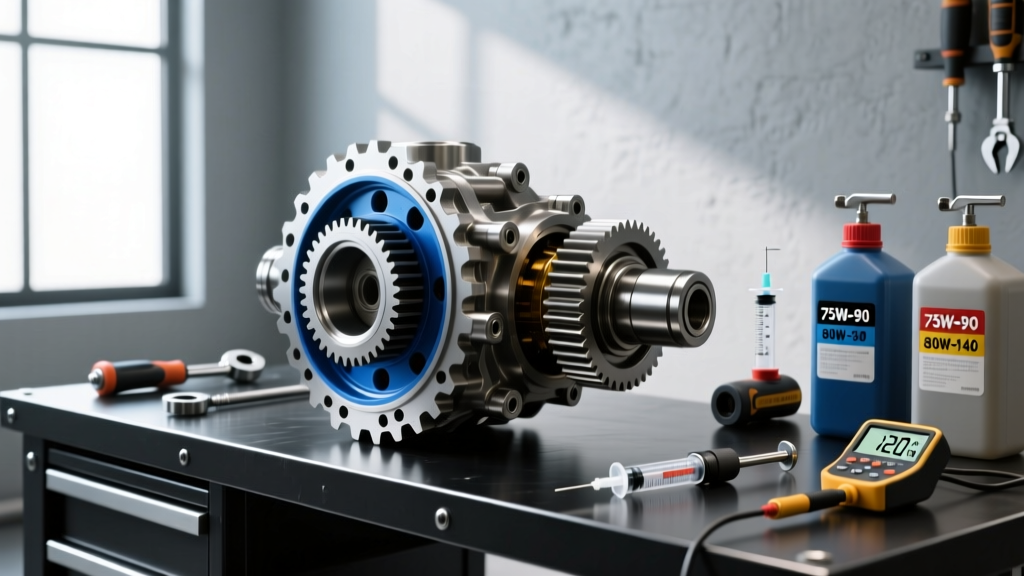
Choosing the correct lubricant is paramount. As detailed in AMSOIL's technical literature on synthetic gear lubes, synthetic base stocks offer vastly superior film strength and lower pour points compared to conventional petroleum-based 80W-90 oils. For heavy-duty towing or track use in 2026, stepping up to a 75W-140 viscosity is highly recommended to maintain gear separation under extreme thermal loads.
- AMSOIL Severe Gear 75W-90: Excellent for daily driving and light towing. Exceptional shear stability. (Approx. $18-$22/quart)
- Red Line 75W140 Synthetic: Ideal for high-horsepower applications, off-road crawling, and heavy towing. Contains high levels of polyol ester base stocks. (Approx. $24-$28/quart)
- Motorcraft XL-3 Friction Modifier: (Part # C6OZ-19B546-A). Absolutely mandatory for Ford Trac-Lok and other clutch-type limited-slip differentials. Without 4 oz of this additive, the clutch packs will experience stick-slip chatter during low-speed turns, which can permanently glaze the friction discs. (Approx. $9-$12/bottle)
Note: Helical gear-based limited-slip differentials (like the Torsen or Eaton Truetrac) do not utilize clutch packs and therefore do not require friction modifiers. Adding them to a gear-biased LSD will not cause harm, but it is an unnecessary expense.
Final Troubleshooting Checklist
Before ordering replacement gears or bearings, always verify the following:
- Is the axle breather vent clogged? A blocked vent causes internal pressure buildup, forcing gear oil past the axle seals and pinion seal, leading to low fluid levels and subsequent whining.
- Are the tires matched in diameter? Mismatched tire sizes on AWD/4WD vehicles force the center differential or transfer case to bind, which can transfer harmonic vibrations that mimic rear differential noise.
- Has the pinion angle been altered by a suspension lift? Excessive driveline angles cause universal joint binding, creating a cyclical vibration that is frequently misdiagnosed as internal gear wear.
By systematically diagnosing the acoustic signature of your axle and adhering to precise torque specifications and fluid chemistry requirements, you can accurately determine when to replace rear differential fluid and when to schedule a comprehensive drivetrain rebuild. Proper maintenance remains the most cost-effective defense against catastrophic hypoid gear failure.