The Ghost in the Machine: Understanding Intermittent Clutch Faults
Intermittent faults in a manual car clutch are the bane of a technician's existence. Unlike a completely shattered friction disc or a blown slave cylinder, an intermittent issue—such as a clutch that slips only during sustained highway driving, or a pedal that drops solely in stop-and-go traffic—defies standard static testing. In 2026, with the proliferation of complex Dual Mass Flywheels (DMFs) and integrated concentric slave cylinders, diagnosing these 'ghost' problems requires a deep understanding of thermal dynamics, hydraulic fluid rheology, and mechanical resonance.
When a customer complains that their manual car clutch feels fine in the morning but becomes unpredictable after a 45-minute commute, the diagnostic approach must shift from simple visual inspections to dynamic, temperature-dependent troubleshooting. This guide explores the root causes of intermittent clutch symptoms and provides a structured, expert-level protocol for isolating the exact failure point.
Thermal Fade: When Heat Triggers Manual Car Clutch Slipping
Intermittent slipping is most frequently a thermal issue, but technicians must differentiate between friction material fade and hydraulic fluid fade. Both manifest as a sudden loss of clamping force under load, but their root causes and diagnostic signatures are entirely different.
Friction Material Outgassing
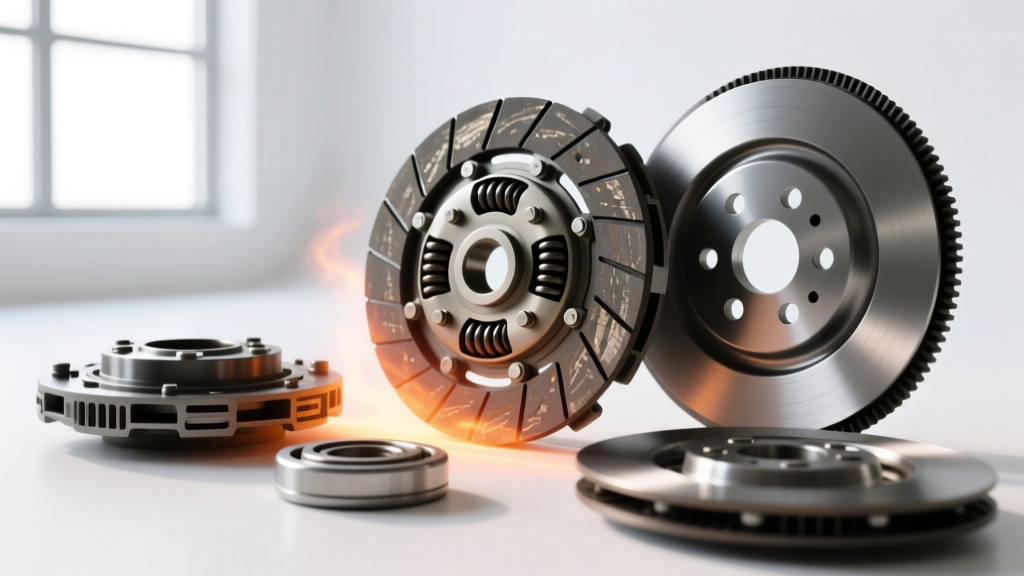
Modern organic and ceramic-hybrid clutch discs are bound by complex resins. When the clutch interface exceeds 400°C (752°F)—common during aggressive launching or riding the pedal in heavy traffic—these resins begin to off-gas. This outgassing creates a microscopic layer of compressible gas between the friction disc and the flywheel. The result is a sudden, severe slip that often resolves once the vehicle is parked and the bellhousing cools. Diagnosing this requires inspecting the flywheel face for 'bluing' (thermal discoloration) and checking the disc for glazed, crystallized friction material.
Hydraulic Fluid Vapor Lock
Most modern manual transmissions utilize DOT 3 or DOT 4 glycol-based brake fluid in the clutch hydraulic system. Glycol fluids are highly hygroscopic, meaning they absorb moisture from the atmosphere over time. While fresh DOT 4 fluid has a dry boiling point of 446°F (230°C), its wet boiling point (at 3.7% water content) drops drastically to 311°F (155°C). If the concentric slave cylinder (CSC) is mounted inside a poorly ventilated bellhousing near the exhaust downpipe, radiant heat can easily push the localized fluid temperature past its wet boiling point. The fluid vaporizes, creating a compressible gas pocket in the hydraulic line. The pedal will feel spongy or sink to the floor, and the clutch will fail to disengage or engage properly until the system cools and the vapor condenses back into a liquid.
The Phantom Pedal: Diagnosing Inconsistent Hydraulic Engagement
Another common intermittent manual car clutch symptom is the 'phantom pedal drop.' The driver holds the clutch pedal depressed at a red light, and over the course of 30 seconds, the pedal slowly sinks toward the floor, eventually causing the car to creep forward or the transmission to grind when shifting.
This is rarely a leak you can see on the garage floor. Instead, it is caused by internal bypassing within the clutch master cylinder. The internal rubber cup seals can develop microscopic wear grooves or harden due to age and heat cycles. When the fluid is cold and viscous, the seals hold pressure adequately. However, as the engine bay heats up and the fluid thins, the degraded seals allow high-pressure fluid to bypass internally from the pressure chamber back into the reservoir.
Diagnostic Test: To confirm internal master cylinder bypass, clamp the soft hydraulic line near the slave cylinder (using a specialized line hose clamp to avoid damaging modern PTFE-lined hoses). Have an assistant depress the clutch pedal and hold it. If the pedal still slowly sinks to the floor while the line is clamped, the master cylinder is internally bypassing and must be replaced. If the pedal holds firm, the fault lies downstream, likely in the concentric slave cylinder or a failing quick-connect fitting.
Temperature-Dependent Chatter and Vibration
Clutch chatter—violently shaking the vehicle upon initial engagement—is highly dependent on ambient and operating temperatures. In modern performance and diesel applications, this is almost always tied to the Dual Mass Flywheel (DMF).
According to ZF Group Aftermarket Services, a DMF utilizes internal arc springs and a friction ring to dampen torsional vibrations from the crankshaft. These internal components are packed with a specialized molybdenum-based grease.
- Cold-Start Chatter: In freezing temperatures, the internal DMF grease becomes highly viscous. The arc springs cannot react quickly enough to dampen low-frequency engine vibrations, resulting in a harsh, chattering engagement until the friction ring warms up and softens the grease.
- Hot-Idle Rattle & Chatter: Conversely, if the DMF internal seals are compromised, engine oil or clutch dust can contaminate the grease, or the grease may liquefy and leak out due to excessive heat. When hot, the lack of damping fluid allows the internal springs to rattle and the secondary mass to oscillate wildly, causing severe chatter when the clutch is fed out in first gear.
Furthermore, intermittent chatter can be caused by the clutch release bearing binding on the transmission input shaft sleeve. If the factory lubrication dries out, thermal expansion during a long drive can cause the bearing collar to seize microscopically on the shaft, preventing smooth, linear clutch engagement.
Intermittent Symptom Diagnostic Matrix
Use the following matrix to quickly cross-reference customer complaints with targeted diagnostic actions. This framework minimizes unnecessary teardowns and focuses on verifiable data points.
| Symptom Condition | Probable Root Cause | Diagnostic Verification Method | Est. Repair Cost (Parts/Labor) |
|---|---|---|---|
| Slipping only after 30+ mins of driving | Hydraulic fluid vapor lock or friction disc outgassing | Measure bellhousing temp with IR pyrometer; test fluid moisture content with a digital brake fluid tester. | $150 (Fluid flush) to $1,200 (Clutch kit) |
| Pedal sinks slowly at stoplights (hot engine) | Master cylinder internal cup seal bypass | Clamp downstream hydraulic line; monitor pedal height under sustained 50 lbs of foot pressure. | $180 - $350 (Master cylinder replacement) |
| Violent chatter on cold morning engagement | DMF grease viscosity issue or glazed friction surface | Check for DMF radial play (spec: usually < 2mm); inspect flywheel face for heat spots. | $900 - $1,600 (DMF and Clutch RepSet) |
| Clutch fails to disengage in stop-and-go traffic | Over-center spring fatigue or worn pedal bushing | Measure pedal free-play (target: 10-15mm); inspect return spring tension and pivot bushing wear. | $40 - $120 (Pedal assembly rebuild) |
| Intermittent squeal that vanishes when pedal is pressed | Pilot bearing binding due to thermal expansion | Use a mechanic's stethoscope on the bellhousing near the input shaft while engine idles hot. | $25 - $80 (Pilot bearing/bushing) |
Advanced Diagnostic Protocol for Ghost Faults
When a manual car clutch issue cannot be replicated on a standard 15-minute test drive, technicians must employ advanced logging and thermal mapping techniques. As highlighted by the experts at AA1Car Automotive Diagnostics, capturing the fault in real-time is the only way to avoid misdiagnosis.
Step 1: Thermal Mapping the Bellhousing
Equip the vehicle with a data-logging infrared thermometer aimed at the transmission bellhousing and the slave cylinder line. Instruct the customer to drive their normal route. If the clutch slips or the pedal drops, check the logged temperatures. If the slave cylinder area exceeds 250°F (121°C), you have confirmed thermal hydraulic fade. The solution may involve installing a thermal barrier sleeve over the hydraulic line or upgrading to a high-temp DOT 5.1 fluid (which has a higher dry boiling point, though it still absorbs moisture).
Step 2: Hydraulic Pressure Decay Testing
Instead of just checking for leaks, connect a 0-1000 PSI hydraulic pressure gauge inline between the master cylinder and the hard line. Pump the pedal to build 600 PSI of static pressure. A healthy system will hold this pressure indefinitely. If the gauge drops 50 PSI or more over a 3-minute window, you have quantifiable proof of internal hydraulic decay, isolating the master or slave cylinder as the culprit before dropping the transmission.
Precision Assembly and Torque Specifications
If your diagnosis dictates a replacement, precision assembly is critical to preventing the recurrence of intermittent chatter and vibration. Always adhere to exact OEM torque specifications and sequences. For example, when servicing a common Honda K-Series application:
- Flywheel to Crankshaft: 77 lb-ft (104 Nm). Always use new, oiled flange bolts and tighten in a crisscross pattern.
- Pressure Plate to Flywheel: 19 lb-ft (26 Nm). Tighten gradually in a star pattern to ensure the diaphragm spring fingers remain perfectly concentric. Uneven torque here is a leading cause of 'phantom' pedal pulsation.
- Concentric Slave Cylinder (CSC) Bleeding: Modern CSCs are notorious for trapping air. Standard pedal pumping is insufficient. Use a vacuum bleeder at the master cylinder reservoir, or perform a reverse-pressure bleed from the slave cylinder bleeder screw upward to force air back into the reservoir.
Conclusion
Diagnosing an intermittent manual car clutch requires looking beyond the mechanical linkage and understanding the thermodynamic and hydraulic environments in which these components operate. By systematically ruling out thermal fade, internal hydraulic bypass, and temperature-sensitive DMF damping issues, technicians can confidently solve the most elusive drivability complaints. Rely on data, utilize thermal imaging, and always verify hydraulic integrity under simulated operating temperatures to ensure a permanent repair.