Beyond the Drivetrain: Understanding Viscous Fan Clutch Diagnostics
When automotive enthusiasts and technicians hear the word 'clutch,' their minds immediately jump to manual transmission friction discs or automatic torque converter lockup mechanisms. However, the viscous engine cooling fan clutch is a critical, fluid-coupled component that demands equal diagnostic rigor. A failing fan clutch will mimic severe engine bearing failures, transmission harmonic vibrations, and accessory drive anomalies. In 2026, with under-hood temperatures rising due to tighter emissions packaging and smaller displacement turbocharged engines, thermal management components are under more stress than ever.
This step-by-step diagnostic guide focuses on identifying fan clutch degradation through three primary sensory channels: noise, vibration, and rotational feel. Furthermore, we will walk through the physical removal and bench-testing process utilizing a budget-friendly but highly effective Pittsburgh Pro fan clutch tool set available at Harbor Freight, proving you do not need to spend hundreds on OEM-specific service tools to perform dealer-level diagnostics.
Symptom 1: Acoustic Profiling (Noise Diagnostics)
The earliest indicator of a failing thermal fan clutch is almost always auditory. The viscous fluid inside the clutch (typically a high-grade polydimethylsiloxane silicone) degrades over time due to thermal cycling and mechanical shearing. When diagnosing by ear, you must isolate the specific frequency of the noise.
The 'Jet Engine' Roar
If your vehicle sounds like it is preparing for takeoff at idle or low speeds, the fan clutch is likely locked in the fully engaged position. This occurs when the internal bimetallic thermostatic coil binds, or when the silicone fluid leaks into the primary shear cavity and cannot be pumped back into the reservoir. While this keeps the engine cool, it robs the crankshaft of up to 15-20 horsepower and places immense radial load on the water pump bearings.
The Metallic Tick and Grind
A rhythmic ticking that scales with engine RPM is rarely the fan clutch fluid itself; it is the internal pilot bearing or the mounting hub. According to AA1Car's cooling system diagnostic guidelines, a worn internal bearing will allow the fan assembly to wobble on the water pump snout. If you hear a harsh metallic grinding, the clutch has completely seized, and the fan belt is slipping across the water pump pulley.
Symptom 2: Harmonic Imbalance (Vibration Diagnostics)
Vibration caused by a fan clutch is often misdiagnosed as a failing transmission mount, a warped torque converter, or an unbalanced driveshaft. Because the fan clutch is bolted directly to the water pump hub—which is driven by the serpentine belt connected to the crankshaft—any imbalance here is transmitted directly into the engine block.
- Idle Shudder: If the steering wheel and dashboard vibrate specifically at idle (600-800 RPM) but smooth out as you accelerate, suspect a fan clutch imbalance. The heavy composite fan blades amplify minor wobbles at lower harmonic frequencies.
- Coolant Frothing: Severe vibration from a wobbling fan clutch hub will destroy the water pump's internal seals. If you open your radiator cap (when cold) and find milky, frothy coolant, the vibration has compromised the pump bearing, allowing air ingress or internal fluid mixing.
- Radiator Shroud Contact: In extreme cases, the lateral runout of a failing clutch will cause the fan blades to strike the plastic radiator shroud, sending sharp, jarring shocks through the front end of the chassis.
Symptom 3: Evaluating Rotational 'Feel' and Resistance
The most definitive field test for a viscous fan clutch is the manual resistance test. This evaluates the 'feel' of the internal shear plates. You must perform this test under two distinct thermal conditions.
The Cold Engine Test
With the engine completely cold (sitting overnight), reach behind the fan blades and attempt to spin the clutch. You should feel a distinct, smooth hydraulic resistance. The fan should rotate no more than one to one-and-a-half revolutions before stopping. If it spins freely like a bicycle wheel, the internal fluid has completely leaked out, and the clutch is dead.
The Hot Engine Test
Run the engine until it reaches normal operating temperature (approx. 195°F - 210°F), ensuring the thermostat has opened. Shut the engine off and immediately (and carefully) attempt to spin the fan. A properly functioning thermal clutch will have engaged, locking the shear plates together. The fan should barely move, offering immense resistance. If it spins easily when hot, the bimetallic spring has failed to open the internal valve, and the vehicle is at high risk of overheating under load.
Step-by-Step Removal Using a Harbor Freight Fan Clutch Tool
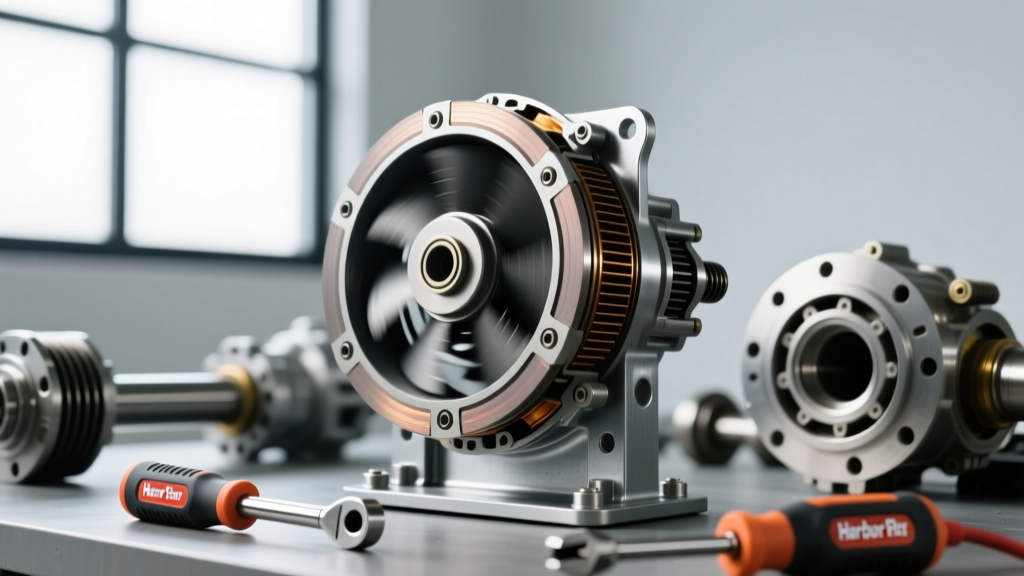
Once your sensory diagnostics confirm a failure, removal is required for bench testing and replacement. Many technicians avoid this job because OEM specialty tools can cost upwards of $150. However, the Pittsburgh Pro 3-Way Fan Clutch Wrench Set and accompanying pulley holders found at Harbor Freight offer a highly capable alternative for under $40.
CRITICAL WARNING: Fan clutch threads are not universal. Depending on the manufacturer and the rotational direction of the water pump, your fan clutch may be standard Right-Hand (RH) thread or reverse Left-Hand (LH) thread. Applying standard 'lefty-loosey' force to a reverse-thread GM V8 will snap the water pump snout.
Step 1: Secure the Water Pump Pulley
You must prevent the serpentine belt and water pump pulley from turning while you break the clutch hub nut loose. Use a heavy-duty strap wrench or the Pittsburgh Pro pulley holding tool to grip the outer lip of the water pump pulley. Do not rely solely on the serpentine belt tensioner, as the sudden shock of a breaker bar can cause the belt to slip or the tensioner to fail.
Step 2: Select the Correct Wrench Profile
The Harbor Freight sets typically include 32mm, 36mm, and 47mm wrenches. Identify your application using the reference table below. Slide the wrench onto the large hex nut situated behind the fan blades, directly at the base of the clutch hub.
Step 3: Apply Shock Force
Fan clutch nuts are often secured with medium-strength threadlocker from the factory. Use a dead-blow hammer to strike the end of your wrench handle sharply. This shock force breaks the threadlocker bond without requiring excessive, continuous torque that could twist the water pump shaft.
Step 4: Unthread and Extract
Once broken loose, unthread the hub. Note that the entire fan blade and clutch assembly will come off as a single, heavy unit. Support the fan blade with your free hand to prevent it from dropping onto the radiator fins.
Thread Specifications and Torque Data Table
Reference this table to determine thread direction, required Harbor Freight tool size, and reinstallation torque specifications for common platforms.
| Thread Size & Pitch | Common Application | Thread Direction | Harbor Freight Wrench Size | Reinstallation Torque |
|---|---|---|---|---|
| M32 x 1.5 | Ford 4.6L / 5.0L Coyote | Right-Hand (Standard) | 32mm | 25 - 35 lb-ft |
| M36 x 1.5 | GM 5.3L / 6.2L LS & LT V8 | Left-Hand (Reverse) | 36mm | 30 - 40 lb-ft |
| M47 x 1.5 | GM 6.6L Duramax L5P | Right-Hand (Standard) | 47mm | 85 - 95 lb-ft |
| M40 x 1.5 | Dodge 5.9L / 6.7L Cummins | Right-Hand (Standard) | 40mm (May require adapter) | 55 - 65 lb-ft |
Bench Testing and Final Verification
Before installing a new clutch (such as a Motorcraft KM5114 or GM 1580698), perform a bench test to verify the thermostatic spring operation. As recommended in Gates Corporation's technical resource bulletins, you can simulate under-hood temperatures using a heat gun or by suspending the clutch over a pot of boiling water.
Heat the bimetallic spring on the front of the clutch to approximately 180°F. You should visibly see the spiral spring wind tighter, opening the internal port. Once cooled back to room temperature, the spring must relax and close the port. If the spring is sluggish, bent, or fails to react to the heat, the new unit is defective and must be exchanged.
By systematically diagnosing noise, isolating harmonic vibrations, and testing rotational feel, you can confidently condemn a failing fan clutch. Utilizing affordable, high-quality aftermarket tools like the Harbor Freight Pittsburgh Pro line ensures you can maintain your vehicle's cooling system and protect your engine from catastrophic thermal failure without breaking the bank.