"A differential rarely fails without a warning. The gears will sing, chatter, or howl long before they shatter. The key to longevity is learning the acoustic fingerprint of your axle and understanding the chemical limits of your gear oil." — Senior Drivetrain Engineer, AutoGearNexus
Diagnosing drivetrain Noise, Vibration, and Harshness (NVH) is one of the most complex tasks in automotive repair. When a customer complains of a whine, clunk, or chatter, the immediate instinct is often to suspect the transmission or wheel bearings. However, the ring and pinion assembly is a highly stressed mechanical environment that relies entirely on hydrodynamic lubrication. This brings up a critical question for technicians and DIY enthusiasts alike: can a simple service of your front and rear differential fluid cure an ailing axle, or is it merely masking a terminal mechanical failure?
In this expert guide, we break down the acoustic signatures of differential wear, the chemical breakdown of extreme pressure (EP) gear oils, and the precise diagnostic frameworks used by drivetrain specialists to isolate axle noise.
The Acoustic Fingerprint of Drivetrain NVH
To accurately diagnose differential noise, you must first isolate the exact operating condition under which the sound occurs. Ring and pinion gears operate under distinct load profiles depending on whether the vehicle is accelerating, coasting, or maintaining steady-state cruise.
1. Drive Whine (Acceleration Load)
A high-pitched whine that occurs strictly under throttle application indicates an issue with the drive side (convex face) of the ring gear teeth, or an improperly preloaded pinion bearing. When you apply torque, the pinion gear attempts to climb out of the ring gear, placing immense stress on the pinion head bearing. If the fluid has lost its shear stability, the microscopic oil film separating these bearings collapses, resulting in metal-to-metal harmonic resonance.
2. Coast Whine (Deceleration Load)
Coast whine happens when you lift off the throttle. The drivetrain load reverses, and the ring gear drives the pinion. This noise is typically linked to the coast side (concave flank) of the gear teeth or a worn pinion tail bearing. According to Yukon Gear & Axle technical documentation, coast whine is frequently misdiagnosed as a transmission output shaft issue. A proper coast-down test at 45-55 MPH in neutral versus in-gear will isolate the axle from the transmission.
3. LSD Chatter (Cornering Load)
If you feel a rhythmic shudder or hear a grinding chatter during tight, low-speed turns, your limited-slip differential (LSD) clutch packs are binding. This is the most common scenario where changing the fluid and adding the correct friction modifier will completely resolve the issue without mechanical teardown.
The Chemistry of Differential Fluid Breakdown
Why does old fluid cause noise? Modern synthetic gear oils rely on sulfur-phosphorus Extreme Pressure (EP) additives. Under the immense shearing forces of a hypoid gear set—where the pinion sits significantly below the centerline of the ring gear—these additives sacrifice themselves to prevent microwelding of the gear teeth.
Over 30,000 to 50,000 miles, the EP additive package depletes. Furthermore, the viscosity index improvers (VIIs) in the oil suffer mechanical shearing. A 75W-90 fluid may physically shear down to a 75W-80 or even a 50-weight equivalent after severe towing or track use. This loss of hydrodynamic film thickness allows gear teeth to make micro-contact, generating the high-frequency "whine" associated with worn axles. Consulting the Red Line Synthetic Oil technical database reveals that ester-based synthetics resist this shearing far better than conventional petroleum-based GL-5 oils.
Diagnostic Framework: Isolating the Noise
Before draining the fluid, you must verify the noise source. Use the following diagnostic matrix to cross-reference the sound with the probable mechanical or chemical culprit.
| Noise Profile | Operating Condition | Primary Mechanical Suspect | Fluid / Chemical Factor |
|---|---|---|---|
| High-Pitch Whine | Under heavy throttle (Drive) | Pinion head bearing wear, Drive-side gear pitting | Sheared VIIs, loss of hydrodynamic film |
| Low-Frequency Howl | Steady-state cruise (55-65 MPH) | Ring gear runout, Improper backlash | Incorrect viscosity (e.g., using 80W-90 in a tight-tolerance axle) |
| Rhythmic Chatter | Low-speed cornering | LSD clutch pack glazing or binding | Depleted Friction Modifier (FM) additive |
| Metallic Clunk | Shifting from Reverse to Drive | Excessive backlash, worn spider gears | None (Fluid cannot fix physical clearances) |
Advanced Tooling: Thermal Mapping and Chassis Ears
Expert technicians do not rely on guesswork. We utilize wireless chassis ears (electronic stethoscopes) clamped directly to the differential housing and the transmission tail shaft. By comparing the decibel amplitude on a dynamometer or during a road test, we can definitively isolate the axle. Additionally, using an infrared pyrometer to measure the differential housing temperature after a 20-mile drive is crucial. A healthy rear differential typically runs 20°F to 40°F above ambient temperature. If the housing exceeds 180°F (82°C) under normal driving, the fluid is failing to manage friction, or the bearing preload is excessively tight.
Expert Service Specifications and Real-World Costs
If your diagnosis points to fluid degradation, a proper service is mandatory. However, using the wrong fluid specification can instantly destroy a clutch-type LSD or cause catastrophic gear wear. Below are the exact specifications, torque values, and fluid requirements for three of the most common light-truck and SUV axles on the road.
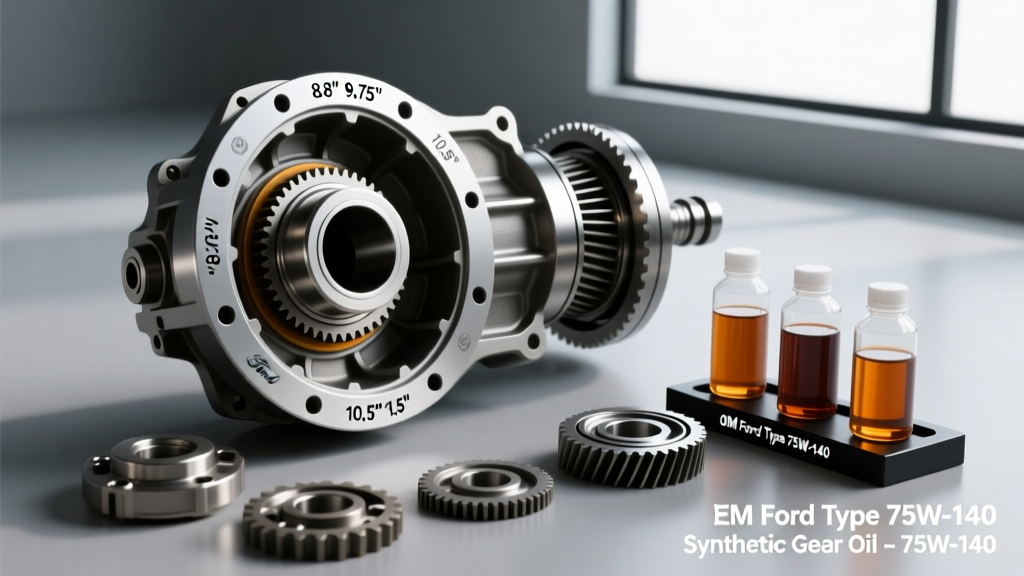
1. Ford 8.8-Inch (Super 8.8 / Traction-Lok)
- Fluid Capacity: 2.5 to 3.0 Pints (1.2 - 1.4 Liters)
- Viscosity Spec: 75W-85 or 75W-140 (for heavy towing)
- Friction Modifier: Mandatory for Traction-Lok. Use Motorcraft XL-3 (Part # XL-3) or equivalent. Add 4 oz prior to filling.
- Fill Plug Torque: 21 - 26 lb-ft (Do not overtighten the plastic/factory plugs; upgrade to a billet steel plug torqued to 25 lb-ft).
- Estimated DIY Cost: $45 - $65 (Fluid + FM)
2. GM 9.5-Inch 14-Bolt (Semi-Floating)
- Fluid Capacity: 2.75 Pints (1.3 Liters)
- Viscosity Spec: 75W-90 Synthetic GL-5
- Friction Modifier: Required if equipped with the G80 Eaton mechanical locking differential. Use GM Part # 88900333 (or equivalent LSD additive).
- Fill Plug Torque: 25 lb-ft (Steel plug).
- Estimated Shop Service Cost: $150 - $225 (Includes labor, fluid, and gasket/RTV).
3. Dana 44 (Jeep Wrangler / Light Duty Trucks)
- Fluid Capacity: 2.0 to 2.5 Pints (0.9 - 1.2 Liters)
- Viscosity Spec: 80W-90 or 75W-90 Synthetic
- Friction Modifier: Required for Trac-Lok; NOT required for Detroit Locker or open differentials.
- Fill Plug Torque: 25 - 35 lb-ft.
- Pro-Tip: Always use RTV silicone (like Permatex Ultra Black) if the Dana 44 cover lacks a reusable rubber gasket groove. Allow 2 hours of cure time before filling.
When Fluid Isn't Enough: Mechanical Failure Modes
While servicing your front and rear differential fluid is an excellent preventative measure and a cure for LSD chatter, it is not a mechanical band-aid. If your axle exhibits the following symptoms, a fluid change will not save it, and a complete teardown or replacement is required:
- Cyclic Howling: A howl that pulses in rhythm with wheel speed indicates excessive ring gear runout or a bent axle shaft. This requires measuring runout with a dial indicator; anything over 0.003 inches mandates a new ring gear or carrier.
- Pinion Seal Leaks with Play: If you grab the driveshaft flange and detect rotational clunk before the wheels move, your pinion bearings are shot, and the crush sleeve has collapsed. Re-torquing the pinion nut without replacing the crush sleeve and bearings will lead to immediate catastrophic failure.
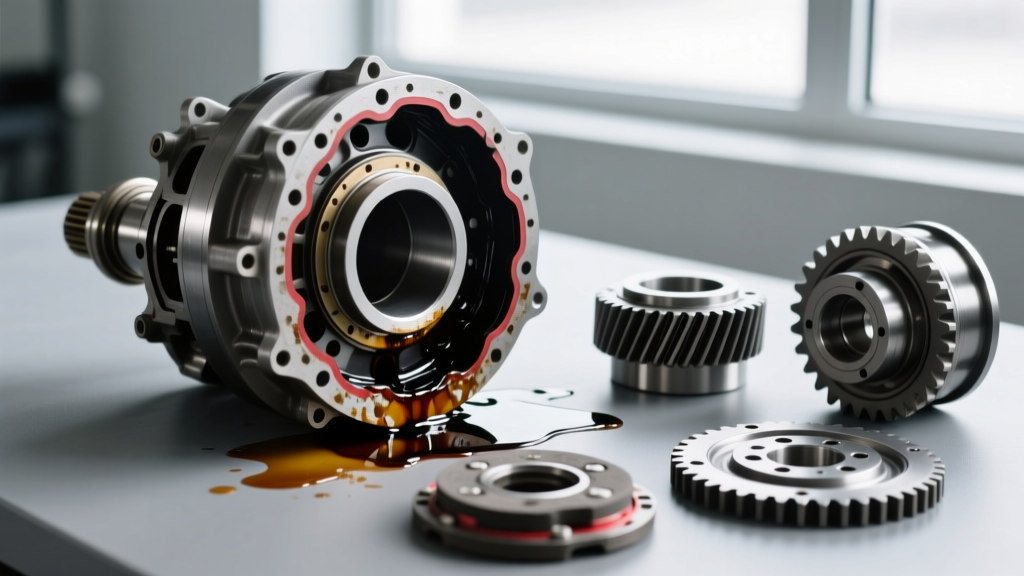
- Glitter in the Oil: When you pull the drain plug (or drop the cover), inspect the fluid. A slight gray haze is normal clutch material wear. However, visible metallic flakes or chunks of the magnetic drain plug being completely "furred" with steel wool indicates bearing or gear spalling. The differential must be rebuilt.
Final Verdict
Proper maintenance of your front and rear differential fluid is the single most cost-effective way to extend the life of your drivetrain. By understanding the chemical limitations of EP additives and strictly adhering to manufacturer torque specs and friction modifier requirements, you can eliminate LSD chatter and prevent premature gear wear. However, always pair your fluid service with a rigorous acoustic and thermal diagnostic check to ensure you aren't ignoring the early warning signs of a mechanical failure.