Why the Tire Spin Method is the Industry Standard
When rebuilding a classic muscle car, re-gearing a lifted off-road rig, or simply verifying the axle code on a used truck, knowing your exact final drive ratio is critical for tuning your speedometer, selecting the right transmission shift points, and optimizing fuel economy. While decoding the VIN or checking the RPO tag inside the glovebox can provide factory specifications, those tags are often inaccurate if the differential has been swapped or rebuilt. This leads many technicians and DIYers to ask: how do you determine gear ratio with absolute certainty without cracking open the differential cover?
The most reliable, non-invasive technique is the tire spin method. By lifting the vehicle, placing the transmission in neutral, and counting the relationship between tire rotations and driveshaft rotations, you can calculate the exact ring and pinion ratio. However, executing this test incorrectly—particularly when dealing with different differential types—will yield wildly inaccurate results. In this guide, we break down the physics, the common pitfalls, and the exact step-by-step procedure to determine your gear ratio like a seasoned drivetrain specialist.
The Physics: How Do You Determine Gear Ratio Mechanically?
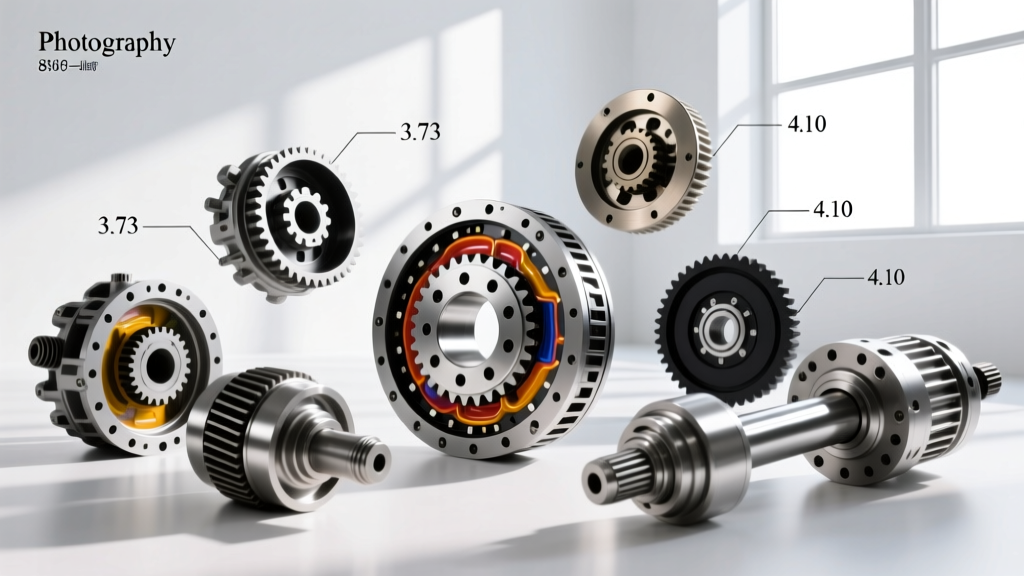
At its core, a differential's gear ratio is a multiplication factor. It represents the number of times the driveshaft (and by extension, the transmission output shaft) must rotate to turn the axle shafts and wheels exactly one full revolution. For example, in a 3.73 gear set, the pinion gear has roughly 11 teeth and the ring gear has 41 teeth (41 ÷ 11 = 3.727). Therefore, the driveshaft must spin 3.73 times for every single rotation of the tire.
Because counting fractional rotations by eye is difficult, professional mechanics use a multiplier technique. By spinning the tire multiple times (usually two or four full revolutions), you can count the driveshaft rotations and divide by the number of tire spins to get a highly accurate ratio.
Open Differentials vs. Limited-Slip (The 2:1 Rule)
The single biggest mistake enthusiasts make when attempting the tire spin test is failing to account for the internal differential type. The physics change drastically depending on whether you have an open differential or a locking/limited-slip differential (LSD).
- Open Differentials: When one wheel is lifted off the ground and the other remains on the pavement, an open differential will send all rotational force to the path of least resistance (the lifted wheel). The internal spider gears will rotate, meaning the driveshaft will only turn half as much as it normally would relative to that single wheel. To get an accurate reading on an open diff, you must spin the lifted tire exactly two full times and count the driveshaft rotations, OR spin it once and multiply your driveshaft count by two.
- Limited-Slip & Locking Differentials: If your vehicle is equipped with a mechanical clutch-type LSD (like the Ford 8.8 Traction-Lok or GM Eaton Positraction), a gear-type locker (like a Detroit Locker), or a spool, the spider gears are locked or heavily resisted. The driveshaft will turn at a true 1:1 ratio relative to the axle shaft. For these setups, spin the tire exactly one full time and count the driveshaft rotations directly.
Expert Tip: If you are unsure whether your differential is open or limited-slip, spin the tire two full rotations. If the driveshaft turns roughly 3.5 to 4.5 times, you likely have an open diff (e.g., a 3.73 ratio). If the driveshaft turns roughly 7 to 9 times, you have a limited-slip or locker.
Step-by-Step Execution Guide
To perform this test accurately, you need a floor jack, heavy-duty jack stands, a chalk marker or paint pen, and a helper to count driveshaft rotations while you spin the wheel.
1. Safety and Vehicle Preparation
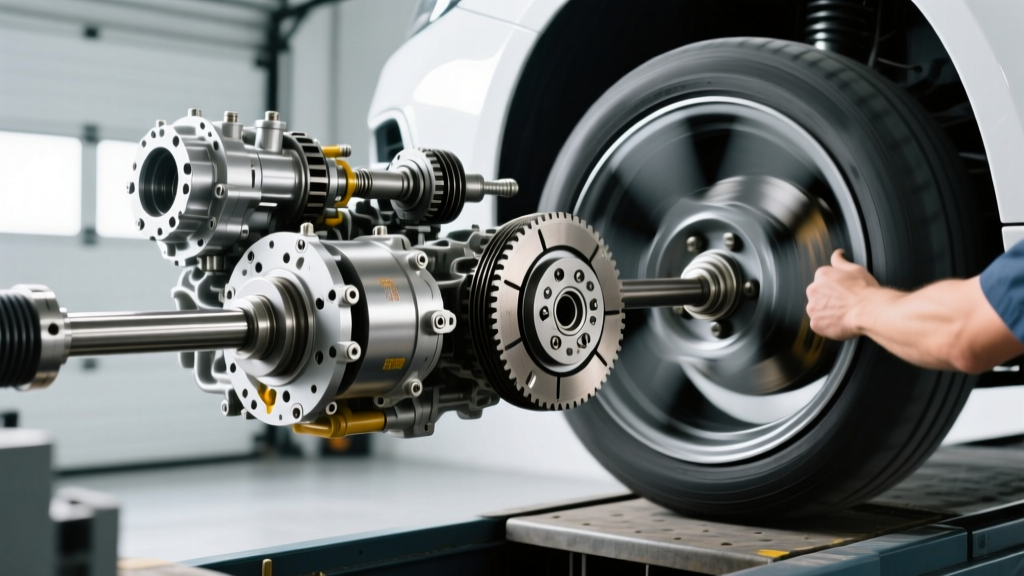
Never rely solely on a hydraulic floor jack. Lift the rear of the vehicle by the frame rails or designated pinch welds and secure it on jack stands. Chock the front wheels heavily. If you are working on a 4WD vehicle with a transfer case (such as an NP241 or NP261), ensure the transfer case is in 2WD High or Neutral. Leaving it in 4-Auto or 4-High will bind the front drivetrain, causing false resistance and inaccurate counts.
Place the transmission in Neutral. For modern vehicles with electronic shift-by-wire transmissions (like the ZF 8HP70 or GM 10-speed 10L90), ensure the ignition is in the 'On' position but the engine is off, allowing the electronic parking pawl to disengage if necessary, or consult the service manual for the exact neutral-drop procedure.
2. Marking the Reference Points
Use a bright yellow or white grease pencil to make a clear, distinct mark on the sidewall of the tire at the 6 o'clock position. Next, make a corresponding mark on the floor directly beneath it. Finally, mark the driveshaft yoke and the differential pinion flange so you can easily track 360-degree rotations of the shaft.
3. The Spin and Count Procedure
Have your helper keep their eyes locked on the driveshaft mark. Slowly and smoothly rotate the tire forward. Jerky movements can cause the spider gears to bind or the limited-slip clutches to slip, throwing off the count. Complete your predetermined number of tire rotations (two for open, one for LSD), stop exactly on your floor mark, and record the driveshaft position.
Driveshaft Rotation Reference Chart
Use the chart below to match your physical observations to common factory and aftermarket gear ratios. These numbers assume you are spinning the tire two full rotations (the standard method for open differentials, which also safely covers LSDs if you divide the final count by two).
| Actual Gear Ratio | Common Applications | Driveshaft Rotations (2 Tire Spins - Open Diff) | Driveshaft Rotations (1 Tire Spin - LSD/Locker) |
|---|---|---|---|
| 3.08 | Highway cruising, light towing | ~6.16 turns | ~3.08 turns |
| 3.42 / 3.55 | Standard GM/Ford half-ton trucks | ~6.84 / ~7.10 turns | ~3.42 / ~3.55 turns |
| 3.73 | Performance street, moderate towing | ~7.46 turns | ~3.73 turns |
| 4.10 | Heavy towing, off-road, 35-inch tires | ~8.20 turns | ~4.10 turns |
| 4.56 | Dedicated rock crawling, 37+ inch tires | ~9.12 turns | ~4.56 turns |
| 5.13 / 5.38 | Competition pulling, extreme crawler | ~10.26 / ~10.76 turns | ~5.13 / ~5.38 turns |
Note: Data aligns with specifications published by Ring & Pinion Service and major axle manufacturers.
Edge Cases: Worn Clutch Packs and Viscous Couplings
The tire spin method is highly accurate, but it can be confounded by worn internal components. If your vehicle is equipped with a clutch-type limited-slip differential (such as the Dana 44 Trac-Lok or the Chrysler 8.75 Sure-Grip), the friction clutches may be completely worn out. In this scenario, the differential will behave exactly like an open differential during the spin test, even though it is technically an LSD.
If you suspect worn clutches, you will need to pull the differential cover. When doing so, be prepared to drain the gear oil (typically 75W-140 synthetic for heavy-duty applications like the GM 14-bolt 10.5-inch) and have the correct friction modifier on hand, such as Motorcraft XL-3 for Ford 8.8 axles or GM EOS additive. According to Yukon Gear & Axle technical support, failing to reinstall the proper friction modifier after a fluid change will result in severe chatter and accelerated clutch wear during tight turns.
Additionally, vehicles with viscous limited-slip differentials (common in some older AWD and 4WD systems) rely on fluid shear and heat to lock. When cold, they may act like open differentials. If you are testing a hot viscous unit, it may lock up entirely. Always perform the spin test when the differential is at ambient room temperature for baseline consistency.
Final Torque Specs and Reassembly
Once you have determined your gear ratio and verified your setup, it is time to lower the vehicle. Do not simply blast the lug nuts back on with an impact wrench. Proper clamping force is vital for preventing warped rotors and sheared wheel studs, especially on heavy-duty axles like the Dana Spicer 60 or 70 series.
Always use a calibrated torque wrench to tighten your lug nuts in a star pattern to the manufacturer's exact specification:
- Ford F-150 / Super Duty (M14x1.5 studs): 150 lb-ft to 165 lb-ft
- GM Silverado / Sierra 1500: 140 lb-ft
- Jeep Wrangler (Dana 44 / M12x1.5 studs): 100 lb-ft to 110 lb-ft
- Toyota Tacoma / Tundra: 83 lb-ft to 97 lb-ft
Conclusion
Understanding how do you determine gear ratio via the tire spin method saves you hours of labor and prevents the contamination of your gear oil just to count teeth on a ring gear. By respecting the mechanical differences between open and limited-slip differentials, securing the vehicle properly, and accounting for 4WD transfer case binding, you can map your drivetrain's final drive ratio with mathematical precision. Whether you are calibrating a modern ECU for larger tires or sourcing a replacement carrier for a GM 4L60E swap, this foundational drivetrain skill is indispensable for any serious automotive builder.