The Mechanical Link: What Is Gear Ratio on a Fishing Reel vs. a Differential?
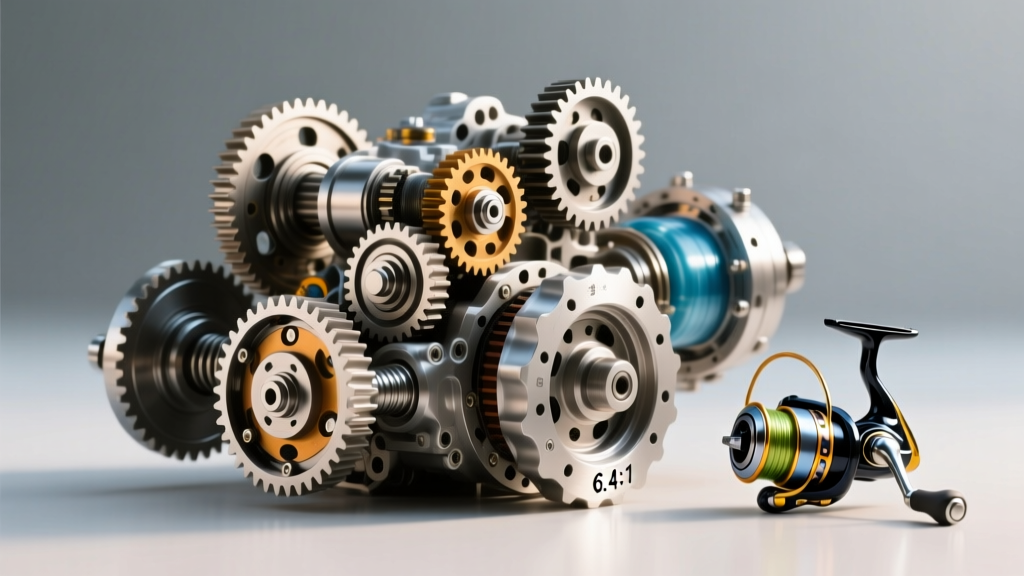
If you have ever shopped for a baitcasting reel, you have likely encountered the term 'gear ratio' and wondered how it impacts your catch. So, what is gear ratio on a fishing reel? In the angling world, a ratio like 8.3:1 means the spool rotates 8.3 times for every single crank of the handle. This high-speed, low-torque setup is perfect for quickly burning a topwater lure across the surface. Conversely, a 5.1:1 winch-style reel provides massive cranking power to drag a heavy fish out of deep cover, but retrieves line much slower.
As an automotive transmission specialist, I can tell you that the exact same physics govern your vehicle’s drivetrain. When enthusiasts ask about gear ratio for performance driving, they are essentially asking whether they want their car to act like an 8.3:1 speed reel (high top speed, sluggish acceleration) or a 5.1:1 winch reel (violent off-the-line torque, but running out of breath at high speeds). Understanding this mechanical analogy is the first step toward optimizing your ring and pinion, transmission, and tire combination for the street, drag strip, or road course.
Defining Gear Ratio for Performance Driving
In an automobile, the final drive ratio (located in the differential) and the transmission gear ratios work in tandem to multiply engine torque before it reaches the pavement. The formula for calculating your effective wheel torque is straightforward:
Effective Wheel Torque = Engine Torque × Transmission Gear × Final Drive Ratio
Let us look at a real-world performance build. Suppose you have a classic GM A-body equipped with an LS3 crate engine producing 430 lb-ft of torque, paired with a Tremec T56 Magnum 6-speed manual transmission. If you are launching in first gear (2.66:1 ratio) and your rear differential houses a 4.10:1 ring and pinion, the math looks like this:
430 lb-ft × 2.66 × 4.10 = 4,693 lb-ft of torque at the wheels (before accounting for drivetrain parasitic loss, typically around 15% for a manual).
This massive torque multiplication is the automotive equivalent of that low-speed, high-power fishing winch. It will snap your head back off the line, but your top speed in first gear will be severely limited, forcing you to shift frequently. If you were to swap to a 2.73:1 highway gear, your wheel torque drops to 3,123 lb-ft. The car will feel sluggish at the stoplight, but it will pull effortlessly to 150+ mph on a runway.
Optimizing the Final Drive: Track, Drag, and Street Setups
Choosing the correct gear ratio for performance driving requires balancing your vehicle's powerband, tire diameter, and intended use. Below is a data table outlining common final drive setups for popular performance differentials like the Ford 8.8-inch and GM 12-bolt.
| Application | Target Final Drive Ratio | Ideal Transmission Pairing | Effective 1st Gear (Approx.) | Performance Characteristic |
|---|---|---|---|---|
| Dedicated Drag Racing | 4.56:1 or 4.88:1 | Powerglide (1.76) or TH400 (2.48) | 8.02 - 11.40 | Violent launches; requires tall tires or high RPM to trap 60-130 mph. |
| Road Course / Autocross | 3.73:1 or 3.90:1 | Tremec T56 (2.97) or ZF 8HP (4.71) | 11.08 - 18.41 | Keeps engine in VTEC/VVT powerband through corners; strong mid-corner exit drive. |
| Street / Highway Cruiser | 3.23:1 or 3.42:1 | 4L60E (3.06) or 6L80E (4.03) | 9.88 - 13.78 | Low highway RPMs for fuel economy; adequate torque for passing. |
The Transmission Factor: Why Modern 8-Speeds Change the Math
Historically, older 4-speed automatics like the GM 4L60E featured a relatively shallow first gear of 3.06:1. To get a heavy car moving aggressively, builders had to install steep rear gears (like 4.10:1 or 4.30:1). However, the modern drivetrain landscape has shifted dramatically.
If you are retrofitting a modern ZF 8HP70 8-speed automatic into a project car, you are working with a massive 4.71:1 first gear. Pairing an 8HP70 with a 4.10 final drive yields an effective first gear ratio of 19.31:1. This is far too steep for a street car; you would be shifting into second gear before you even crossed the intersection, and your 1-2 shift shock could shatter U-joints. For an 8-speed swap, a final drive in the 2.93:1 to 3.23:1 range provides the perfect blend of off-the-line snap and relaxed highway cruising.
Wrenching Realities: Installation Specs, Preloads, and Costs
Understanding the theory is only half the battle; executing a ring and pinion swap requires precision machining and strict adherence to torque specifications. As of 2026, sourcing high-quality gear sets from manufacturers like Motive Gear, Yukon, or Richmond remains highly accessible, but the installation tolerances are unforgiving.
Setting Up a Ford 8.8-Inch Differential
If you are upgrading a Mustang or Fox-body with a 4.10 gear set, you cannot simply bolt the new ring gear to the carrier and call it a day. The setup process involves measuring pinion depth, backlash, and bearing preload.
- Ring Gear Bolt Torque: 70-85 ft-lbs, secured with Loctite 242 (Blue). Always use new OEM or ARP bolts.
- Backlash Tolerance: 0.006 to 0.010 inches, measured via dial indicator at three different points around the ring gear.
- Pinion Bearing Preload: This is the most critical step. Using an inch-pound torque wrench, you must measure the rotational drag of the pinion yoke. For new Timken bearings, the target is typically 8-14 in-lbs of rotational drag.
- Pinion Nut Torque: To achieve that 8-14 in-lb preload, the actual pinion nut must often be torqued to an astonishing 200-275 ft-lbs. This requires a heavy-duty impact or a specialized yoke holding tool.
Cost Breakdown (2026 Estimates)
Budgeting for a professional gear swap requires accounting for both hard parts and specialized labor. Expect the following pricing for a standard solid-axle setup:
- Ring and Pinion Set (e.g., Yukon 4.10): $260 - $320
- Master Install Kit (Timken bearings, seals, shims, crush sleeve): $130 - $180
- Differential Fluid (e.g., 2.5 quarts of Amsoil Severe Gear 75W-140): $60 - $85
- Professional Installation Labor (Machine shop or drivetrain specialist): $400 - $650
Total out-the-door costs typically range from $850 to $1,235. Attempting this in a home garage without a dial indicator, bearing puller, and inch-pound torque beam frequently results in whining gears and catastrophic failure within the first 500 miles.
The Tire Diameter Variable: Recalculating for Traction
No discussion on gear ratio for performance driving is complete without addressing tire diameter. Your tires are the final leverage point in the drivetrain. If you install a set of 4.10 gears to improve acceleration, but then swap from a 26-inch street tire to a 30-inch drag radial to handle the power, you have effectively negated your gear swap.
To find your equivalent gear ratio after changing tire sizes, use this formula:
Effective Ratio = (Old Gear Ratio × New Tire Diameter) / Old Tire Diameter
For example, if you had 3.73 gears with 26-inch tires, and you move to 30-inch slicks, your effective ratio drops to 3.23:1. To restore your original performance baseline, you would need to physically swap the differential gears to a 4.30:1 set.
The 2026 EV Swap Perspective
As electric vehicle (EV) drivetrain swaps become mainstream in the restomod and performance community, the concept of the final drive ratio has become more critical than ever. Unlike internal combustion engines, most EV motors (like those pulled from a Tesla Large Drive Unit) utilize a single-speed reduction gear, typically around 9.73:1. Because there is no multi-speed transmission to multiply torque off the line, EV swappers must carefully select their final drive or rely on custom chain-drive reductions to balance extreme launch G-forces with usable highway top speeds. Understanding the foundational physics of mechanical advantage—whether you are reeling in a bass or launching a 3,000-pound EV down the quarter-mile—remains the ultimate key to drivetrain optimization.