The Core Physics: Fluid Coupling vs. Mechanical Friction
When automotive engineers and transmission specialists evaluate a DCT transmission vs torque converter architecture, the fundamental divergence lies in how engine torque is transferred to the gearbox input shaft. While both systems ultimately serve as the primary drivetrain disconnect and coupling mechanism, their mechanical execution, thermal tolerances, and failure symptoms are vastly different. In 2026, as automakers push for higher thermal efficiency and faster shift strategies, understanding the boundary between hydrodynamic fluid coupling and mechanical multi-plate friction is critical for accurate diagnosis and repair.
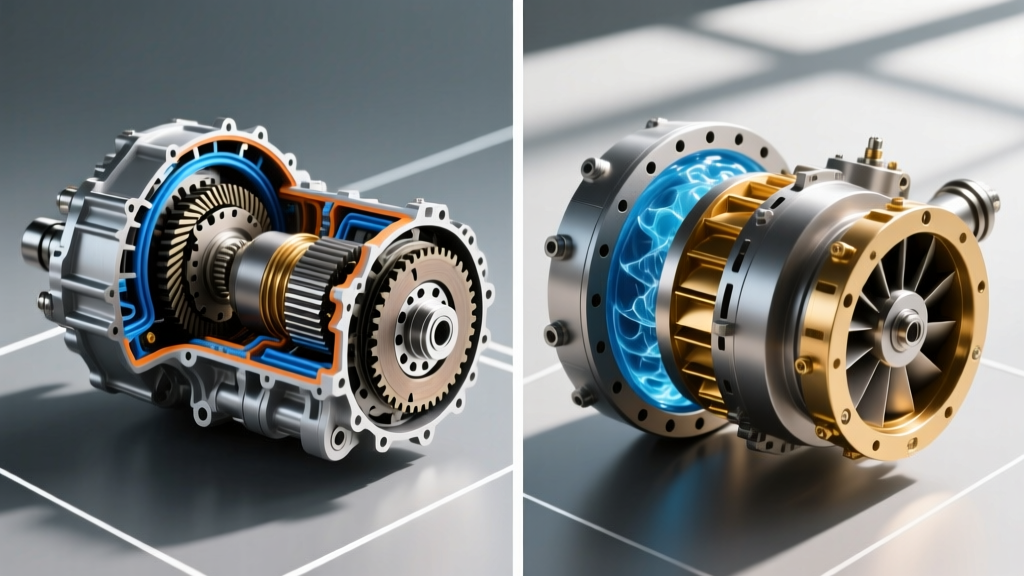
A traditional torque converter relies on the kinetic energy of automatic transmission fluid (ATF) to multiply torque and absorb torsional vibrations. In contrast, a Dual-Clutch Transmission (DCT) utilizes interleaved friction and steel plates—actuated by precise hydraulic or electromechanical clamping forces—to create a direct mechanical link. This technical deep-dive explores the engineering realities, specific failure symptoms, and economic factors of both systems, referencing industry benchmarks like the ZF 8HP, GM 6L80, and VW DQ500 platforms.
Hydrodynamic Torque Multiplication in Torque Converters
The modern torque converter is a three-element hydrodynamic device consisting of an impeller (pump), a turbine, and a stator. The impeller is bolted directly to the engine flexplate, spinning at engine RPM and flinging ATF outward via centrifugal force. This fluid strikes the turbine, which is splined to the transmission input shaft. The stator, mounted on a one-way clutch, redirects the returning fluid to multiply torque—often achieving a 2.0:1 to 2.5:1 multiplication ratio at stall speed.
For example, the GM 6L80 torque converter features a stall speed of approximately 1,800 to 2,200 RPM, allowing the engine to enter its optimal power band before the vehicle begins to move. However, fluid shear creates massive heat. To mitigate this, modern units utilize a Torque Converter Clutch (TCC) that mechanically locks the impeller and turbine together via a carbon-fiber or sintered-bronze friction lining, achieving near 100% mechanical efficiency in higher gears.
DCT Multi-Plate Clutch Mechanics
A DCT eliminates the fluid coupling entirely, opting instead for two independent multi-plate clutch packs housed in a single module or dual concentric shafts. According to BorgWarner Dual-Clutch Technology documentation, wet DCT clutches operate bathed in specialized gear oil, which provides continuous cooling and allows for higher torque capacities (up to 1,000 Nm in heavy-duty applications). Dry DCTs, like the Getrag 6DCT250, operate in air, relying on the thermal mass of the clutch plates and brief engagement times to prevent overheating.
When the mechatronic unit commands a gear change, it modulates hydraulic pressure to the clutch pistons. The clamping force compresses the friction discs against the steel separator plates. Unlike a torque converter, which can slip indefinitely at idle without catastrophic failure (provided the cooling circuit is functional), a DCT clutch pack must achieve full lock-up almost instantly. Prolonged micro-slip in a DCT leads to rapid friction material degradation and severe thermal runaway.
Comparative Engineering Data: TC vs. DCT Clutch Packs
To understand the diagnostic differences between these systems, we must look at the raw engineering specifications. The table below contrasts a traditional ZF 8-speed torque converter with two prevalent DCT architectures.
| Specification | ZF 8HP70 (Torque Converter) | VW DQ500 (Wet DCT) | Getrag 6DCT250 (Dry DCT) |
|---|---|---|---|
| Coupling Type | Hydrodynamic + TCC Lockup | Wet Multi-Plate Clutch | Dry Multi-Plate Clutch |
| Max Torque Capacity | ~700 Nm (at TCC lockup) | ~1,000 Nm (Clutch 1 & 2) | ~250 Nm (Per Clutch) |
| Friction Material | Carbon-Fiber / Cellulose TCC | Paper/Carbon Composite | Sintered Metallic / Organic |
| Fluid / Cooling | ZF Lifeguard 8 (ATF) | G 052 182 (Wet Clutch Oil) | Air-Cooled (No fluid bath) |
| Primary Failure Symptom | TCC Shudder / Slip Codes | Clutch Glazing / Drag | Thermal Overload / Actuator Failure |
Thermal Management and Failure Symptoms
Diagnosing drivetrain issues requires recognizing how thermal limits manifest as physical symptoms in both torque converters and DCT clutch packs.
Torque Converter Shudder and TCC Degradation
The most common symptom of a failing torque converter clutch is 'shudder'—a low-frequency, rhythmic vibration typically felt between 40 and 60 mph under light throttle. As documented in SAE International Technical Papers, TCC shudder occurs when the carbon friction lining degrades or the ATF loses its friction-modifying additives. Instead of smoothly transitioning into a 100% mechanical lock, the TCC rapidly engages and disengages at a frequency of 20 to 50 Hz.
In a GM 6L80 or 8L90, this triggers diagnostic trouble codes (DTCs) such as P0741 (TCC Stuck Off) or P0711 (Transmission Fluid Temperature Sensor Circuit Range/Performance). If left unaddressed, the TCC lining will completely disintegrate, sending metallic and carbon debris through the transmission's valve body, scoring the solenoid bores and destroying the line pressure regulator.
DCT Clutch Pack Glazing and Mechatronic Wear
DCT failures present differently. In wet DCTs like the VW DQ250 or DQ500, the primary symptom of clutch wear is 'clutch drag' or harsh, low-speed engagement. As the friction material wears, the mechatronic unit must constantly adapt the hydraulic bite point. Once the physical wear exceeds the software's adaptation window (typically around 0.4mm to 0.6mm of clutch pack compression loss), the transmission will throw a DTC for 'Clutch Adaptation Limit Reached' and default to limp mode.
Dry DCTs, such as the Ford Powershift (6DCT250) or early VW DSG dry units, are notorious for thermal overload symptoms. In stop-and-go traffic, the mechatronic unit 'feathers' the clutch to simulate automatic creep. This generates immense surface heat on the dry plates, leading to glazing. The physical symptom is severe juddering upon takeoff, accompanied by a dashboard warning indicating 'Gearbox Overheating: Stop Safely.'
Real-World Diagnostics and Replacement Economics
From a 2026 workshop perspective, the economic and diagnostic pathways for these two systems require entirely different toolsets and budgets.
- Torque Converter Diagnostics: Technicians monitor TCC slip RPM via OBD2 live data. A healthy ZF 8HP or GM 10L90 should show 0 to 15 RPM of slip when the TCC is fully commanded ON. If slip exceeds 50-100 RPM under load, the converter friction lining is failing. Cost Factor: Replacing a GM 6L80 torque converter requires transmission removal. The OEM converter costs $600-$900, with labor adding $500-$800, totaling roughly $1,100-$1,700.
- DCT Clutch Pack Diagnostics: Diagnostics involve reading the Measuring Value Blocks (MVB) for clutch adaptation pressures and stroke distances. If the hydraulic pressure required to achieve clutch lock-up drops significantly below baseline, the friction discs are worn or the fluid is contaminated with clutch dust. Cost Factor: Replacing a wet clutch pack in a VW DQ500 is highly labor-intensive, requiring specialized alignment tools to set the clutch stack height. Parts (OEM BorgWarner clutch kit) run $1,200-$1,800, and labor is $1,000-$1,500, pushing total repair costs to $2,200-$3,300.
- Dry DCT Actuator Failures: In dry DCTs, the clutch pack itself is relatively cheap ($300-$500), but the electromechanical clutch actuators and shift forks frequently fail due to heat exposure. Complete mechatronic and clutch replacement often exceeds $3,500.
Verdict: Application-Specific Drivetrain Selection
When comparing a DCT transmission vs torque converter, neither is universally superior; they are optimized for different operational realities. The torque converter remains the undisputed king of low-speed durability, heavy towing, and torsional vibration dampening. As highlighted by ZF Friedrichshafen AG, modern torque converters with multi-disc lock-up clutches now offer shift speeds that rival DCTs while maintaining the fluid-coupling reliability required for heavy-duty trucks and large SUVs.
Conversely, the DCT clutch pack architecture excels in high-performance, lightweight, and motorsport applications where direct mechanical connection and zero-rpm power loss during shifts are paramount. However, the diagnostic reality is that DCT clutch packs are wearable friction items—much like a manual transmission clutch—whereas a torque converter is generally designed to last the lifetime of the vehicle, provided the ATF is maintained and the TCC cooling circuit remains unobstructed. Understanding these mechanical distinctions is the key to accurate drivetrain troubleshooting and long-term reliability.