The Intersection of Differential Gear Ratio and Performance
When modifying a vehicle for off-road capability or towing, the conversation inevitably turns to the axle assemblies. Specifically, understanding the relationship between differential gear ratio and performance is critical for any drivetrain enthusiast. For this model-specific repair guide, we are focusing on the legendary Dana 44 axles found in the Jeep Wrangler JK (2007-2018). When owners upgrade to 35-inch or 37-inch tires, the factory 3.21 or 3.73 gear ratios become a massive bottleneck, robbing the engine of its effective torque curve and forcing the transmission to hunt for gears. Regearing to a 4.88 or 5.13 ratio restores drivability, but this intensive mechanical procedure inherently involves dismantling the pinion assembly, which brings us to a frequently asked question: what is the true differential pinion seal replacement cost when performing a full axle overhaul?
Why Regearing Demands Seal and Yoke Attention
Changing your ring and pinion gears is not a simple bolt-in affair. It requires pulling the pinion gear from the differential housing to swap out the inner and outer pinion bearings, set the pinion depth, and establish proper bearing preload. Because the pinion yoke must be removed to access the pinion nut and bearings, the factory pinion seal is compromised and must be replaced. Furthermore, the mating surface on the yoke itself often requires machining or a repair sleeve to ensure the new seal does not leak immediately. Therefore, the seal replacement is not an isolated repair; it is a mandatory sub-procedure of the regearing process.
Performance Metrics: 3.73 vs. 4.88 Gear Ratios
To understand why enthusiasts accept the high cost of axle teardowns, we must look at the physics of gear reduction. A numerically higher gear ratio multiplies the torque delivered from the transmission to the wheels. According to Quadratec's JK Gearing Guide, matching your gear ratio to your tire diameter is essential for maintaining the factory RPM-to-speed relationship, which optimizes both fuel economy and engine longevity.
| Metric | Factory 3.73 Gears (35" Tires) | Upgraded 4.88 Gears (35" Tires) |
|---|---|---|
| Effective Final Drive Ratio | Equivalent to 3.10 on stock tires | Equivalent to 4.10 on stock tires |
| Highway RPM (70 MPH in 5th Gear) | ~1,950 RPM (Lugging) | ~2,550 RPM (Optimal Powerband) |
| Transmission Shift Logic | Constant hunting, overheating | Decisive shifts, reduced heat |
| Low-Range Crawling Torque | Moderate, requires clutch slipping | Exceptional, precise throttle control |
Evaluating the Differential Pinion Seal Replacement Cost
When researching the differential pinion seal replacement cost, it is vital to distinguish between a standalone leak repair and a seal replacement necessitated by a gear ratio swap. In 2026, labor rates at specialized 4x4 drivetrain shops typically range from $130 to $190 per hour.
Scenario A: Standalone Pinion Seal Leak Repair
If your Dana 44 is simply leaking gear oil from the pinion yoke and you are retaining your current gear ratio, the repair is relatively straightforward. The mechanic will drain the fluid, mark the pinion nut and yoke for alignment, remove the yoke, extract the old seal, install a new one, and torque the nut back to its exact previous position to maintain bearing preload. Estimated Cost: $250 to $400 total (Parts: $45, Labor: 1.5 to 2 hours).
Scenario B: Seal Replacement During a Regear
If you are upgrading your differential gear ratio for performance, the pinion seal replacement cost is effectively absorbed into the broader regear package. A complete front and rear Dana 44 regear includes master rebuild kits (bearings, shims, seals), new ring and pinion sets, and extensive machine shop labor to set gear backlash and contact patterns. Estimated Cost: $1,400 to $1,900 per axle. In this scenario, you do not pay a premium for the seal; it is a mandatory consumable included in the master kit provided by Spicer Drivetrain Systems.
Model-Specific Repair Guide: Dana 44 Pinion Seal and Gear Swap
Executing a pinion seal replacement and gear swap on a Dana 44 requires strict adherence to torque specifications and an understanding of the axle's internal architecture. Unlike the Ford 8.8 axle which utilizes a one-time-use crush sleeve to set bearing preload, the Dana 44 uses a solid spacer and a precision shim pack. This is a massive point of failure for amateur mechanics who attempt to 'crush' the Dana 44 spacer, resulting in catastrophic bearing failure.
Critical E-E-A-T Warning: The Pinion Yoke and Speedi-Sleeve
Before installing the new Spicer 51191 pinion seal, you must inspect the sealing surface of the pinion yoke. Over tens of thousands of miles, the rubber lip of the original seal cuts a microscopic groove into the steel yoke. If you install a new seal over this groove, it will leak within 500 miles. The professional solution is to install an SKF Speedi-Sleeve (Part #99181 for the Dana 44). This ultra-thin stainless steel sleeve slides over the worn yoke, providing a pristine, factory-smooth surface for the new seal lip to ride on, completely eliminating the need to purchase a brand-new $150 OEM yoke.
Step-by-Step Torque and Assembly Specifications
- Pinion Depth Setting: Use the proprietary pinion depth gauge tool. The depth is set by adding or subtracting shims between the inner pinion bearing race and the housing. Target the exact measurement laser-etched on the head of your new pinion gear (usually between 0.002" and 0.006" variance from nominal).
- Bearing Preload: With the pinion depth set and the solid spacer installed, add shims to the outer bearing race until you achieve a rotational drag torque of 15 to 25 inch-pounds (measured with a beam-style inch-pound torque wrench with the carrier removed and no seal installed).
- Pinion Nut Torque: Once preload is verified, install the pinion yoke, a new pinion nut, and apply Red Loctite 271 to the threads. Torque the pinion nut to 250 lb-ft. Re-check rotational drag; it should increase slightly (target 20-30 in-lbs with the seal installed due to seal friction).
- Ring Gear Bolts: The ring gear must be bolted to the carrier using new 7/16"-20 x 1.25" bolts. Apply Red Loctite 271 and torque to 85 lb-ft in a star pattern. Verify gear backlash using a dial indicator; the Dana 44 spec is typically 0.006" to 0.010".
Post-Rebuild Fluid Dynamics and Break-In Procedure
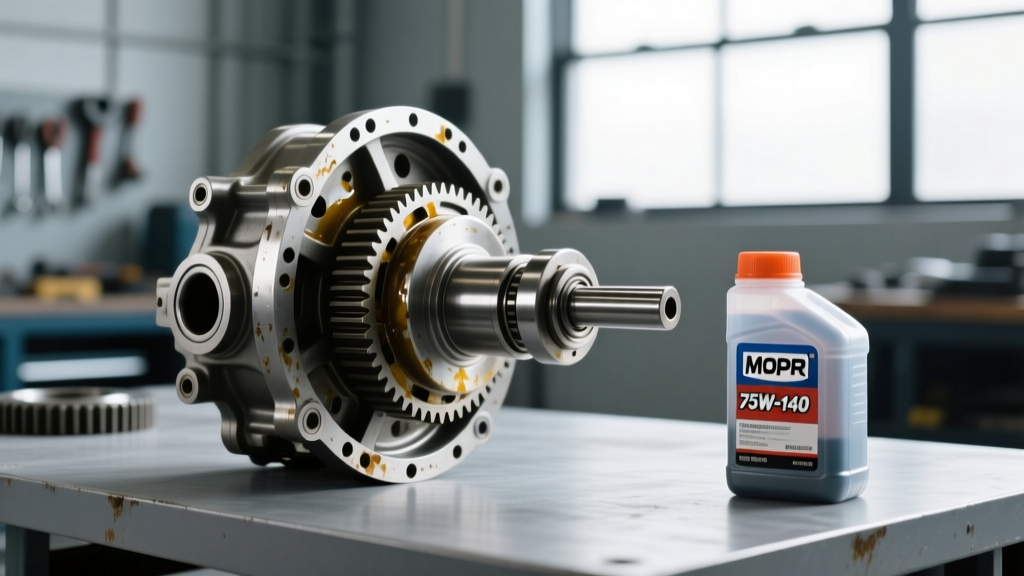
The final step in securing your differential gear ratio upgrade and pinion seal replacement is fluid selection and the critical break-in cycle. The Dana 44 requires approximately 2.5 quarts of fluid per axle. For a regear running 4.88 ratios and larger tires, the increased rotational mass and heat generation mandate a high-viscosity synthetic. We recommend a 75W-140 Synthetic Gear Oil, such as Amsoil Severe Gear or Mobil 1 Synthetic 75W-140.
If your axle is equipped with a Trac-Lok or aftermarket limited-slip differential (LSD), you must add 4 ounces of a dedicated friction modifier additive to prevent clutch chatter during low-speed cornering. However, if you have upgraded to a locking differential like an ARB Air Locker or an Eaton E-Locker, do not use friction modifiers, as they are unnecessary and can degrade the performance of the locking mechanism.
The Heat Cycle Protocol
New ring and pinion gears generate immense friction during their initial mating phase. To prevent the gear oil from breaking down and the pinion seal from blowing out due to extreme thermal expansion, you must follow a strict break-in procedure. Drive the vehicle normally for the first 10 to 15 miles, keeping speeds under 45 MPH. Then, stop and allow the axle housings to cool completely to ambient temperature. Repeat this heat-and-cool cycle three to four times. This gradual thermal stressing allows the gears to work-harden and mate properly without exceeding the thermal limits of your newly installed pinion seal and synthetic fluid.