The CVT Crossroads: Rebuild or Manual Swap in 2026?
As the first major wave of continuously variable transmissions from the early 2010s reaches the end of its service life in 2026, owners and performance shops face a critical decision. When a Subaru Lineartronic TR690 or a Nissan Jatco JF011E begins to slip or throw solenoid codes, the immediate instinct is to search for a replacement or a rebuild kit. However, the traditional cvt clutch kit—which addresses internal forward and reverse friction packs—does not solve the inherent torque-limiting weaknesses of the CVT belt-and-pulley system. Consequently, a massive trend in the tuner and off-road community is the CVT-to-manual transmission swap. This migration brings us to one of the most complex engineering hurdles in modern drivetrain conversions: clutch disc and flywheel compatibility. Swapping from a CVT flexplate setup to a traditional manual flywheel and clutch disc is rarely a simple bolt-on affair. It requires a deep understanding of crankshaft flange machining, pilot bearing depths, and spline mating.
Demystifying the 'CVT Clutch Kit'
Before dissecting manual swap compatibility, it is vital to understand what a CVT clutch kit actually contains. Unlike a manual transmission that utilizes a single large friction disc clamped against a flywheel, automotive CVTs rely on internal wet multi-plate clutch packs to engage forward and reverse gears, as well as to manage torque converter lock-up. A standard OEM or aftermarket cvt clutch kit for a Jatco JF011E, for example, includes a series of thin friction discs (often part number 31447AA080 or similar equivalents), steel separator plates, and snap rings. These components operate entirely inside the transmission bell housing, bathed in CVT fluid, and have absolutely zero physical relationship to the engine's flywheel or flexplate. Therefore, when a CVT fails catastrophically due to pulley shearing or belt snapping, replacing the internal clutch packs will not save the unit. This is precisely why enthusiasts opt to delete the CVT entirely and adapt a 5-speed or 6-speed manual transmission, forcing a direct confrontation with clutch disc and flywheel compatibility.
The Core Hurdle: Clutch Disc and Flywheel Compatibility
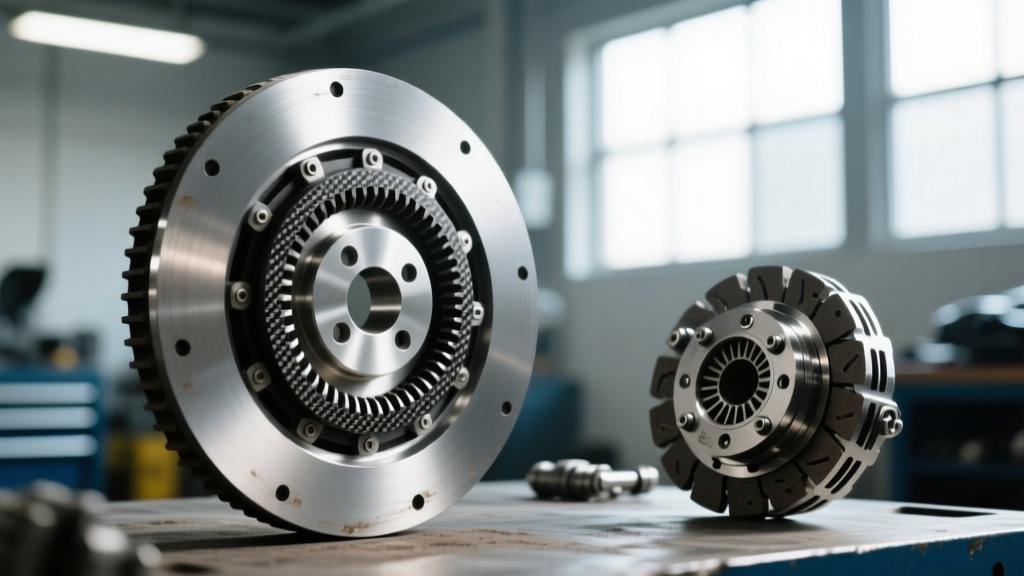
When you remove a CVT to install a manual transmission, the first casualty is the flexplate. CVT flexplates are designed solely to transfer engine rotation to the torque converter and are incredibly thin, lacking the mass required to smooth out engine pulses for a manual clutch engagement. You must install a manual flywheel. However, clutch disc and flywheel compatibility is dictated by the engine block and crankshaft, which were originally machined for a CVT. The primary issues revolve around crankshaft step height, dowel pin alignment, and the pilot bearing bore.
Crankshaft Flange and Step Height Variances
Automakers often use the same base engine block for both CVT and manual variants, but the crankshaft flange (the rear face where the flywheel mounts) can differ. In many Subaru FA and FB series engines, the 8-bolt crankshaft flange pattern is identical. However, the 'step height'—the distance from the crankshaft mating surface to the engine block mating surface—can vary by fractions of a millimeter. If you bolt a manual flywheel onto a crankshaft that was specifically balanced and machined for a CVT flexplate, you may encounter severe clutch disc runout. This runout prevents the clutch disc from fully disengaging, leading to gear grinding and premature wear on the transmission input shaft synchros. To verify compatibility, machinists must measure the crank step height with a dial indicator before mounting the new flywheel.
Compatibility Matrix: CVT Flexplate vs. Manual Flywheel
To illustrate the physical differences that dictate clutch disc and flywheel compatibility, review the data table below comparing a standard CVT setup to a manual swap configuration on a popular tuner platform (Subaru 2.0L/2.5L Boxer).
| Specification | OEM CVT Flexplate Setup | Aftermarket Manual Flywheel (e.g., Exedy) |
|---|---|---|
| Component Weight | 3.8 lbs (Flexplate only) | 14.5 lbs (Single Mass) / 22 lbs (Dual Mass) |
| Crank Bolt Pattern | 8-Bolt (M10x1.25) | 8-Bolt (M10x1.25) |
| Friction Surface | N/A (Torque Converter Mating) | 240mm Machined Steel |
| Pilot Bearing Requirement | None (Torque Converter Hub) | Required (Supports Manual Input Shaft) |
| Crankshaft Step Height | Optimized for thin flexplate | Requires verification/machining for thick hub |
The Pilot Bearing Dilemma
The most frequent point of failure in a CVT-to-manual swap regarding clutch disc and flywheel compatibility is the pilot bearing. In a manual transmission, the tip of the transmission input shaft rests in a pilot bearing or bushing pressed into the center of the crankshaft flange. This supports the shaft and ensures perfect alignment with the clutch disc spline. CVT-equipped engines, however, do not use a pilot bearing; the torque converter hub is supported entirely by the transmission's front pump bushing. As a result, the center bore of a CVT crankshaft is often left unmachined, or machined to a completely different diameter. Attempting to force a standard pilot bearing into a CVT crankshaft will result in improper input shaft support, leading to catastrophic clutch disc wobble and immediate destruction of the transmission bell housing. The solution requires either having a machine shop bore the CVT crankshaft flange to accept the correct manual pilot bearing (typically 15mm or 16mm OD depending on the transmission), or sourcing a specialized custom bronze bushing designed specifically for CVT-to-manual crankshaft adaptations.
Clutch Disc Spline and Hub Compatibility
Once the flywheel is mounted and the pilot bearing is resolved, the clutch disc itself must mate to the manual transmission input shaft. Clutch discs are not universal; they are defined by their outer diameter (e.g., 225mm, 240mm) and their internal spline count. For instance, a Nissan 6-speed manual (FS6R31A) requires a 24-spline clutch disc, while older 5-speeds may use a 23-spline. If you are retaining the OEM CVT engine ECU and wiring harness, you must ensure the manual clutch disc hub does not interfere with the CVT-specific rear main seal housing or sensor reluctor wheels. Sourcing a high-quality clutch kit from reputable manufacturers like Exedy ensures that the damper springs in the clutch disc are tuned for the specific torque curve of the engine, preventing drivetrain shock that the CVT previously absorbed via its fluid coupling.
Sourcing and Part Numbers for the Swap
When executing this swap, relying on OEM dealership parts counters can be frustrating, as their systems often flag manual flywheel part numbers as incompatible with your CVT-born VIN. The aftermarket is your best resource. For Subaru applications, the Exedy SUB108 (OEM replacement single mass) or the Exedy SUB025 (lightweight chromoly) are industry standards. For Nissan applications utilizing the Jatco CVT8 or JF011E, swapping to a manual requires verifying the flywheel bolt circle diameter. Always cross-reference your chosen clutch disc and flywheel assembly on platforms like RockAuto to verify the exact spline count and flywheel thickness, as a variance of even 2mm in flywheel thickness will alter the clutch fork geometry, preventing the throw-out bearing from fully engaging the pressure plate fingers.
Critical Torque Specifications & Assembly Guidelines
Proper assembly is the final pillar of clutch disc and flywheel compatibility. Because you are adapting a manual flywheel to an engine originally balanced for a CVT flexplate, fastener integrity is paramount. The rotational mass is significantly higher, placing immense shear stress on the flywheel bolts.
- Flywheel to Crankshaft Bolts: Always use new OEM or ARP high-tensile bolts. For most modern 8-bolt flanges (Subaru/Nissan), the spec is typically 74 lb-ft, followed by an additional 90-degree angle turn. Apply a medium-strength thread locker (Loctite 243) to the threads to prevent backing out under high-RPM manual shifts.
- Clutch Disc Alignment: Never eyeball the clutch disc. Use a precision CNC-machined alignment tool that matches the exact spline count and pilot bearing inner diameter. A misaligned disc by even 0.5mm will bind on the input shaft, causing the clutch to drag when the pedal is depressed.
- Pressure Plate to Flywheel: Torque the pressure plate bolts in a sequential star pattern to 25 lb-ft. This ensures even clamping force across the friction material, preventing localized hot-spotting and premature warping of the flywheel mating surface.
Expert Builder's Note: 'When deleting a CVT, don't forget the rear main seal. CVT crankshafts often have a different polished surface width for the seal lip compared to manual cranks. Inspect the seal mating surface for grooves before bolting the manual flywheel on, or you will chase an oil leak that contaminates your new clutch disc for the rest of the vehicle's life.' — Senior Drivetrain Technician, AutoGear Nexus
Final Verdict for 2026
While purchasing a cvt clutch kit to rebuild the internal forward and reverse packs might seem like the path of least resistance, it is ultimately a band-aid on a compromised transmission design. For those seeking reliability and performance, the manual transmission swap remains the superior choice. However, success hinges entirely on meticulous attention to clutch disc and flywheel compatibility. By verifying crankshaft step heights, machining the pilot bearing bore, and strictly adhering to torque specifications, you can successfully bridge the gap between modern CVT engine architectures and the timeless durability of a manual drivetrain. For comprehensive part lookups and OEM schematics, consult resources like Jatco's technical archives or your manufacturer's specific service manual before ordering your swap components.