Diagnosing Drivetrain Strain: When Your Truck Fails the Towing Test
Towing a 10,000-pound travel trailer or a loaded car hauler exposes every weakness in your truck's drivetrain. As an automotive transmission specialist, I frequently see owners of modern half-ton and three-quarter-ton trucks burning up torque converters and frying clutch packs on steep grades. The culprit is rarely a defective part; it is almost always a mismatched final drive ratio. If your truck is hunting for gears, flaring between shifts, or pushing transmission fluid temperatures past 230°F (110°C), you have a gearing problem. Understanding how to compute gear ratio for your specific hauling profile is the first step in diagnosing and resolving these chronic drivetrain failures.
Common Symptoms of an Incorrect Towing Gear Ratio
Before tearing into the differential or swapping the ring and pinion, you must accurately diagnose whether the symptoms point to mechanical failure or simple mathematical mismatch. Here are the primary indicators that your current axle ratio is too tall (numerically low) for your towing demands:
- Chronic Gear Hunting: The transmission control module (TCM) constantly cycles between 5th and 6th gear on mild inclines. This occurs because the engine falls out of its peak torque band in the overdrive gear, forcing a downshift, which then spikes the RPMs and triggers an immediate upshift.
- Excessive TCC Slip: Using a bi-directional scanner to monitor Torque Converter Clutch (TCC) slip is critical. Under heavy load, if your TCC slip speed consistently reads above 20-30 RPM while in lockup, the converter is generating massive internal heat. This is a hallmark of engine lugging due to a numerically low axle ratio.
- Sluggish Grade Climbing: The engine bogs down below 1,600 RPM on a 6% grade, requiring heavy throttle input just to maintain 55 MPH. This excessive throttle loading drastically increases Exhaust Gas Temperatures (EGTs) in diesels and cylinder head temperatures in gas V8s.
The Math: How to Compute Gear Ratio for Hauling
To diagnose the root cause, you need to know exactly where your engine is operating in its powerband while under load. When learning how to compute gear ratio for towing, the most critical metric is your cruising RPM in the highest tow-friendly gear (often one gear below the absolute top overdrive gear). Use this industry-standard formula:
RPM = (MPH × Axle Ratio × Transmission Gear Ratio × 336) / Tire Diameter
Real-World Troubleshooting Scenario: The 6L80E Overheating Crisis
Let us look at a common diagnostic case: a 2018 Silverado 1500 equipped with the 6L80E transmission, a 3.42 rear axle ratio, and 33-inch aftermarket all-terrain tires. The owner reports the transmission goes into limp mode after 40 miles of towing a 7,500 lb trailer on the highway.
Let us compute the RPM at 65 MPH in 5th gear (0.85 ratio), which is the highest gear the TCM will allow while in Tow/Haul mode:
- MPH: 65
- Axle Ratio: 3.42
- Trans Ratio (5th): 0.85
- Tire Diameter: 33 inches
Calculation: (65 × 3.42 × 0.85 × 336) / 33 = 1,941 RPM.
At first glance, 1,941 RPM seems acceptable. However, the 5.3L EcoTec3 V8 makes its peak towing torque closer to 4,100 RPM. At 1,941 RPM under heavy load, the engine is lugging. The TCM commands the TCC to lock up, but the engine lacks the rotational mass to maintain it without severe knock retard. The TCM commands partial TCC slip to save the engine, generating enough friction to push Transmission Fluid Temperature (TFT) past the 260°F (126°C) fail-safe threshold, triggering limp mode. The diagnosis is clear: the 3.42 ratio combined with oversized tires has effectively lowered the final drive to an unusable towing state.
Diagnostic Matrix: Symptom vs. Computed Ratio Fix
Use the following troubleshooting matrix to correlate your scanner data and driving symptoms with the necessary mathematical correction. This data applies to modern 6-speed, 8-speed, and 10-speed automatic transmissions (such as the GM 6L80, ZF 8HP70, and Ford 10R80).
| Observed Symptom | Scanner Data (TCM Logs) | Root Cause Diagnosis | Computed Ratio Correction |
|---|---|---|---|
| Hunting between 5th and 6th gear on flat ground | Throttle Position > 45%, Frequent shift events | Final drive too tall for aero drag of trailer | Increase axle ratio by 0.31 (e.g., 3.42 to 3.73) |
| Transmission Limp Mode on highway grades | TFT > 250°F, TCC Slip > 40 RPM | Torque converter generating heat due to engine lugging | Increase axle ratio to achieve 2,200+ RPM at cruise |
| Harsh downshifts and rear-end 'clunk' | High line pressure codes, Output speed sensor drop | Drivetrain bind or excessive backlash from worn R&P | Inspect gear pattern; replace if backlash > 0.012' |
Hardware Corrections: Swapping the Ring and Pinion
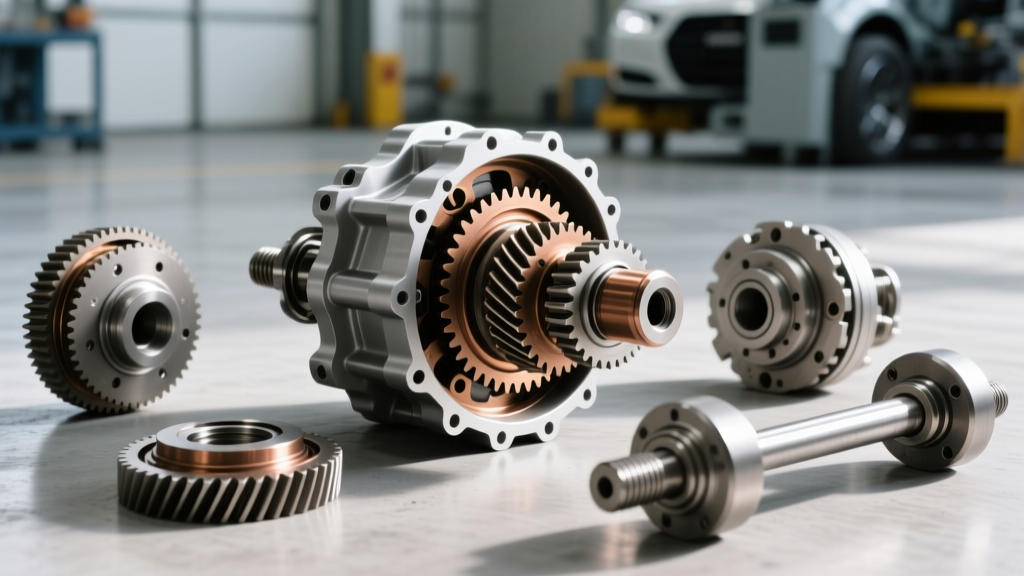
Once you use the formula to compute the ideal gear ratio for your hauling needs, the physical repair involves swapping the differential ring and pinion. For a GM 9.5-inch 14-bolt semi-floating axle, moving from a 3.42 to a 3.73 or 4.10 ratio requires precise setup. According to Yukon Gear & Axle installation guides, improper setup under towing loads will result in catastrophic tooth shearing within the first 500 miles.
Critical Setup Specifications for Towing Axles
When installing a new 4.10 ring and pinion set (such as Yukon part number YG GM9.5-410), you must adhere to strict tolerances to handle the immense torque multiplication of towing:
- Ring Gear Bolt Torque: 74 lb-ft. You must use a high-strength threadlocker like Loctite 263 (Red) and ensure the mating surfaces are completely free of oil. Under heavy towing loads, ring gear bolts are subjected to severe shearing forces.
- Pinion Bearing Preload: 15 to 25 inch-pounds of rotational drag (measured with a dial inch-pound torque wrench on the pinion nut with the axle shafts removed). If preload is too loose, the pinion gear will walk under load, destroying the crush sleeve and causing a high-speed blowout.
- Backlash: Set between 0.006' and 0.010'. Towing generates extreme differential heat, which expands the aluminum or cast-iron housing. Setting backlash too tight will result in gear binding when the differential reaches 180°F+ under a trailer load.
- Gear Pattern: Under load, the pattern should be centered on the tooth face. A toe-heavy or heel-heavy pattern will cause the gears to whine and eventually spall under the continuous load of hauling.
Fluid and Cooling Considerations Post-Swap
Changing your gear ratio alters the thermal dynamics of the entire driveline. As noted by experts at Transmission Digest, a lower (numerically higher) gear ratio keeps the engine RPMs up, which increases mechanical efficiency and reduces TCC slip, but it also increases the rotational speed of the ring and pinion. This means the differential itself will run hotter.
After regearing for towing, always upgrade the differential fluid to a high-quality full synthetic 75W-90 or 75W-140, depending on the manufacturer's specification for heavy-duty use. For the transmission, ensure you are using the exact OEM-specified low-viscosity fluid, such as ACDelco Dexron ULV for GM 8-speed and 10-speed applications, to maintain proper shift timing and TCC apply rates under load.
Final Diagnostic Takeaways
Troubleshooting a truck that struggles to tow is rarely about replacing failed hard parts; it is about correcting the physics of the drivetrain. By monitoring TCM data, understanding your engine's torque curve, and knowing exactly how to compute gear ratio based on your tire size and trailer weight, you can confidently diagnose the root cause of drivetrain strain. Whether you are reprogramming the TCM to alter shift points or physically installing a 4.10 ring and pinion, the math must always dictate the mechanical repair. Never guess your axle ratio when thousands of dollars in transmission repairs are on the line.