What Exactly is a Final Drive Ratio?
When automotive enthusiasts and mechanics talk about drivetrain performance, the term "final drive ratio" is thrown around constantly. But what does it actually mean? In the simplest terms, your vehicle's final drive ratio is the last point of gear reduction between the engine and the drive wheels. While your transmission (whether it's a classic 4L60E, a modern ZF 8HP, or a manual Tremec T-56) provides multiple gear ratios to keep the engine in its powerband, the final drive is a fixed, single ratio located inside the differential housing.
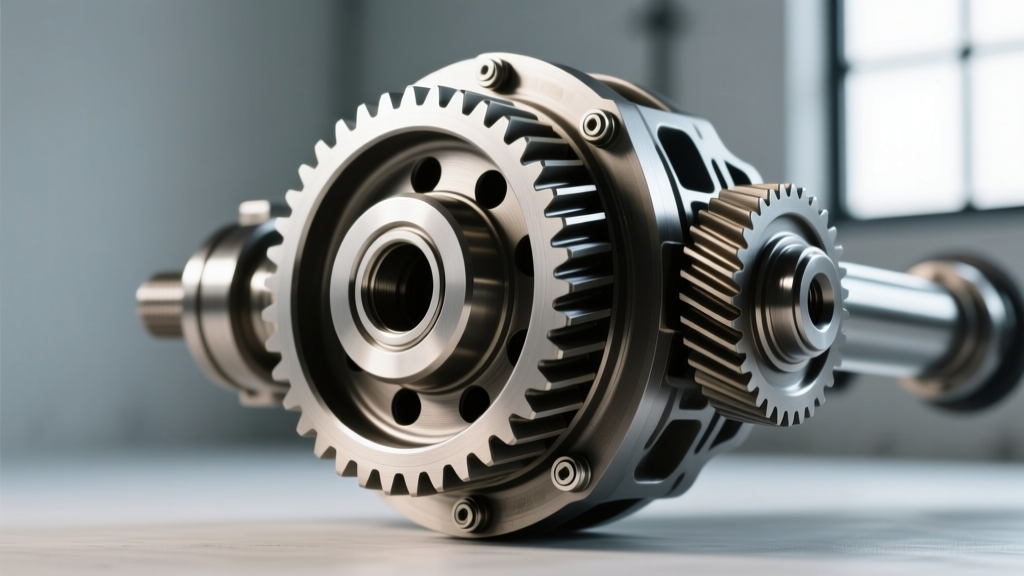
Mathematically, the final drive ratio is determined by dividing the number of teeth on the large ring gear by the number of teeth on the small pinion gear. For example, if your ring gear has 41 teeth and your pinion gear has 11 teeth, your final drive ratio is 3.73:1 (41 ÷ 11 = 3.727). This means the driveshaft must rotate 3.73 times to turn the axle shafts and wheels exactly one time.
Understanding this concept is crucial because it dictates your vehicle's mechanical advantage. A numerically higher ratio (like 4.10:1) provides immense low-end torque multiplication for towing and off-roading, while a numerically lower ratio (like 3.08:1) reduces engine RPM at highway speeds, prioritizing fuel economy.
Why Beginners Need to Understand Final Drive Math
Many beginners mistakenly believe that changing their transmission will drastically alter their low-speed crawling ability. However, the true multiplication happens when you combine the transmission's first gear, the transfer case's low range (if equipped), and the final drive ratio. This is known as the Overall Crawl Ratio.
- Transmission 1st Gear: 3.06 (e.g., GM 4L60E)
- Transfer Case Low Range: 2.72 (e.g., NP241)
- Final Drive Ratio: 4.10
- Overall Crawl Ratio: 3.06 × 2.72 × 4.10 = 34.08:1
As you can see, the final drive acts as a massive multiplier for the entire drivetrain. If you are planning to upgrade your tires from 31 inches to 35 inches, you will need to calculate a new final drive ratio to restore your factory performance. But before you buy a new set of gears, you need to know what you currently have.
How to Count Gear Ratio: The Two Best Methods
If you bought a used truck or project car and the window sticker is long gone, you might be wondering how to count gear ratio accurately. There are two primary ways to do this: the non-invasive tire spin method, and the definitive physical counting method.
Method 1: The Tire Spin Method (No Tools Required)
This is the fastest way to estimate your final drive ratio without getting your hands dirty. You will need a floor jack, jack stands, a grease pencil or chalk, and a helper.
- Safety First: Safely lift the rear axle and support it on jack stands placed directly under the axle tubes. Never rely solely on a hydraulic jack.
- Mark the Driveshaft: Use your chalk to make a highly visible line on the rear driveshaft and a corresponding mark on the differential pinion yoke.
- Mark the Tire: Make a mark on the bottom of the tire tread and a corresponding mark on the floor or on the axle backing plate.
- The Spin Test (Open Differential): If your vehicle has a standard "open" differential, put the transmission in Neutral. Rotate the tire exactly two full revolutions while keeping the opposite tire stationary (have your helper hold it). Count how many times the driveshaft rotates.
- The Spin Test (Limited Slip/Locker): If you have a positraction, limited-slip, or locking differential, both tires will spin together. Rotate the tire exactly one full revolution and count the driveshaft turns.
Pro-Tip: If the driveshaft turns roughly 3 and 3/4 times, you have a 3.73 ratio. If it turns just over 4 times, you have a 4.10. If it turns about 3 and 1/8 times, you are looking at a 3.08 or 3.27 ratio.
Method 2: Counting Ring and Pinion Teeth (The Exact Way)
While the tire spin method is great for a quick estimate, learning how to count gear ratio by physically inspecting the differential is the only way to be 100% certain, especially if the previous owner swapped the differential cover but left the internals a mystery.
Tools Required:
- Socket set (typically 3/8", 10mm, or 13mm for diff cover bolts)
- Drain pan (capable of holding 2.5 to 4 quarts)
- Brake cleaner and shop towels
- New differential cover gasket or RTV Silicone (e.g., Permatex Ultra Black Part #81878)
- New 75W-90 or 75W-140 GL-5 Gear Oil
- Limited-Slip Friction Modifier (if equipped with a clutch-type LSD)
- Drain the Fluid: Remove the bottom-most bolt on the differential cover to let the gear oil drain into your pan. Be prepared for the distinct, pungent sulfur smell of GL-5 gear oil.
- Remove the Cover: Unbolt the perimeter bolts and carefully pry the cover off. Do not use a screwdriver on the mating surfaces, as gouging the metal will cause permanent leaks.
- Clean the Ring Gear: Spray the large ring gear with brake cleaner and wipe it down with a lint-free shop towel. You need to expose the bare metal on the face of the gear.
- Read the Stampings: In 90% of factory and quality aftermarket axles, the ratio is laser-etched or stamped directly onto the face of the ring gear. You will typically see a sequence like
41 11 3.73or a date code followed by the tooth counts. - Count Manually: If the stampings are worn away, use a paint marker to mark a starting tooth on the ring gear and count every tooth until you return to the mark. Repeat for the pinion gear. Divide the ring gear count by the pinion count.
Real-World Axle Data: Tooth Counts and Torque Specs
To help you identify your setup, here is a data table featuring some of the most common light-duty and off-road axles found on the road today, complete with factory torque specifications for reassembly. Proper torque is critical; under-torquing ring gear bolts will lead to catastrophic gear failure under load.
| Axle Model | Common Ratio | Ring / Pinion Teeth | Ring Gear Bolt Size | Ring Bolt Torque Spec | Fluid Capacity |
|---|---|---|---|---|---|
| Ford 8.8" (Solid Axle) | 3.73 | 41 / 11 | 7/16"-20 | 85 lb-ft (with Red Loctite) | 2.5 - 3.0 Quarts |
| Dana Spicer 44 | 4.10 | 41 / 10 | 3/8"-24 | 70 lb-ft | 2.0 - 2.5 Quarts |
| GM 8.5" 10-Bolt | 3.42 | 41 / 12 | 3/8"-24 | 75 lb-ft | 2.0 - 2.2 Quarts |
| Chrysler 8.25" (C-Clip Elim.) | 3.21 | 45 / 14 | 3/8"-24 | 65 lb-ft | 2.2 Quarts |
Note: Always refer to the specific OEM service manual or aftermarket manufacturer guidelines from experts like Ring-Pinion.com or Dana Spicer for exact torque sequences and bearing preload specifications.
Reassembly and Expert Best Practices
Knowing how to count gear ratio is only half the battle; putting the axle back together correctly ensures it survives the next 100,000 miles. If you had to remove the ring gear from the carrier to count the teeth (or if you are upgrading the gears), follow these strict E-E-A-T approved reassembly rules:
- Thread Locker is Mandatory: Ring gear bolts endure immense shear stress. You must apply a high-strength thread locker like Loctite 272 (Red) or Loctite 262 (Green) to the threads before torquing. Never install them dry.
- RTV vs. Gaskets: While some differentials use pre-cut paper or rubber gaskets, many modern axles (like the Ford 8.8 and GM 10-bolt) rely on RTV silicone. Use a sensor-safe, high-torque RTV like Permatex "The Right Stuff". Apply a continuous 1/4" bead, wait 10 minutes for it to become tacky, and then mate the surfaces. This prevents the silicone from squishing entirely into the housing and clogging the oil pickup.
- Friction Modifier: If your axle is equipped with a clutch-based limited-slip differential (like Ford's Traction-Lok or GM's Auburn), you must add a friction modifier (typically 4 oz of Ford XL-3 or GM EOS) to your new 75W-90 synthetic gear oil. Skipping this $8 bottle of fluid will result in severe chatter and binding during low-speed turns, eventually destroying the clutch packs.
- Break-In Procedure: If you installed a brand new ring and pinion set, the gears need to be heat-cycled. Drive conservatively for the first 500 miles, avoiding sustained highway speeds and heavy towing. Change the gear oil immediately after this break-in period to remove the microscopic metal shavings generated during initial wear.
Final Thoughts on Drivetrain Mathematics
Mastering the final drive ratio is a rite of passage for any gearhead. Whether you are using the quick tire-spin method to verify a Craigslist seller's claims, or dropping the differential pan to count 41 ring gear teeth and 11 pinion teeth, understanding this fixed multiplication factor is the key to building a vehicle that performs exactly how you want it to. By combining accurate calculations with precision reassembly torque specs, you ensure your drivetrain is not only optimized for your tire size, but built to handle the abuse of the road and trail for years to come.