The Universal Physics of Gears: From Water to Asphalt
Whether you are casting a lure into heavy cover or launching a 4,000-pound vehicle off the line, mechanical advantage dictates your success. When anglers and outdoor enthusiasts ask, what do gear ratios mean in fishing reels, the answer lies in the exact same fundamental physics that govern automotive drivetrains. A gear ratio is simply a mathematical expression of the trade-off between rotational speed and torque multiplication.
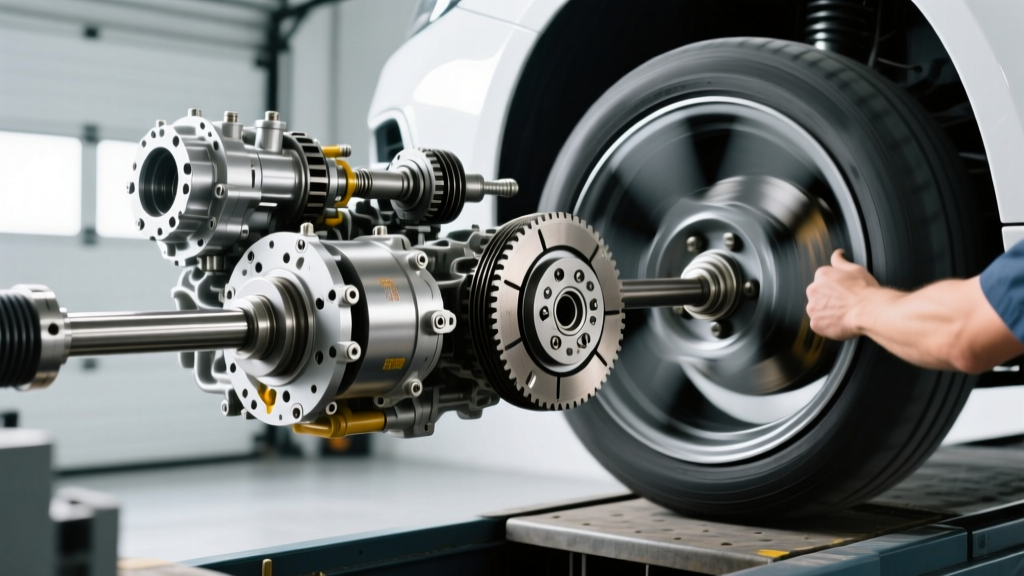
In a high-speed baitcasting reel like the Shimano Curado 7.1:1, turning the handle 7.1 times yields one full rotation of the spool. This prioritizes retrieval speed over cranking power. Conversely, in an automotive transmission, a lower numerical gear (like 1st gear) prioritizes torque multiplication to overcome vehicle inertia. As an automotive transmission specialist, I frequently use the fishing reel analogy to teach apprentices how planetary gearsets and final drive differentials manipulate engine output.
The Golden Rule of Gearing: You cannot create energy; you can only trade speed for torque, or torque for speed. A higher numerical ratio (e.g., 4.10:1) multiplies torque but reduces top speed. A lower numerical ratio (e.g., 0.67:1 overdrive) increases speed potential but reduces torque at the wheels.
Step 1: Decoding the Baseline Ratios
To understand how gear ratios affect performance, we must first map the terminology across both domains. In a fishing reel, the gear ratio is fixed by the main gear and pinion gear teeth count. In a vehicle, the total drivetrain reduction is a compound calculation involving the transmission gear, the torque converter (if applicable), and the final drive (axle) ratio.
Automotive Transmission Baselines
- GM 4L60E (4-Speed Auto): 1st Gear (3.06:1), 2nd (1.63:1), 3rd (1.00:1), 4th (0.70:1). Total system fluid capacity: 11.2 quarts of Dexron VI.
- ZF 8HP70 (8-Speed Auto): 1st Gear (4.71:1), 8th Gear (0.67:1). Utilizes 4 planetary gearsets and 5 shifting elements. Dry fill capacity: 9.5 liters of ZF LifeguardFluid 8. Max torque capacity: 700 Nm (516 lb-ft).
Step 2: Calculating True Wheel Torque
Understanding what do gear ratios mean in fishing reels is easy because the ratio is isolated. In a car, you must calculate the Final Drive Ratio (FDR) to find true wheel torque. The formula is:
Engine Torque × Transmission Gear Ratio × Axle Ratio = Gross Wheel Torque
Real-World Calculation Example
Imagine a 5.3L V8 producing 383 lb-ft of torque, paired with a 4L60E transmission and a 3.73 rear axle.
- 1st Gear Launch: 383 lb-ft × 3.06 (1st gear) × 3.73 (axle) = 4,372 lb-ft of gross torque to the tires (minus ~15% drivetrain loss).
- 4th Gear Highway Cruise: 383 lb-ft × 0.70 (overdrive) × 3.73 (axle) = 1,000 lb-ft of gross torque, optimized for fuel economy and low RPM.
If you were to swap the axle to a 4.10 ratio, your 1st gear torque would jump to 4,806 lb-ft, drastically improving acceleration but increasing highway RPMs by roughly 10%.
Step 3: Step-by-Step Guide to Altering Your Final Drive Ratio
If you need more torque multiplication—similar to dropping down to a 5.1:1 reel for deep-sea cranking—you must change the vehicle's ring and pinion. Here is a professional-grade, step-by-step guide to swapping a GM 8.5-inch 10-bolt differential from a 3.23 to a 4.10 ratio using a Yukon Gear & Axle YG GM8.5-410 kit (Retail: ~$420).
Required Tools & Specs
- Dial indicator with magnetic base (for backlash measurement)
- Inch-pound torque wrench (for bearing preload)
- Foot-pound torque wrench
- Red Loctite 271 & Gear Marking Compound (Yellow)
The Installation Sequence
- Tear Down & Measurement: Remove the differential cover and drain the 75W-90 synthetic gear oil (approx. 2.2 quarts). Before removing the carrier, measure the original backlash using the dial indicator. Factory spec is typically 0.008" to 0.012".
- Pinion Depth Setup: Install the new pinion gear with the appropriate shims. The pinion depth (distance from the axle centerline to the pinion head) is critical. Use the marking compound on the ring gear. A proper pattern will sit centered on the drive side of the teeth, slightly toward the heel.
- Crush Sleeve & Preload: Install a new crush sleeve and pinion seal. Torque the pinion nut to 125–150 lb-ft to crush the sleeve. Stop frequently to check rotational torque with the inch-pound wrench. Target 22–28 in-lbs of rotational preload for new bearings.
- Carrier & Backlash: Mount the new 4.10 ring gear to the carrier. Torque the ring gear bolts to 75–85 lb-ft in a star pattern, applying Red Loctite. Install the carrier into the housing with the new carrier bearings and side shims.
- Final Verification: Measure backlash again. Adjust side shims until you achieve exactly 0.010" of backlash. Rotate the assembly 360 degrees to ensure the pattern remains consistent under load.
Step 4: Comparative Data Mapping (Reel vs. Transmission)
To visualize how the speed vs. torque tradeoff scales across different mechanical systems, review the comparison table below. Notice how the ZF 8HP utilizes a massive 4.71:1 first gear to move heavy luxury vehicles, mirroring the low-gear winching power of a specialized reel.
| System / Model | Ratio (Low / High) | Primary Function | Speed vs. Torque Bias |
|---|---|---|---|
| Shimano Curado Baitcaster | 7.1:1 (Fixed) | Fast lure retrieval, burning baits | High Speed / Low Torque |
| Penn Squall II Levelwind | 2.5:1 (Fixed) | Deep dropping, heavy winching | Low Speed / High Torque |
| GM 4L60E Transmission | 3.06:1 / 0.70:1 | General duty, light towing | Balanced (4-Speed Spread) |
| ZF 8HP70 Transmission | 4.71:1 / 0.67:1 | Heavy luxury, high-torque launch | Extreme Torque Mult. / Wide Spread |
| GM 10-Bolt (4.10 Axle) | 4.10:1 (Fixed Final) | Off-road crawling, heavy towing | Low Speed / Max Torque Mult. |
Summary: Matching the Ratio to the Load
Whether you are trying to understand what gear ratios mean in fishing reels to pick the right setup for flipping heavy timber, or you are recalibrating a ZF 8HP for a supercharged build, the mechanical truth remains unchanged. Ratios are multipliers. By mastering the calculation of engine torque, transmission spread, and final drive reduction, you can precisely tune any machine to deliver the exact balance of speed and pulling power required for the task at hand. Always ensure that when increasing torque multiplication via lower gearing, you verify that the transmission's internal clutch packs and the differential's ring gear bolts are rated to handle the amplified stress at the contact patches.