The Physics of Pedal Feel: Real-World Degradation vs. Sim Telemetry
For automotive engineers and high-level sim racers, the Moza clutch pedal (such as the CRP1000 or standard load-cell variants) represents the pinnacle of haptic feedback. By utilizing high-resolution load cells and tunable elastomer dampers, Moza pedals accurately replicate the non-linear torque curve of a real-world diaphragm spring—specifically the 'over-center' hump that occurs just past the engagement bite point. However, in actual manual transmission vehicles, this precise mechanical symphony degrades over time. Understanding clutch wear signs and lifespan indicators requires analyzing the divergence between factory-spec hysteresis and the degraded physical feedback felt through the pedal. By applying the analytical mindset used to calibrate a Moza clutch pedal's telemetry, technicians can diagnose real-world drivetrain issues long before catastrophic failure occurs.
5 Critical Clutch Wear Signs and Lifespan Indicators
Diagnosing a failing clutch assembly goes far beyond the cliché of 'slipping in high gears.' Modern manual transmissions, from the Tremec T56 Magnum to the Porsche G50, exhibit highly specific mechanical and hydraulic warnings as their friction materials and springs approach end-of-life.
1. Engagement Point Migration (The Hysteresis Shift)
As the friction disc wears, its overall thickness decreases. A new OEM clutch disc typically measures between 8.0mm and 9.5mm. As the material wears down to the 5.5mm threshold, the release bearing must travel further to disengage the pressure plate. In a properly adjusted hydraulic system, the master and slave cylinders compensate for this wear, causing the pedal's engagement 'bite point' to migrate closer to the top of the pedal's upward travel. If the bite point is within 1 inch of the fully released position, the clutch disc is nearing the rivet exposure limit (0.3mm from the friction surface), indicating immediate replacement is required.
2. Friction Material Glazing and Thermal Degradation
When a clutch is subjected to prolonged slip—such as during aggressive launch control usage or heavy stop-and-go traffic in high-torque applications—friction surface temperatures can exceed 400°C (752°F). At this threshold, the organic resin binders in the friction material bake out and migrate to the surface, creating a hardened, glass-like layer known as glazing. The primary symptom is a high-frequency shudder or micro-slip under heavy load (e.g., 3rd-gear roll-on at 3,000 RPM). Unlike a healthy disc that exhibits a progressive, linear grab, a glazed disc will feel abruptly 'on/off,' entirely destroying the modulation that a precision load cell setup like a Moza clutch pedal is designed to simulate.
3. Pressure Plate Diaphragm Spring Fatigue
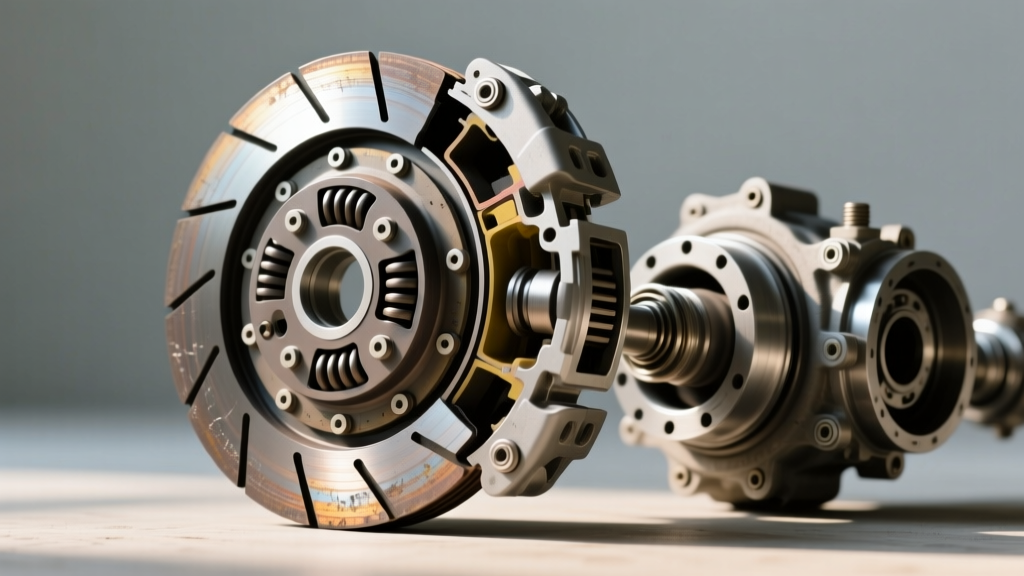
The diaphragm spring is a marvel of metallurgical engineering, designed to exert upwards of 2,500 to 3,500 lbs of clamp load on the friction disc. Over tens of thousands of engagement cycles, the spring fingers experience cyclical fatigue and thermal annealing from heat radiating off the flywheel. The most prominent indicator of spring fatigue is a noticeable reduction in pedal effort. If a pedal that originally required 30 lbs of force to depress suddenly requires only 15 lbs, the diaphragm spring has lost its tensile memory. This results in reduced clamp load, leading to slip under peak engine torque, even if the friction disc still has 4mm of usable material remaining.
4. Hydraulic System Hysteresis and Master Cylinder Bypass
Often misdiagnosed as mechanical clutch wear, hydraulic hysteresis occurs when the internal seals of the clutch master cylinder (CMC) begin to bypass fluid. Symptoms include a 'spongy' pedal that slowly sinks to the floor when held depressed at a stoplight, or a delayed return stroke. Because the CMC cannot maintain static hydraulic pressure, the slave cylinder retracts slightly, causing the release bearing to drag against the diaphragm spring fingers. This not only alters the pedal feel but accelerates wear on the release bearing and spring fingers, generating metallic debris in the bellhousing.
5. Flywheel Runout and Chatter Harmonics
Clutch chatter—a violent, low-frequency oscillation during takeoff in first gear—is frequently blamed on contaminated friction surfaces or worn engine mounts. However, excessive flywheel runout is a primary culprit. According to Schaeffler Automotive (LuK), maximum allowable flywheel lateral runout is typically 0.005 inches (0.12 mm). When the flywheel face is warped beyond this tolerance, the clutch disc is forced to oscillate axially as it clamps against the pressure plate, translating harmonic vibrations directly through the drivetrain and into the chassis.
Diagnostic Data Table: Measuring Clutch Lifespan Indicators
Precision diagnostics require quantifiable data. The following table outlines the critical measurement thresholds for manual transmission clutch systems, contrasting new specifications with end-of-life wear limits.
| Diagnostic Parameter | New / OEM Specification | Wear Limit / Replacement Threshold | Measurement Tool |
|---|---|---|---|
| Friction Disc Thickness | 8.0mm - 9.5mm | 5.5mm or 0.3mm above rivets | Digital Vernier Caliper |
| Flywheel Lateral Runout | 0.000 - 0.002 in (0.05mm) | > 0.005 in (0.12mm) | Magnetic Dial Indicator |
| Pressure Plate Clamp Load | 2,800 - 3,500 lbs | < 2,200 lbs (Spring Fatigue) | Clutch Cover Test Rig |
| Release Bearing Freeplay | 0.040 - 0.060 in (1.0-1.5mm) | 0.000 in (Constant Contact) | Feeler Gauge / Endoscope |
| Hydraulic Pedal Travel | 130mm - 150mm total | < 110mm effective engagement | Travel Ruler / Potentiometer |
Precision Diagnostics: Applying Load-Cell Logic to Street Cars
Enthusiasts who utilize a Moza clutch pedal for sim racing are intimately familiar with reading telemetry graphs that map pedal travel percentage against force (kg/lbs). This exact methodology can be applied to street and track cars using a handheld digital pedal force gauge. By plotting the force required at 10mm intervals of pedal travel, a technician can map the real-world hysteresis loop of the vehicle. A healthy diaphragm spring will show a distinct peak in force (the over-center hump) around 40% of pedal travel, followed by a slight drop in resistance as the spring inverts. If the telemetry graph shows a linear, flat progression with no hump, the pressure plate spring is severely fatigued or the pivot ball in the bellhousing has worn excessively, altering the fulcrum geometry of the clutch fork.
Furthermore, analyzing hydraulic fluid condition provides vital lifespan indicators. Clutch systems share DOT 4 or DOT 5.1 glycol-based fluid, which is highly hygroscopic. As moisture content exceeds 3%, the fluid's boiling point drops drastically. During heavy track use, heat from the release bearing and transmission tunnel can cause localized boiling in the slave cylinder, resulting in vapor lock. Flushing the system with a high-dry-boiling-point fluid like Castrol SRF or Motul RBF 660 is a mandatory preventative maintenance step that directly preserves pedal haptics and engagement consistency.
Replacement Intervals, Torque Specs, and Cost Realities
When clutch wear signs confirm the end of the assembly's lifespan, precision during reinstallation is paramount. Referencing data from Tremec Transmission Systems and major OEM repair manuals, fastener torque specifications must be strictly adhered to in order to prevent harmonic imbalances and premature wear.
- Flywheel to Crankshaft (e.g., GM LS V8 M10x1.0 bolts): Torque to 74 lb-ft (100 Nm) in a crisscross pattern. Always use new stretch bolts and apply a medium-strength threadlocker (e.g., Loctite 243).
- Pressure Plate to Flywheel (M8 bolts): Torque to 26 lb-ft (35 Nm) in a star pattern. Overtorquing can warp the pressure plate cover, leading to uneven diaphragm spring tension and immediate chatter.
- Bellhousing to Engine Block: Torque to 37 lb-ft (50 Nm). Bellhousing misalignment exceeding 0.005 inches will destroy the transmission input shaft bearing and cause severe release binding.
Regarding cost realities for 2026, a high-quality OEM-equivalent replacement (such as a LuK RepSet or Exedy OEM clutch kit) for a standard passenger vehicle ranges from $250 to $450 for parts. However, labor-intensive vehicles (like mid-engine sports cars or AWD platforms requiring subframe drops) can push total shop costs between $1,800 and $3,500. For high-performance applications utilizing multi-disc carbon or cerametallic clutches, parts alone can exceed $1,500, necessitating resurfacing or replacement of the dual-mass or lightweight chromoly flywheel.
Ultimately, whether you are analyzing the digital feedback of a Moza clutch pedal on a rig or feeling the mechanical degradation through the floorboards of a track car, the physics of friction, hydraulics, and metallurgy remain absolute. Recognizing these nuanced wear signs ensures optimal drivetrain longevity and preserves the mechanical engagement that makes manual transmissions an enduring automotive art form.