While you might be Googling clutch coffee nutrition facts to optimize your morning shop brew and keep the technician crew fueled, the real recipe for drivetrain longevity lies in a rigorous, data-driven mechanical inspection. Caffeine gets the car on the lift; precision diagnostics keep it on the road.
As we navigate the 2026 automotive landscape, manual transmissions are increasingly relegated to high-performance niches—think the Porsche 911 GT3’s 6-speed or the Toyota GR Corolla’s iMT. Because these vehicles are driven hard, clutch system diagnostics can no longer rely on guesswork. A comprehensive clutch system inspection checklist is mandatory to differentiate between a failing friction disc, a compromised dual-mass flywheel (DMF), or a simple hydraulic fault.
Phase 1: Pedal Assembly and Hydraulic Diagnostics
Before dropping the transmission, the diagnostic process must begin in the cabin and along the hydraulic lines. Modern manual transmissions utilize hydraulic concentric slave cylinders (CSC) that are highly sensitive to fluid degradation and air ingestion.
1. Pedal Free-Play and Pushrod Clearance
Unlike older cable-driven systems requiring 1 to 1.5 inches of free-play, modern hydraulic setups (such as those paired with the Tremec MT-82) rely on master cylinder pushrod clearance. If the pushrod is pre-loaded, the clutch will slip under high torque loads because the hydraulic circuit cannot fully vent to the atmosphere.
- Inspection Step: Depress the pedal by hand. You should feel 0.25 to 0.50 inches (6-12mm) of light resistance before the master cylinder piston engages.
- Failure Mode: Zero free-play causes chronic clutch slip and premature friction material glazing.
2. Hydraulic Fluid and Master/Slave Integrity
Clutch hydraulic systems share fluid with the brake system or use a standalone reservoir. By 2026, most OEMs specify low-viscosity DOT 4 or DOT 5.1 fluid (e.g., Bosch ESI). Moisture absorption lowers the boiling point, leading to vapor lock during track days or heavy towing.
- Visual Check: Inspect the bell housing inspection cover for fluid weeping from the CSC. A leak here requires transmission removal.
- Test: Have an assistant hold the clutch pedal to the floor for 60 seconds. If the pedal slowly sinks, the master cylinder internal seals are bypassing fluid.
Phase 2: Internal Component Teardown and Measurement
Once the transmission (e.g., a ZF S6-53 or Honda 6-speed) is on the bench, the physical inspection checklist shifts to exacting tolerances. Guessing the condition of a clutch by 'eyeballing' it leads to warranty returns and comebacks.
3. Flywheel Runout and Surface Condition
Flywheel runout is the silent killer of new clutch installations. If the mating surface is warped, the friction disc will chatter upon engagement, and the diaphragm spring fingers will wear unevenly.
- Tool: Magnetic base dial indicator.
- Specification: Maximum allowable lateral runout is 0.004 inches (0.10 mm). If runout exceeds this, the flywheel must be resurfaced or replaced.
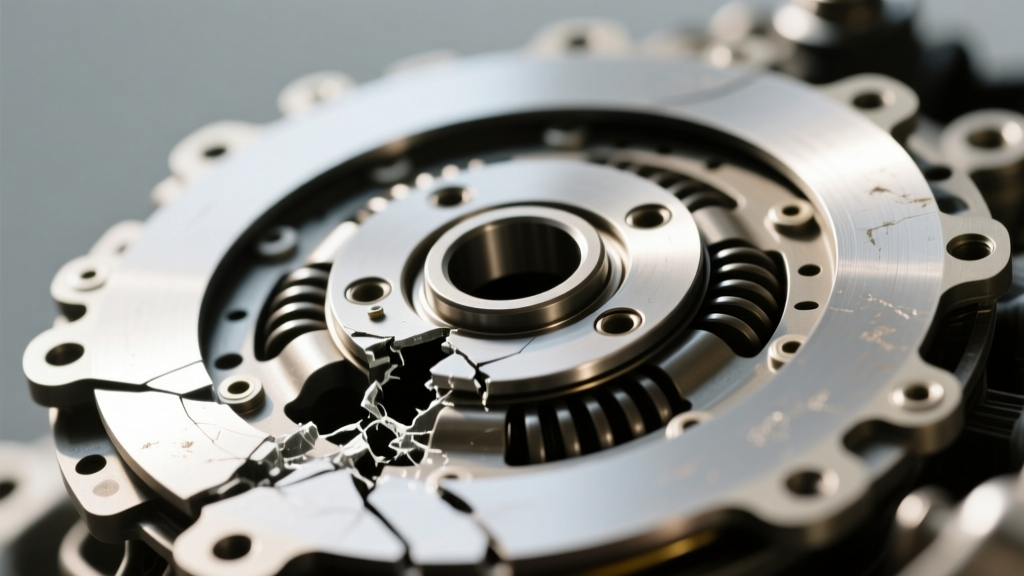
- Hot Spots: Look for blue discoloration on cast iron or steel inserts. This indicates severe thermal eventing, requiring replacement.
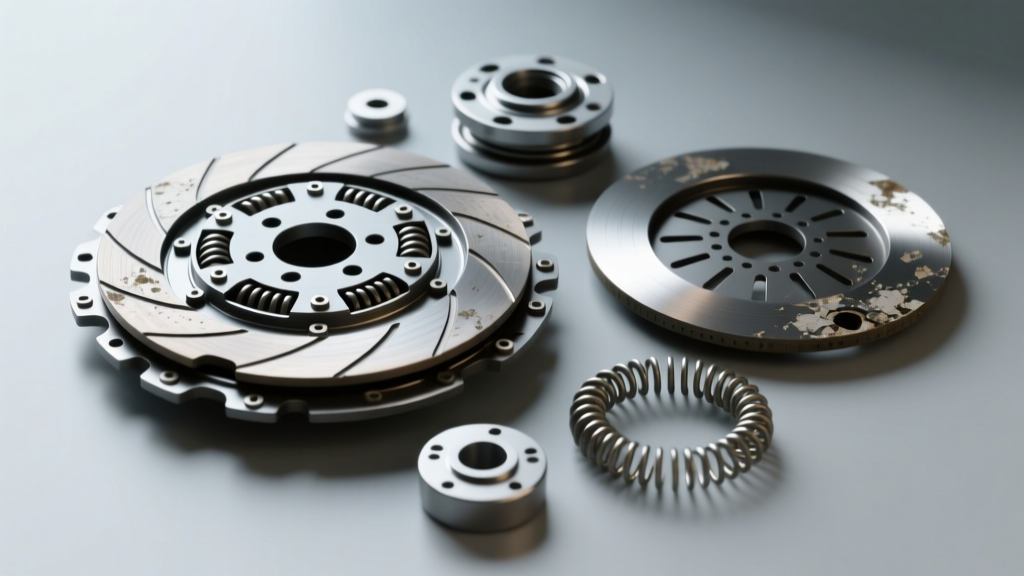
4. Friction Disc and Pressure Plate Evaluation
Measure the friction material thickness from the rivet heads. Most OEM organic discs (like those from LuK or Exedy) require replacement when the material is within 0.030 inches of the rivets. For sintered iron or cerametallic discs used in motorsport, look for micro-cracking and chunking rather than just thickness.
Diagnostic Matrix: Symptoms vs. Inspection Findings
Use this matrix to correlate driver complaints with physical inspection data.
| Driver Symptom | Probable Fault | Inspection Tool / Method | Pass / Fail Criteria |
|---|---|---|---|
| Chatter on take-off (1st gear) | Oil contamination or warped flywheel | Dial Indicator / UV Light | Fail if runout > 0.004' or UV shows lube |
| Pedal pulsation at high RPM | Bent diaphragm spring fingers | Caliper / Straight Edge | Fail if finger height variance > 0.020' |
| Difficulty shifting into gear | Drag / Incomplete release | Feeler Gauge (Pedal) | Fail if master pushrod lacks free-play |
| Rattling at idle (neutral) | DMF internal spring failure | Sachs DMF Tester / Pry Bar | Fail if free-play arc exceeds 2-3 teeth |
Dual Mass Flywheel (DMF) Validation Protocols
Dual Mass Flywheels are standard on most modern torque-heavy manual diesels and performance gasoline engines to dampen torsional vibrations. A failing DMF will mimic a bad clutch disc or transmission bearing.
According to Schaeffler's LuK technical bulletins, DMFs must be tested for rotational free-play and axial play. Using a specialized DMF tester or a calibrated pry bar, rotate the secondary mass of the flywheel. You should feel the resistance of the internal arc springs engage within 2 to 3 ring gear teeth. If the secondary mass spins freely with a 'clunk' and no spring tension, the internal dampers have collapsed. Furthermore, axial wobble (rocking the secondary mass toward and away from the engine block) should not exceed 1.5mm. If it does, the internal bearing is destroyed.
Reassembly: Critical Torque Specifications
Proper clamping force is non-negotiable. An under-torqued pressure plate will slip; an over-torqued one can warp the flywheel or snap the casting ears. Always use a calibrated torque wrench and follow the OEM star-pattern sequence.
Common 2026 Platform Torque Specs
- GM LS/LT V8 (e.g., Tremec T56 Magnum): Flywheel to crankshaft bolts: 25 lb-ft + 50 degrees. Pressure plate to flywheel: 22 lb-ft.
- Ford Modular 5.0L (e.g., Getrag MT-82): Flywheel bolts: 59 lb-ft. Pressure plate bolts: 21 lb-ft.
- Subaru Boxer (e.g., 6-speed): Flywheel bolts: 69 lb-ft. Pressure plate: 18 lb-ft.
Note: Always apply a medium-strength threadlocker (e.g., Loctite 243) to flywheel bolts to prevent backing out under high-RPM harmonic vibration.
Sourcing and 2026 Pricing Realities
When the inspection checklist dictates replacement, sourcing quality components is vital. The aftermarket is currently flooded with substandard white-box kits. Stick to Tier 1 OEM suppliers like LuK, Sachs, or Exedy.
- Standard Organic Kit (LuK RepSet): $250 - $450 (Includes disc, pressure plate, release bearing, and alignment tool).
- DMF Replacement (Sachs): $600 - $950. Never pair a new DMF with a solid flywheel conversion kit unless specifically engineered for it, as this transfers destructive harmonics directly into the transmission input shaft.
- Hydraulic CSC Replacement: $120 - $200. Always replace the CSC when the transmission is out; the labor overlap makes reusing an old hydraulic bearing financial malpractice.
For deeper engineering standards regarding torsional dampening and friction material coefficients, refer to the SAE International standards database and the Tremec technical resource library. Mastering this clutch system inspection checklist ensures that whether your customer is daily driving a hatchback or tracking a sports car, the drivetrain performs flawlessly.