The Physics of the Limited Slip Differential Lock
Many enthusiasts and even some technicians conflate a true mechanical locking differential (like a Detroit Locker or ARB Air Locker) with a limited slip differential (LSD). However, understanding the limited slip differential lock mechanism—specifically how it biases torque rather than mechanically locking the axles together—is critical for proper drivetrain tuning, fluid selection, and long-term maintenance. As of 2026, with the rise of high-torque EV swaps and advanced turbocharged platforms, understanding the exact physics of your differential's internal lock is more important than ever.
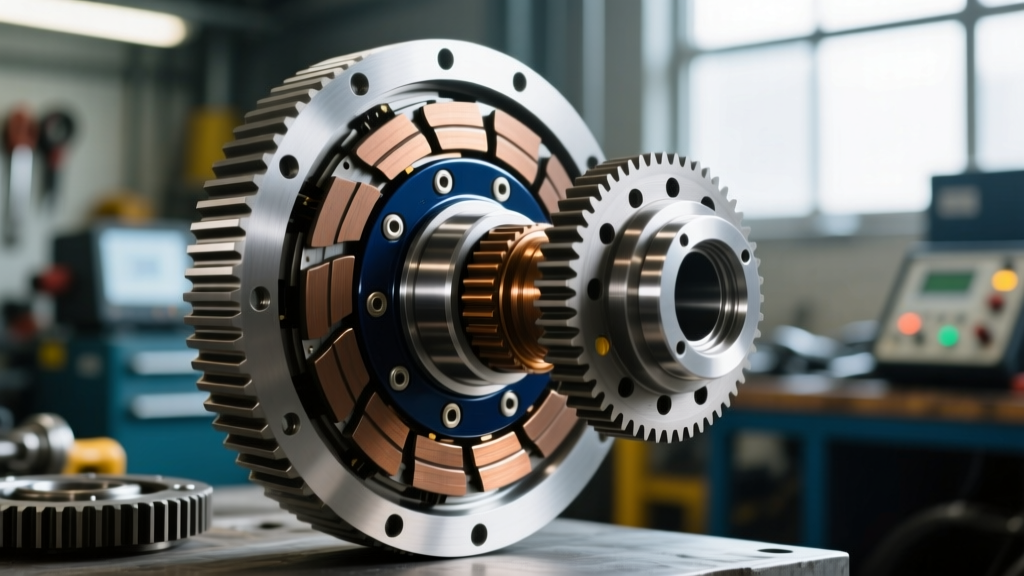
An open differential splits torque 50/50 between the left and right axles. If one wheel loses traction, it receives 100% of the available rotational speed but minimal torque, leaving the vehicle stranded. The limited slip differential lock introduces internal resistance to prevent this. In clutch-pack LSDs, this resistance is achieved via preload springs and clutch friction. In helical gear LSDs, it is achieved via gear separation forces and friction between the element gears and the differential case.
Torque Bias Ratio (TBR) Explained
The effectiveness of a limited slip differential lock is measured by its Torque Bias Ratio (TBR). A TBR of 2.5:1 means the differential can send up to 2.5 times more torque to the wheel with traction compared to the wheel that is slipping. If the slipping wheel requires 100 lb-ft of torque to spin, the LSD can transfer up to 250 lb-ft to the gripping wheel. Once the traction difference exceeds this ratio, the differential 'breaks away' and acts like an open unit.
Clutch-Pack vs. Helical Gear: Locking Mechanisms Compared
Not all limited slip differential lock mechanisms operate identically. The internal architecture dictates the maintenance schedule, fluid requirements, and rebuild intervals. Below is a technical comparison of the most prevalent LSD designs found in modern and classic solid-axle and independent rear suspension (IRS) setups.
| LSD Type | Locking Mechanism | Torque Bias Ratio (TBR) | Friction Modifier Required? | Common Application |
|---|---|---|---|---|
| OEM Clutch-Pack | Preload S-Spring + Axle Thrust | 2.0:1 to 3.5:1 | Yes (Strictly) | Ford 8.8, GM 10-Bolt, Dana 44 |
| Helical Gear (Torsen) | Gear Separation Force & Thrust Washers | 2.5:1 to 4.0:1 | No | Eaton Truetrac, Zexel Torsen |
| Carbon Fiber Clutch | High-Friction Composite Plates | 4.0:1 to 6.0:1 | Yes (Specific FM) | Auburn Gear PRO Series |
Fluid Chemistry: Gear Oil and Friction Modifiers
The operation of a clutch-based limited slip differential lock is entirely dependent on boundary lubrication. API GL-5 gear oils contain extreme pressure (EP) additives—typically sulfur-phosphorus compounds—designed to protect hypoid ring and pinion gears under massive sliding loads. However, these exact EP additives cause the clutch plates in an LSD to grab and release erratically, resulting in the infamous 'chatter' or 'shudder' during low-speed cornering.
Friction modifiers (FMs) alter the boundary lubrication layer on the clutch discs, ensuring a smooth, continuous slip rather than a violent grab-and-release cycle.
Specific Fluid and Additive Recommendations
- Base Gear Oil: For most heavy-duty truck and performance car applications (like the Ford 8.8 or Dana 60), a full synthetic 75W-140 GL-5 is required to handle the thermal loads of the ring and pinion. For lighter IRS applications, 75W-90 GL-5 is standard.
- Friction Modifier (OEM Clutch Packs): Motorcraft XL-3 (EST-M2C118-A) or GM ACDelco 10-4016. The standard dosage is exactly 4 oz (118 ml) per 2.5 quarts of fluid capacity.
- Helical Gear LSDs: According to Eaton Truetrac Differentials, helical gear units require standard GL-5 synthetic gear oil but must never use friction modifiers. Adding FM to a Truetrac reduces the coefficient of friction on the thrust washers, effectively destroying the limited slip differential lock mechanism and turning it into an open differential.
Precision Maintenance: Ford 8.8 and Dana 44 Specifications
When servicing or rebuilding a clutch-type LSD, guessing the clearances will lead to premature failure or immediate chatter. Below are the exact OEM and aftermarket specifications for the two most common solid-axle differentials.
Ford 8.8 Track-Lok Rebuild Specs
The Ford 8.8 utilizes an S-spring to provide preload to the clutch packs. Over time, the composite clutch discs wear down, increasing the step clearance between the side gear and the clutch pack. When this clearance exceeds specifications, the S-spring cannot apply enough clamping force, and the limited slip differential lock fails to engage under load.
- Cover Bolt Torque: 28-38 lb-ft (apply RTV silicone if no gasket is used, or use a Fel-Pro RDS 55024 gasket).
- Fill Plug Torque: 15-30 lb-ft.
- Fluid Capacity: Approximately 2.5 to 3.0 quarts (depending on cover depth).
- Clutch Pack Step Clearance: Must be measured with a feeler gauge between the side gear and the clutch pack. Target specification is 0.030' to 0.060'. If clearance exceeds 0.060', you must install thicker clutch plates or a thicker preload S-spring. The Yukon Gear Ford 8.8 Clutch Kit (YP KB8.8) includes varying thickness plates to dial in this exact measurement.
Dana 44 Trac-Lok Service Specs
The Dana 44 Trac-Lok uses a similar clutch pack design but features a different cross-pin and side gear arrangement. Proper setup requires checking the side gear clearance against the differential case.
- Cover Bolt Torque: 25-35 lb-ft.
- Side Gear Clearance: 0.005' to 0.020' (measured between the side gear hub and the differential case).
- Shimming: Use selective thrust washers behind the side gears to achieve the correct clearance. If the clearance is too tight, the limited slip differential lock will bind and cause axle hop; if too loose, the unit will slip under hard acceleration.
Diagnostic Flowchart: Chatter, Slip, and Noise
Diagnosing a failing limited slip differential lock requires isolating the symptom to either the friction surfaces, the preload mechanism, or the ring and pinion itself.
Symptom: Low-Speed Binding or Chatter in Turns
Cause: Depleted friction modifier, degraded fluid, or glazed clutch plates. As the fluid shears over 30,000 to 50,000 miles, the friction modifier loses its chemical efficacy.
Fix: Drain the differential completely. Refill with fresh 75W-140 GL-5 synthetic and exactly 4 oz of Motorcraft XL-3. Drive the vehicle to a dry, clean parking lot and perform 10 tight figure-8 turns to work the modifier into the porous surface of the clutch discs.
Symptom: One Wheel Spins Freely Under Heavy Load
Cause: Worn clutch packs, broken S-spring, or incorrect step clearance. This is common in vehicles that have been subjected to high-horsepower drag launches without proper axle bracing.
Fix: Remove the differential cover, inspect the S-spring for fractures, and measure the step clearance. A complete teardown and rebuild using a high-quality carbon-fiber or Kevlar-lined clutch kit is required.
Symptom: Whining Noise on Deceleration
Cause: Pinion bearing preload loss or ring gear runout. This is entirely unrelated to the limited slip differential lock mechanism itself, but often misdiagnosed as such because the noise emanates from the center of the axle.
Fix: Check pinion nut torque and ring gear backlash (typically 0.006' to 0.010' for most OEM setups). Consult a comprehensive Ring & Pinion LSD Setup Guide for exact backlash and pattern reading techniques before condemning the LSD unit.
Summary of 2026 Best Practices
Maintaining a limited slip differential lock is not a 'fill it and forget it' endeavor. Whether you are running a classic Dana 44 in a restomod or a modern Ford 8.8 in a track car, adhering to exact torque specifications, measuring clutch pack clearances with precision feeler gauges, and utilizing the correct ratio of friction modifier to GL-5 base oil will ensure your drivetrain puts power to the pavement exactly as engineered.