The DIY Trap: Misdiagnosing Internal Clutch Wear
When a manual transmission vehicle begins to exhibit a soft pedal, delayed engagement, or difficulty slipping into gear, the immediate instinct for many DIY mechanics is to search for guides on how to adjust clutch cable tension. It makes logical sense on the surface: if the clutch isn't fully disengaging or the pedal feels loose, surely the cable has simply stretched. However, turning the firewall adjuster to compensate for internal mechanical wear is a temporary band-aid that masks a much more severe issue. In cable-actuated platforms—such as the Ford Foxbody and SN95 Mustangs (T-5 and T-56 transmissions), Honda K-Series and B-Series engines, and early Subaru EJ platforms—the true culprit is frequently hidden inside the bellhousing.
As of 2026, with the resurgence of restomods and track-prepped vintage builds, understanding the relationship between the clutch fork, the pivot ball, and the release bearing is critical. If the internal leverage geometry is compromised due to clutch fork and pivot issues, no amount of external cable adjustment will restore proper clutch operation. In fact, over-tightening the cable to compensate for internal wear will lead to premature release bearing failure and catastrophic crankshaft thrust bearing damage.
The Mechanics of Clutch Fork and Pivot Ball Wear
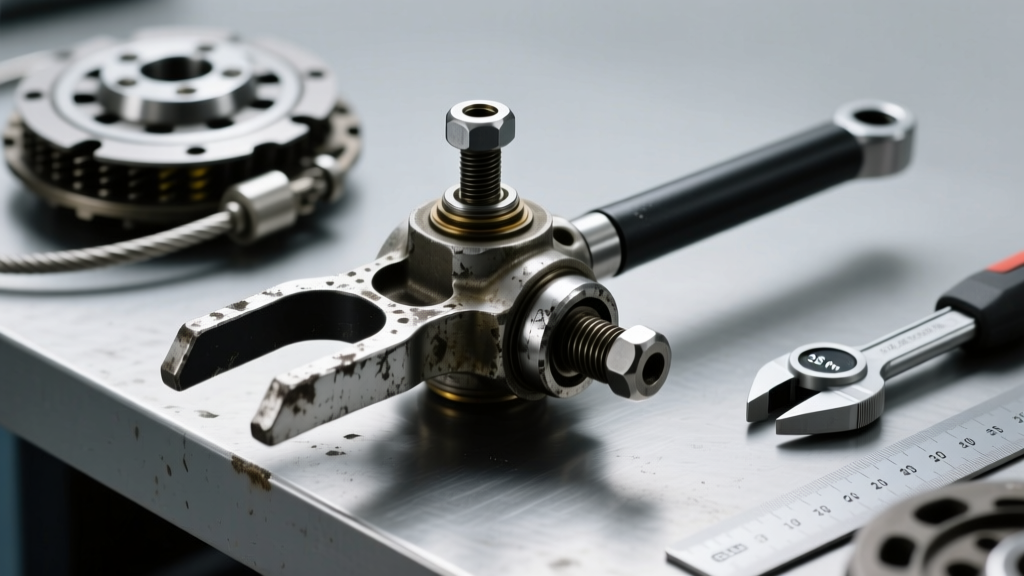
The clutch fork acts as a simple lever. The pivot ball (or pivot stud) serves as the fulcrum, and the release bearing is the load. When you pull the clutch cable, the fork pivots on the ball, pushing the release bearing against the pressure plate diaphragm fingers. This system relies on precise, hardened contact points to maintain a 1:1 or specific leverage ratio.
Common Failure Modes
- Pivot Ball Mushrooming: The spherical end of the pivot stud is subjected to immense localized friction. Over 80,000 to 100,000 miles, the hardened steel can wear down, flatten, or 'mushroom,' effectively moving the fulcrum point and introducing 2mm to 4mm of dead travel.
- Fork Pivot Pocket Elongation: The concave pocket on the clutch fork that rides on the pivot ball is often made of softer stamped steel or cast iron. This pocket wears into an oval shape, creating slop before the fork actually begins to push the release bearing.
- Fork Deflection (Flex): Upgrading to a high-performance clutch introduces massive clamp loads. A stock stamped-steel Ford T-5 fork is designed for roughly 2,200 lbs of clamp load. If you install a Stage 3 ceramic puck clutch with 3,400 lbs of clamp load, the stamped fork will physically bend under pressure. The cable pulls the fork, the fork flexes, and the bearing never achieves full travel.
Symptom Matrix: Cable Slack vs. Fork/Pivot Wear
Differentiating between a simple cable adjustment issue and internal bellhousing wear requires careful observation of the pedal feel and engagement characteristics.
| Symptom | Likely Cause: Cable Slack | Likely Cause: Fork/Pivot Wear |
|---|---|---|
| Pedal Freeplay | Excessive freeplay at the top of the pedal stroke. | Normal freeplay, but a 'dead zone' or sponginess mid-stroke. |
| Gear Engagement | Grinding into 1st or Reverse when stopped. | Difficulty engaging 3rd/4th under load; gear lever feels notchy. |
| Pedal Return | Pedal returns slowly or stays near the floor. | Pedal returns sharply, but engagement point is extremely high. |
| Visual Inspection | Cable is visibly loose at the fork arm. | Cable is taut, but the fork exhibits visible wobble on the pivot. |
Expert Inspection: The Dial Indicator Deflection Test
To definitively diagnose clutch fork and pivot issues without dropping the transmission, professional drivetrain specialists use a dial indicator test. This measures the exact mechanical loss between the cable input and the bearing output.
- Setup: Remove the inspection cover or slave cylinder to expose the clutch fork. Mount a magnetic base dial indicator directly to the bellhousing, with the plunger resting on the tip of the clutch fork where it contacts the release bearing.
- Baseline Measurement: Have an assistant slowly pull the clutch cable by hand (or push the pedal) while you measure the total travel of the fork tip.
- Identify Deflection: Watch the fork arm closely. If the cable pulls the fork 0.25 inches before the dial indicator registers any movement at the bearing tip, you have 0.25 inches of deflection. This 'lost motion' is the physical manifestation of a worn pivot pocket or a bending fork.
According to McLeod Racing's technical bulletins, any fork deflection exceeding 0.050 inches under load indicates that the stamped steel is yielding or the pivot geometry is severely compromised. At this point, learning how to adjust clutch cable will only result in the cable pulling the fork into the bellhousing wall before the pressure plate fully releases.
Technical Specifications and Part Upgrades
When internal wear is confirmed, replacing the components with upgraded metallurgy is mandatory, especially for track or high-horsepower applications. Below are the industry-standard specifications and part numbers for common platforms.
Ford Modular & 5.0L (T-5, T-56, TKO)
- OEM Pivot Ball Stud: 1/2"-13 thread. Torque spec: 15-22 lb-ft. Must be secured with Loctite 271 (Red) to prevent backing out into the bellhousing.
- Heavy-Duty Upgrade: Ford Performance M-7510-A (High-Profile Pivot Ball). MSRP: ~$28. Features a hardened, larger-radius sphere to reduce pocket wear.
- Adjustable Upgrade: McLeod 16505 Adjustable Pivot Ball. MSRP: ~$85. Allows for precise height adjustment to maintain optimal fork geometry when swapping bellhousings or using aftermarket blocks.
- Billet Fork: Steeda or McLeod Billet Aluminum Forks (approx. $180-$240). These eliminate fork flex entirely, ensuring 100% of the cable's pull translates to bearing movement.
Honda K-Series (EP3, FG2, K-Swaps)
Honda's cable-actuated K-series transmissions suffer from a unique pivot issue. The release bearing rides on a plastic guide sleeve (Honda PN 22830-PRP-005, ~$15). The clutch fork pad physically wears a trench into this plastic sleeve. If you attempt to tighten the clutch cable to fix the resulting slack, the fork will bind against the worn trench, causing the cable to snap at the firewall adjuster.
The Correct Sequence: Fix the Pivot, Then Adjust the Cable
Only after the clutch fork, pivot ball, and release bearing guide have been verified or replaced should you proceed with external adjustments. Proper clutch cable adjustment requires setting the static freeplay, not maximizing tension.
For most cable-actuated systems, the correct procedure dictates 1/2-inch to 3/4-inch of freeplay measured at the clutch fork arm before the release bearing makes contact with the diaphragm fingers. If you eliminate this freeplay to compensate for a worn pivot ball, the release bearing will ride constantly against the spinning pressure plate. This generates immense heat, melts the internal bearing grease, and ultimately transfers axial load directly into the engine's crankshaft thrust bearing—a repair that requires a complete engine rebuild.
Cost Breakdown: Band-Aid vs. Proper Repair
Ignoring clutch fork and pivot issues in favor of constant cable adjustments will ultimately leave you stranded. Below is a realistic 2026 pricing breakdown for addressing the root cause versus the temporary fix.
| Repair Strategy | Parts Required | Estimated Parts Cost | Estimated Labor Cost |
|---|---|---|---|
| Cable Adjustment (Band-Aid) | None / Replacement Cable | $0 - $65 | $0 (DIY) / $90 (Shop) |
| Fork & Pivot Replacement | Billet Fork, HD Pivot Ball, Bearing | $180 - $350 | $800 - $1,400 (R&R Trans) |
| Catastrophic Failure Repair | Fork, Bearing, Crankshaft Thrust Bearings | $400 - $1,200+ | $2,500 - $4,000 (Engine R&R) |
Final Expert Takeaway
The clutch release system is a closed-loop mechanical circuit. External inputs (the cable) can only yield correct outputs (clutch disengagement) if the internal geometry is sound. If you find yourself searching for tutorials on how to adjust clutch cable every few thousand miles, or if the engagement point continues to migrate toward the firewall, stop turning the adjuster. Drop the transmission, inspect the pivot pocket for elongation, check the fork for deflection, and restore the mechanical fulcrum. For further drivetrain geometry specifications, consult the engineering resources available via Ford Performance Parts or Tremec Transmissions to ensure your manual gearbox operates flawlessly for the long haul.